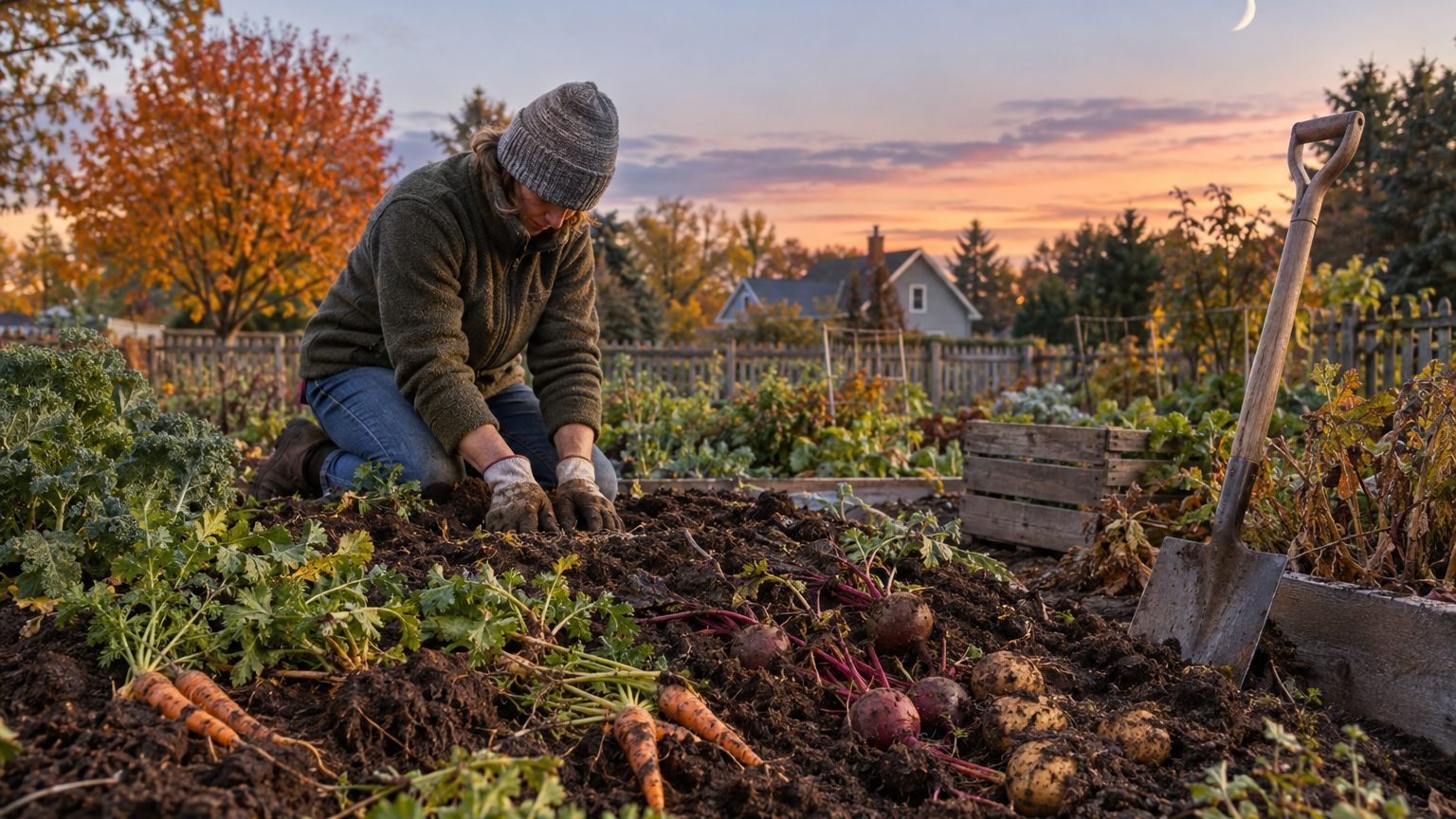

According to almanac tradition, the waning Moon (full to new) has two halves. The first, from full Moon to last quarter, is for root crops, bulbs and perennials. The second, from last quarter to new Moon, is for rest: weeding, pruning, turning the soil and composting. The next full-to-new stretch runs from October 26, 12:11 a.m. ET to November 9, 2:02 a.m. ET. None of this is proven, and your local frost dates come first.
What the tradition says about waning moon

Almanac gardeners split the lunar month into four quarters and give each one a job. The waxing Moon, from new to full, is tied to crops that bear above ground. The waning Moon is tied to what grows below ground, and then to a stretch with no sowing at all. It is a calendar convention handed down through farm almanacs. Nobody has established that the phase changes how a seed behaves, so read everything below as “the almanac rule is” and not as horticulture.
| Quarter | Moon span | Almanac tradition |
|---|---|---|
| First quarter (waxing) | New Moon to first quarter | Leafy crops that bear above ground (lettuce, spinach, cabbage, broccoli, celery) |
| Second quarter (waxing) | First quarter to full Moon | Above-ground crops that bear seed inside the fruit (tomatoes, peppers, beans, squash, corn) |
| Third quarter (waning) | Full Moon to last quarter | Root crops, bulbs, perennials (potatoes, carrots, garlic, onions, beets) |
| Fourth quarter (waning) | Last quarter to new Moon | Rest: weeding, pruning, turning the soil, composting |
Two halves, two different jobs
Half the waning Moon is a planting phase and half is not. Gardeners who plant by the Moon treat the third quarter as the time to set root crops, bulbs and perennials. They treat the fourth quarter as time for maintenance. If you follow the practice, this is why a waning Moon calendar looks so much emptier than a waxing one.
The sign layer
Many almanacs add a second filter, the zodiac sign the Moon is passing through. In the usual convention, Cancer, Scorpio and Pisces are labeled fruitful. Taurus, Libra and Capricorn are labeled semi-fruitful. Aries, Gemini, Leo, Virgo, Sagittarius and Aquarius are labeled barren. Sources differ on Virgo, Sagittarius and Aquarius. A Traditional window is a day that has both the right quarter and a fruitful or semi-fruitful sign.
The Moon never overrides the calendar of your place. Frost dates and soil temperature decide whether a crop can go in the ground at all. The Moon, for those who follow it, only picks among days the local calendar already allows. Your state’s planting guide is the place to check that first.
The next waning moon dates
The waning Moon is already underway. It reached last quarter on October 3 at 9:25 a.m. ET and ends with the new Moon on October 10 at 11:50 a.m. ET. In the tradition, that entire span sits in the fourth quarter, the rest phase. The Moon entered Virgo on October 6 at 10:52 p.m. ET and enters Libra on October 9 at 4:10 a.m. ET.
From full to new, October into November
- Full Moon (Hunter’s Moon, in Taurus): October 26, 12:11 a.m. ET
- Last Quarter: November 1, 3:28 p.m. ET
- New Moon: November 9, 2:02 a.m. ET
So the next waning Moon covers October 26, 12:11 a.m. ET to November 9, 2:02 a.m. ET. The third-quarter span ends at last quarter on November 1, and the rest span runs from there to the new Moon. The following waning Moon begins with the Beaver Moon on November 24 at 9:53 a.m. ET, in Gemini.
Traditional root-crop windows
Here the quarter rule meets the sign rule. These are the traditional windows for root crops, bulbs and perennials.
| Window | Moon sign (convention’s label) | Clock times, ET |
|---|---|---|
| October 26-27 | Taurus (semi-fruitful) | From the full Moon at 12:11 a.m. on October 26 until the Moon leaves Taurus at 9:01 p.m. on October 27 |
| October 30-31 | Cancer (fruitful) | Moon enters Cancer at 10:05 p.m. on October 29 and leaves at 12:18 a.m. on November 1 |
| November 26-27 | Cancer (fruitful) | Moon enters Cancer at 5:51 a.m. on November 26 and leaves at 6:20 a.m. on November 28 |
The November 26-27 window belongs to the waning Moon that starts on November 24.
Which crops this phase is for, in the tradition
The waning Moon splits into two jobs, so the crop list is shorter than for the waxing Moon.
Third quarter: below the surface
According to almanac tradition, the stretch from full Moon to last quarter belongs to root crops, bulbs and perennials. The named examples are:
- Potatoes
- Carrots
- Garlic
- Onions
- Beets
Whether any of them can go in the ground in late October or November depends on where you live. A gardener in a cold northern state and one in the Gulf South face very different calendars. This page does not give a planting date for any place. Your state’s planting guide does.
Fourth quarter: a rest phase
From last quarter to new Moon, the tradition does not call for sowing. It calls for the jobs that keep a garden in order:
- Weeding
- Pruning
- Turning the soil
- Composting
Almanac followers use this stretch to clear beds and tidy up before the next waxing Moon. In October 2026, for example, the Moon is in Virgo until October 9 at 4:10 a.m. ET, inside that span.
Where the systems disagree
The biodynamic system based on Maria Thun uses a different sign grouping. Taurus, Virgo and Capricorn are root days. Gemini, Libra and Aquarius are flower days. Cancer, Scorpio and Pisces are leaf days. Aries, Leo and Sagittarius are fruit days. Under that scheme, October 26-27 (Taurus) is a root-day window, while October 30-31 (Cancer) is a leaf-day window. The fruitful and semi-fruitful convention used above would still call both traditional windows for root crops. If you plant by the Moon, pick one system and stay with it.
How much weight to give it
The effect of the Moon’s phase on seeds and roots is unproven. The Moon’s tidal pull is far too small to act on anything as light as a seed. Using NASA’s figures for the Moon (a 29.53-day phase cycle, a 27.32-day orbit against the stars and a mean distance of 384,400 km, about 238,900 miles), the pull at Earth’s surface comes out, by calculation, to about 1.1 millionths of a meter per second squared. That is roughly one ten-millionth of gravity (1.1 x 10^-7 g) at its strongest. The figure is calculated from those constants, not measured in a garden.
The local planting calendar decides the season, full stop. Frost dates, soil temperature and the crop’s own needs come first, and the Moon can only choose among days that are already open. Treat the windows above as a tradition you may enjoy keeping, not as a forecast. The wider question, whether planting by the moon has any measurable effect at all, is covered in that guide.
Questions
Can I use any day of the waning Moon for root crops?
Not under the stricter version of the tradition. The third quarter, from full Moon to last quarter, supplies the phase. The sign then narrows the days. Almanac followers who use the sign rule keep to days when the Moon is in a fruitful or semi-fruitful sign. For the coming waning Moon that means October 26-27 in Taurus and October 30-31 in Cancer. Whether the soil and the frost calendar allow planting on those days is a separate check.
What happens between last quarter and new Moon?
In the tradition, nothing is planted. This is the rest phase: weeding, pruning, turning the soil and composting. The current one runs from October 3, 9:25 a.m. ET to October 10, 11:50 a.m. ET. The next one runs from November 1, 3:28 p.m. ET to November 9, 2:02 a.m. ET.
When does the waning Moon after this one begin?
It begins with the Beaver Moon on November 24 at 9:53 a.m. ET, when the Moon is in Gemini, a sign the convention labels barren. The traditional root-crop window that follows is November 26-27, with the Moon in Cancer.