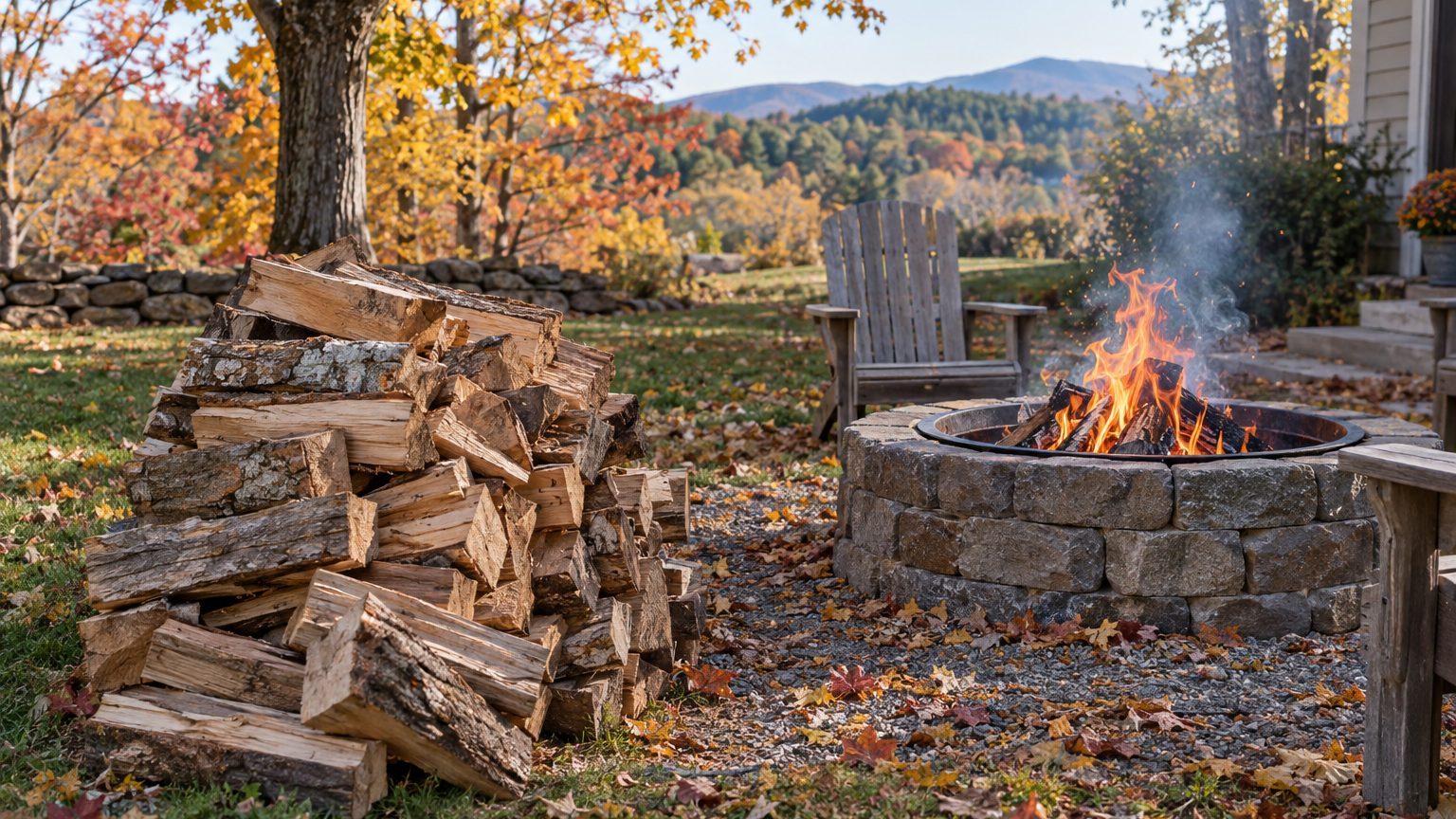

American beech sits among the hottest firewoods on this site, so keep it for the coldest nights of winter. It only earns that place when it is dry. Green wood spends its heat boiling off its own water, and a wet beech log will warm a room worse than a seasoned aspen log. Before you stack any beech for winter, split one round and look at the end grain for cracks running out from the center.
How much heat American beech gives
Utah State University Extension’s “Wood Heating” publication, in its Table 1 Firewood Facts, lists American beech at 27.5 million BTU per cord of seasoned wood. That figure assumes dry fuel. It says nothing about what a green cord will do in your stove.
A number on its own tells you little, so place it on the scale. The low end belongs to light woods such as cottonwood and aspen. The high end belongs to dense hardwoods such as oak, which gives nearly twice the heat per cord that cottonwood does. Beech lands in the top group, among the hottest woods on this site. That makes it a wood for deep cold, when the stove has to carry the house through a long night. On milder days a lighter wood does the job and saves your beech for later.
To compare beech with any other species on equal terms, use the Firewood by Species index, which draws its heat values from one consistent table.
Why density decides, not the species
Pound for pound, nearly every species gives roughly the same heat. What separates them is density. A cord is a fixed volume of stacked wood, so a dense wood packs more pounds into it than a light one does. You buy volume and you burn weight. A cord of beech is a heavier pile of fuel than a cord of cottonwood, which is why it lasts longer through a cold week and needs fewer refills of the firebox.
Why other charts show different numbers
You will find other published figures for beech, and they will not match. Moisture content, wood density and testing method all differ from one source to the next, and a sample from one stand is not a sample from another. This page uses the Utah State University Extension figure and only that one. Do not average it with a number from a different chart, because the result would be a value no source ever published. If you compare two species, take both figures from the same table.
Smoke, sparks, and which stove suits it
The source that gives beech its heat value does not publish smoke or spark behavior for this species. That is a real gap, and this page will not fill it by guessing. Density does not tell you how a wood pops or how much it smokes, and a related species does not tell you either. Anyone who hands you a confident spark rating for beech is borrowing it from somewhere else.
What you can do is match the unknown to your appliance, because the same wood behaves very differently depending on where it burns. Sparks are a hazard in an open fireplace and a non-event behind a closed stove door. Heavy smoke is a nuisance in a leaky hearth and a smaller problem in a tight stove with a good draft.
| Appliance | What the sources do not settle | What to do before burning beech hard |
|---|---|---|
| Open fireplace | Whether beech throws sparks onto the hearth | Fit a fine mesh screen, start with small loads, watch the hearth rug and the floor |
| Closed stove or insert | How much smoke beech makes on a cold start | Burn a test load with the door shut, then check the chimney cap for visible smoke |
| Outdoor fire pit | Spark behavior in wind | Keep it clear of decks, dry grass and overhanging branches |
Run the test the first time you burn beech. Light a modest fire, keep the screen or the door closed, and note what you see for the first hour. Look for glowing fragments landing outside the firebox and for smoke rolling into the room. If either shows up, you have your answer for your own hearth, and it is worth more than any chart.
Whatever the species, wet wood is the usual cause of smoky fires and of sooty deposits in the flue. If beech smokes on your first test, check its dryness before you blame the wood.
How long it takes to season

Wood has to fall below about 20 percent moisture before it gives you the heat you paid for. Until then the fire must boil off the water first, and that consumes the energy you wanted for the room. This is why seasoning outranks every figure in the table above. A green oak burns worse than a seasoned aspen, and a green beech is no exception.
The source behind the heat figure does not publish a drying time for American beech. Some species dry slowly because of their cell structure, but nothing here says that beech is one of them, so no calendar number will appear on this page. Judge the wood, not the date on your stack.
Tests that work without a meter
- Cracks run outward from the center of the end grain, and the ends look gray rather than pale.
- Bark lifts away by hand or has already loosened on its own.
- Two split pieces knocked together give a hollow ring, not a dull thud.
- A piece feels light for its size compared with a fresh-cut one.
No single sign is proof. Take two or three together and you can trust them. If you own a meter, use it on the fresh split face as described above and treat the meter as the final word.
Setting the stack up to dry
Split the rounds small, because bare wood loses water faster than wood shut inside bark. Stack the pieces off the ground on pallets or rails, in a spot that catches sun and wind. Cover the top only and leave the sides open, so rain runs off while air still moves through. A tarp pulled down over every side traps moisture and undoes the work. If you have recently bought a load sold as seasoned, run the tests on it before you trust the label.
Getting hold of it
American beech is a native tree of the eastern half of the country. If you live there, you have a fair chance of finding it, often sold as “mixed hardwood” without a species name. West of the Great Plains it is rarely on offer. In the Pacific states, the Pacific madrone as Firewood: Heat, Smoke and Sparks page covers a wood you are far more likely to be offered there.
Ask the seller for the species by name. If the answer is a vague hardwood, ask to see split faces and check dryness with the tests above. When the load turns out to be a mixture, the Black cherry as Firewood: Heat, Smoke and Sparks page gives the same heat, smoke and spark treatment for another eastern hardwood you may find in the pile.
Why local wood matters
Buy wood from as close to your fireplace as you can. Transported firewood is how the emerald ash borer reached the Midwest, and the beetle has since killed tens of millions of ash trees. Insects and fungi travel inside logs and under bark, and a load that looks clean can still carry them. Beech has its own tree pests, so the same caution applies to moving it.
Rules on moving firewood differ by state and sometimes by county, and this page does not state any of them. Check with your state department of agriculture or forestry agency before you carry wood across a line, and ask any seller where the wood was cut.
Common questions
Is American beech better than oak for heat?
This page cannot say, because the figure it holds is for beech alone. Utah State University Extension gives 27.5 million BTU per cord for seasoned beech, and any comparison needs oak’s number from the same table. Do not set it against a figure from another chart, since methods differ.
Does 27.5 million BTU per cord mean my stove will give me that much heat?
No. That figure is the energy in a cord of seasoned wood, not the heat delivered to your room. Your stove or fireplace loses part of it up the chimney, and damp wood loses more. Dry wood in a tight stove gets you the closest.
Can I mix beech with lighter wood?
Yes, and it is a sensible way to use it. Lighter woods suit mild days, and beech carries you through the coldest nights. Keep the two stacks separate so you reach for the right one, and season both to the same standard.
How do I tell beech from other hardwood in a log pile?
Look at the bark first. American beech has smooth, light gray bark that stays smooth even on large trunks, which sets it apart from most hardwoods. Bark comes off in the handling, though, so ask the seller to point out an intact log.