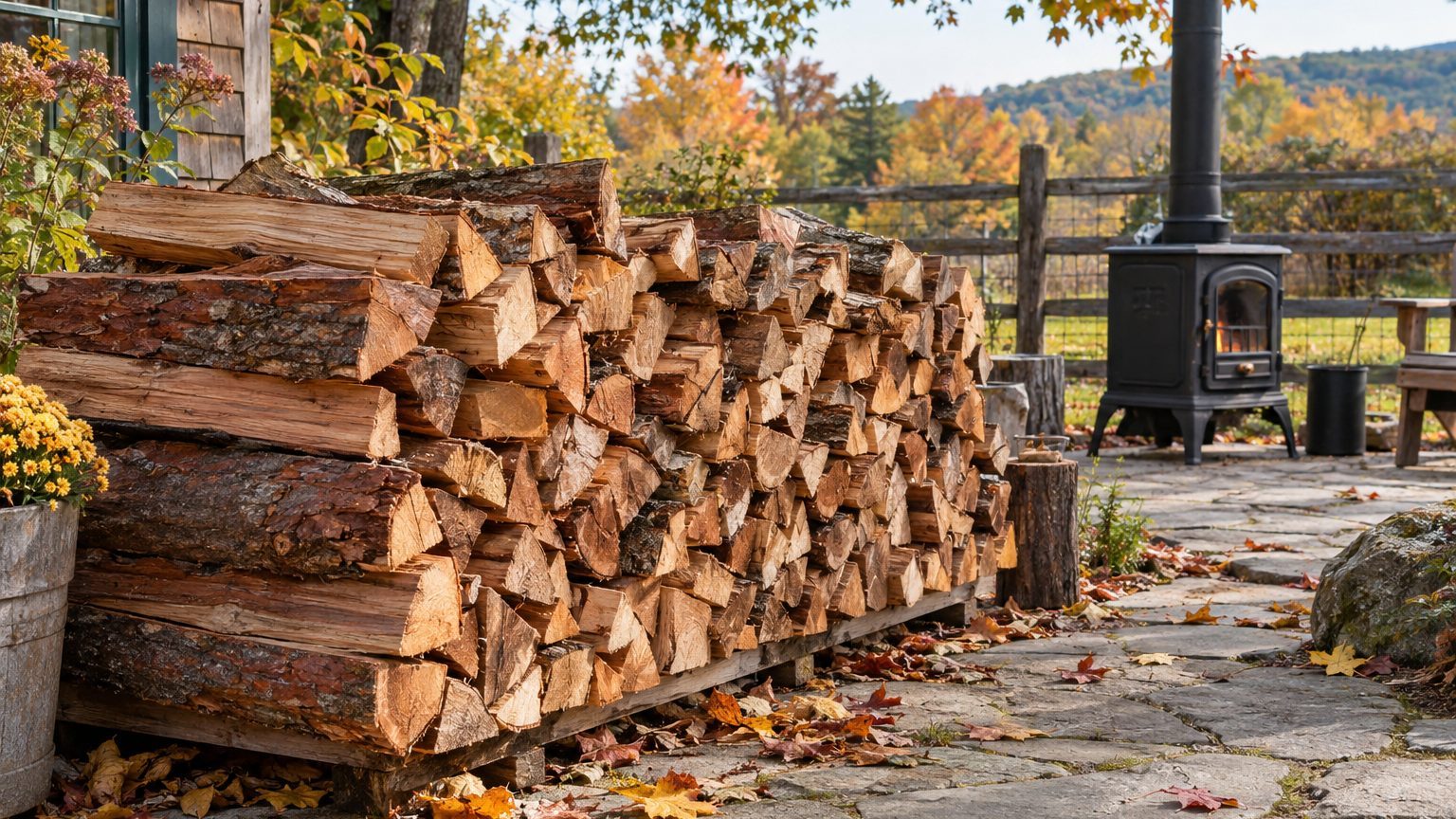

Black cherry firewood delivers 20.5 million BTU per cord of seasoned wood, according to University of Kentucky : Kentucky Woodlands Magazine, « Forestry 101 », D. McLaren. That puts it mid-range among the species on this site: a respectable fire, neither the hottest nor the weakest. The same source does not document how cherry smokes or throws sparks, so the stove question stays open. Dryness will matter more than the species either way.
How much heat Black cherry gives
The figure is 20.5 million BTU per cord of seasoned wood. A BTU is the amount of heat needed to raise a pound of water by one degree Fahrenheit, and a cord is a stacked volume of wood. Taken alone, 20.5 million tells you very little. It needs a ruler beside it.
Reading the number against the whole range
Across common North American firewood, the spread is wide. Dense hardwoods such as oak sit near the top, and light species such as cottonwood sit near the bottom. Oak gives nearly twice what cottonwood gives from the same stacked volume. Black cherry lands in the middle of that spread, which the site ranks as mid-range. You get a dependable fire without the premium price that the densest hardwoods often command.
For a sense of the spread, Douglas-fir as Firewood: Heat, Smoke and Sparks and Pecan as Firewood: Heat, Smoke and Sparks cover two other species with their own place on the scale. The hub page, Firewood by Species, lays them all side by side.
Why a cord of cherry beats a cord of poplar
Here is the part that surprises people. Pound for pound, every species of wood gives roughly the same heat. A pound of cottonwood and a pound of oak are close to equals once both are dry. What differs is density. A cord is a fixed volume, so a dense wood packs more pounds into it. You buy volume, and you burn weight. Black cherry’s mid-range ranking simply means a cord of it holds a middling number of pounds.
One caution on the numbers themselves. Published figures for the same species differ from one source to the next, because moisture content, density and testing method all vary. The figure used here comes from the Kentucky source named above. Don’t average it with a number from a different chart, because the result would be a value nobody measured.
Smoke, sparks, and which stove suits it
This is where most BTU charts stop helping. Two cords with identical heat ratings can behave very differently once lit. One pops and flings embers a few feet onto the hearth rug. Another smolders and fills a room with haze. Neither trait shows up in the heat number.
What is and isn’t documented for cherry
The Kentucky source gives a heat value for black cherry and nothing on smoke or sparks. So the honest answer is that those behaviors are not documented here. Guessing from density, or from what a related species does, would be inventing data. Here is the full picture of what the source supports:
| Trait | Black cherry |
|---|---|
| Heat per cord, seasoned | 20.5 million BTU (Kentucky source) |
| Position on this site | Mid-range |
| Smoke | Not documented |
| Sparks | Not documented |
How to turn the gap into a decision
Smoke and sparks only matter in combination with the appliance you own. A species that throws many sparks can be a real hazard in an open fireplace and perfectly harmless behind the glass of a closed stove. A species that smokes heavily may heat as well as the best of them and still be unpleasant to burn indoors, especially in a leaky old fireplace where the haze drifts back into the room. Judge a wood by what it does in your appliance, never in the abstract.
With cherry’s behavior unpublished, the sensible approach is to test it small. In a closed stove or an insert with a tight door, start with a few splits mixed into your usual wood and watch the glass and the chimney draft. In an open fireplace, keep a fire screen in place, clear flammable rugs from the hearth, and burn a small armload first. If it pops, you will know in the first twenty minutes, and you will have learned something no chart could tell you.
Dryness changes this too. Wet wood smokes badly in any species, so a bad first test with cherry may only mean the splits were damp.
How long it takes to season

Wood has to drop below about 20 percent moisture before it gives real heat. Until then, a good share of the fire’s energy goes into boiling water out of the log, and that is energy you wanted for the room. A green log in the stove is partly a kettle.
This Matters More Than anything in the species table. Green wood spends its heat boiling off its own water before it can warm a room, so a green oak burns worse than a seasoned aspen. Someone who buys the hottest species and burns it wet gets less warmth than someone who seasons a modest one properly. The same goes for cherry: a seasoned cord delivers the 20.5 million BTU, and an unseasoned one doesn’t come close.
How fast black cherry dries is not documented in the Kentucky source, so no number of months is given here. Some woods dry slowly because of their cell structure, and drying time depends heavily on split size, stacking, sun, wind and your local climate. Split wood dries far faster than rounds, because the bark seals moisture in. Stack it off the ground, cover only the top, and leave the sides open to the wind.
You don’t need a moisture meter to check progress, though one costs little and gives a direct reading against the 20 percent line. Three signs work without gear:
- Cracks (checks) radiating across the end grain, widening over time.
- Bark that lifts or peels away when you pull at it by hand.
- Weight and sound: dry splits feel light, and two knocked together ring with a sharp clack rather than a dull thud.
If a split fails all three, give it more time. If it passes, burn a test piece and see whether it lights readily and hisses at the ends. Hissing means water is still escaping.
Getting hold of it
Whether black cherry turns up near you depends on your region and your supplier, and the source behind this page doesn’t say where it is sold. The practical route is to ask. Call local firewood dealers and tree services and ask what species they carry. Many sell mixed hardwood loads, so request the species by name and ask to see a few splits for the signs of seasoning above. Storm cleanup and tree removal crews are another common source, though wood from fresh-cut trees will be green and needs time to dry.
Insist on local wood, whatever the species. Moving firewood is one of the main ways tree-killing pests travel. The emerald ash borer reached the Midwest that way and has killed more than fifty million ash trees. A load carried a hundred miles can carry insects and disease that local forests have no defense against. Many states restrict or quarantine firewood movement, so check your state’s agriculture or forestry department before hauling wood across a county or state line. As a rule, buy and burn within a short distance of where the tree grew.
If you cut your own, know what you’re taking. Identify the tree, get permission or a permit where required, and plan the drying time before the cold sets in, so that this winter’s fire comes from last year’s cutting.
Common questions
Is black cherry good firewood?
It is a mid-range wood. At 20.5 million BTU per cord of seasoned wood, per the Kentucky source, it heats solidly without topping the table. What it is good at is steady heat once dry. How it smokes and sparks is not documented there.
Is black cherry safe in an open fireplace?
The source doesn’t publish a spark rating, so nobody can promise either way. Use a fire screen, keep the hearth clear, and burn a small test batch before relying on it. A closed stove contains any popping.
Does burning green cherry work?
It burns poorly. Green wood uses its heat boiling off water before it can warm the room, so even a modest seasoned wood outperforms green cherry. Wait until the wood is below about 20 percent moisture.
Why do published BTU numbers differ?
Moisture, density and testing method vary between sources, so two honest charts can disagree. This page uses the Kentucky figure of 20.5 million BTU per cord and does not blend it with other numbers.