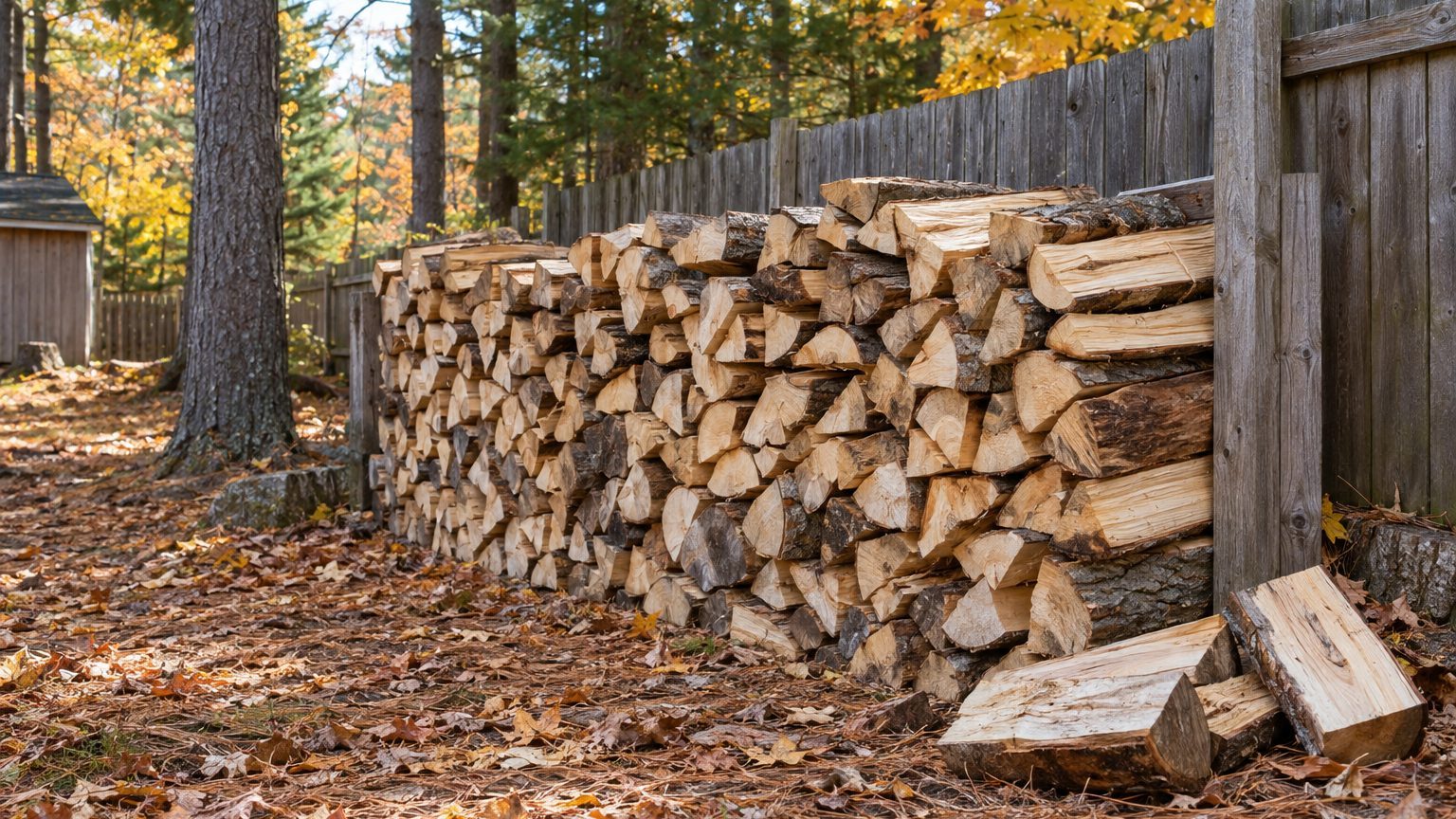

Eastern white pine firewood gives 15 million BTU per cord of seasoned wood. That is the low end of the range on this site. It is excellent for starting a fire and not enough to hold one through a night. Its smoke and spark behavior are not documented by the source that publishes the heat figure, so this page does not invent them. What it can do is tell you how to decide which appliance deserves a test load.
How much heat Eastern white pine gives
The figure comes from University of Kentucky : Kentucky Woodlands Magazine, « Forestry 101 », D. McLaren: 15 million BTU per cord of seasoned wood. A BTU is the heat needed to warm one pound of water by one degree Fahrenheit, so 15 million of them is a lot of heat in absolute terms. The number only means something next to other species.
Here the mechanism is counterintuitive. Pound for pound, nearly every species gives roughly the same heat. A pound of dry pine and a pound of dry oak release about the same energy. What differs is density. A cord is a fixed volume (a stack 4 feet high, 4 feet deep and 8 feet long), and a dense wood packs more pounds into that space. You buy volume, but you burn weight. A light wood fills the same stack with less fuel, and that is why it sits low on the chart.
The spread across species is wide. Oak gives nearly twice what cottonwood gives from the same cord, and Eastern white pine lands near the cottonwood end, not the oak end. In practice, a stove that would need one armload of dense hardwood to get through the evening will want noticeably more pine, loaded more often. The wood burns well. There is just less of it in each stack.
That profile suits particular jobs. A fire that catches fast and gives quick heat is what you want in a cold stove at 6 a.m., or on a 45-degree October evening when you only need to take the chill off. It does not suit a January night when the stove has to hold a coal bed for Eight Hours. For a quick comparison, the Silver maple as Firewood: Heat, Smoke and Sparks page covers a species with its own trade-offs, and the Ironwood (eastern hophornbeam) as Firewood: Heat, Smoke and Sparks page covers one from a very different part of the chart.
One caution on numbers. Public sources disagree on some species, because moisture content, density and test method all differ. This page uses the Kentucky figure, 15, and nothing else. Averaging it with another table would produce a number nobody measured.
Seasoning outranks the whole table. Green wood spends its heat boiling off its own water before it can warm a room, so a green oak burns worse than a seasoned aspen. Someone who picks the hottest species and burns it wet gets less heat than someone who seasons a modest one properly.
Smoke, sparks, and which stove suits it
This is the part a BTU chart never answers. Heat value tells you how much energy is in the wood. It says nothing about what the wood does in your particular firebox, and two traits matter there: how much smoke it makes and how many sparks it throws.
The two behave differently by appliance. A species that throws many sparks is dangerous in an open fireplace and harmless in a closed stove with the door latched. A species that smokes heavily can heat as well as the best wood on the list and still be miserable to burn indoors, especially in a fireplace with a weak draft. Neither trait makes a wood “bad.” Each makes it wrong for one appliance and fine for another.
For Eastern white pine, the source that gives the heat value does not publish smoke or spark ratings. I am not going to infer them from its density or from what a related species does. Both shortcuts produce confident-sounding claims with nothing behind them. Here is what is documented and what is not:
| Trait | Status for Eastern white pine |
|---|---|
| Heat per cord, seasoned | 15 million BTU |
| Position in range on this site | Low end; good for starting fires, not for holding one overnight |
| Smoke rating | Not documented |
| Spark rating | Not documented |
What to do with an unknown rating
An unknown is a reason to choose the appliance, not a reason to avoid the wood. A closed stove with a gasketed door contains whatever the fire throws, so it is the sensible place for a first test. Burn a small batch of well-seasoned splits, watch the glass and the chimney top, and note whether the stove smokes at the door or the flue.
In an open fireplace, the same uncertainty calls for more care. Use a fitted screen, keep the load small, do not leave the fire unattended, and keep rugs and furniture well back from the hearth. If the first few fires behave, you have your own answer, which beats any generic rating. If they do not, you have lost very little. Whatever you burn, a chimney that is swept once a year is the baseline.
How long it takes to season

Wood has to fall below about 20 percent moisture before it gives real heat. Until then, much of the energy goes into boiling off the water in the cells, which is exactly the energy you wanted for the room. A log at 40 percent moisture can be hissing, spitting and sulking in the firebox while the chimney fills with steam and smoke.
How long a species takes to get there depends on its structure. Some dry slowly because of their cell structure, and the water has a long way to travel out through the end grain. The source that gives the heat figure for Eastern white pine does not publish a drying time for it. I will not hand you a number of months that no one measured. Climate matters as much as species anyway: a stack in a breezy, sunny yard in Pennsylvania behaves differently from one in a damp, shaded corner in Maine.
You do not need a meter to check. Three signs work on any species:
- Cracks in the end grain. Seasoned wood shows checks radiating from the center of the cut face, and the ends turn gray or yellowish instead of bright and fresh.
- Bark that lifts by hand. If the bark pries off with your fingers, the wood underneath has shrunk away from it.
- Weight and sound. Knock two splits together. Dry wood gives a hollow crack, while wet wood gives a dull thud and feels heavy for its size.
Split wood dries faster than rounds because the water escapes from fresh faces. Stack it off the ground, in a single row if you can, with the top covered and the sides open to wind. A moisture meter that costs less than a tank of gas settles any doubt, since you read it on a freshly split face and not on the outside of the log.
Getting hold of it
Eastern white pine is a northern and Appalachian tree. It grows across New England, the Great Lakes states and down the Appalachian ridge into the Southeast, and it is a common timber species in those regions. Anywhere in that range, you may find it from tree services, from sawmill slab piles, or from landowners clearing storm-damaged trees. Outside the range, you are unlikely to see it sold as firewood at all, and that is fine, because a local species you can season yourself is nearly always a better buy.
Buy local, and stay local. Moving firewood is how the emerald ash borer reached the Midwest. The beetle has since killed more than fifty million ash trees. A load of logs from another county can carry insects and diseases that have no natural enemies in the place you unload them, and the larvae sit under bark where you will not see them. Many states restrict moving firewood across county or state lines, so it is worth checking your state forestry agency’s rules before hauling a truckload from a relative’s place two states over.
Practical sourcing advice follows from that. Ask the seller where the wood was cut, and avoid bundles at gas stations that travel long distances. If you buy by the cord, confirm the dimensions of the stack, because a “truckload” or “rick” is not a cord. Then season it yourself. Because pine sits at the low-density end, you will want a generous stack to cover a heating season if it is your main fuel. Many people keep it as a secondary supply beside something denser, using pine for lighting the fire and shoulder-season evenings.
Common questions
Is Eastern white pine good firewood?
It depends on the job. At 15 million BTU per cord of seasoned wood, it sits at the low end of the range on this site, which makes it excellent for starting a fire and not enough to hold one through a night. For overnight burns, pair it with a denser species.
Does it throw sparks in a fireplace?
The source that gives its heat value does not publish a spark rating, so there is no documented answer. If you try it in an open fireplace, use a fitted screen, keep the load small and stay nearby. A closed stove with the door latched is the safer place for a first test.
Does it make a lot of smoke?
Smoke behavior is not documented for this species in the Kentucky source. Wood below about 20 percent moisture smokes far less than wet wood of any species, so seasoning is the variable you control. Test a small batch before committing to a full cord.
Why does a cord of pine give less heat than a cord of oak?
Pound for pound, species give roughly the same heat, but oak is denser, so a cord of it holds more pounds of fuel. A cord is a fixed volume. You buy volume and you burn weight, which is why oak delivers nearly twice what cottonwood does from the same stack.