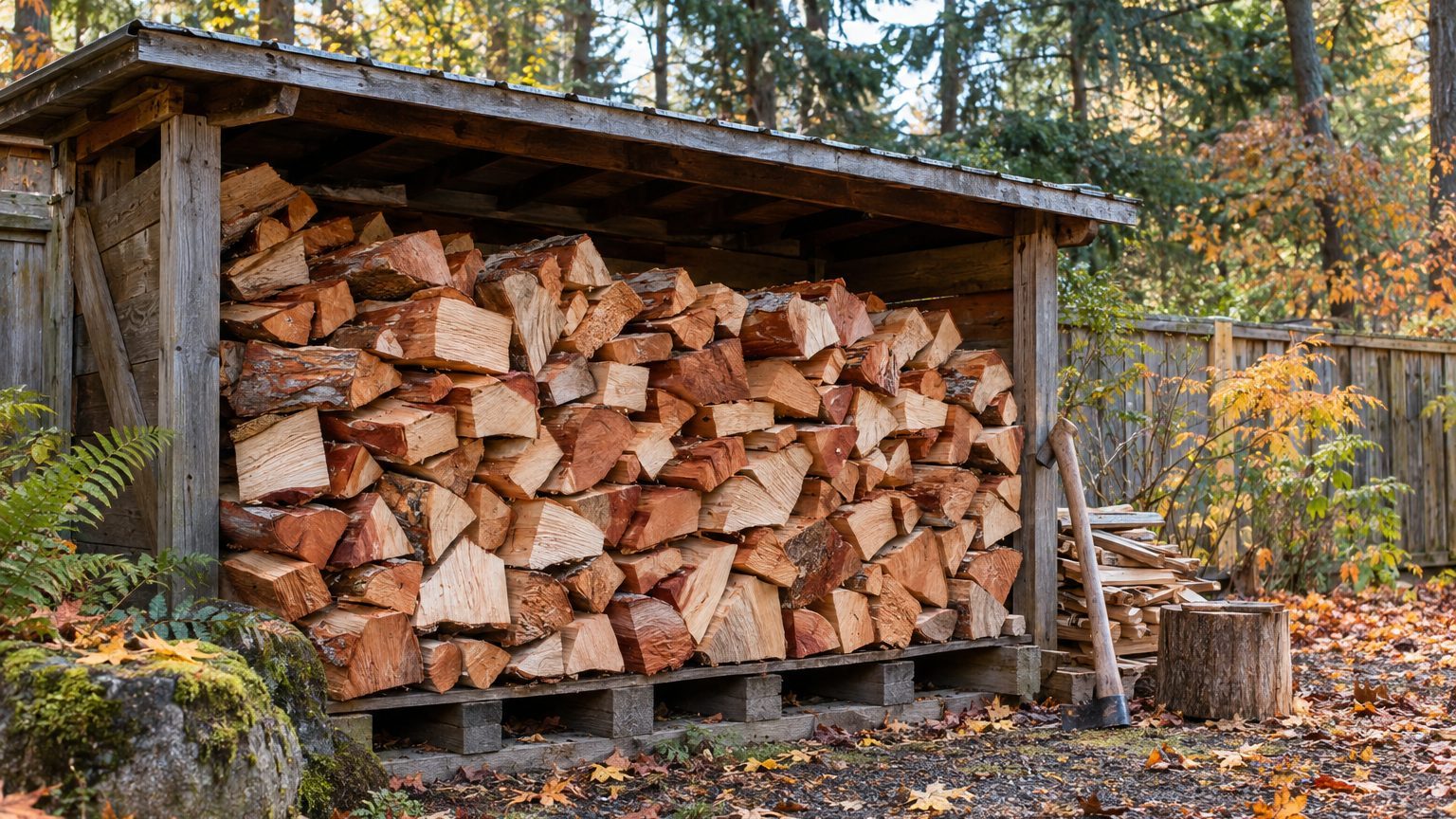

Pacific madrone puts out 30 million BTU per cord of seasoned wood, according to Oregon State University Extension, which places it among the hottest woods on this site. That makes it a wood to save for the coldest nights. The same source says nothing about how much it smokes or throws sparks, so those parts of the picture are still open. And the figure only applies if the wood is dry.
How much heat Pacific madrone gives
The figure and where it comes from
The number used here is 30 million BTU per cord of seasoned wood. It comes from Oregon State University Extension, publication EC 1628 (revised November 2013), which labels its values as approximate. That label matters. Moisture content, density and testing method all shift from one tree to the next, so published tables rarely agree to the last digit. Where two public sources disagree, this page uses the OSU Extension figure and does not average it with anyone else’s.
On its own, 30 million BTU means little. It helps to know the spread. Across common North American firewood species, the best performers give nearly twice the heat of the weakest, and oak gives nearly twice what cottonwood gives, cord for cord. Madrone sits at the top of that range. It’s in the group you’d pick for a January cold snap, not the group you’d burn on a mild October evening when the house only needs taking the chill off.
Why a cord of dense wood beats a cord of light wood
Pound for pound, nearly every species gives roughly the same heat. Wood is mostly cellulose and lignin, and those burn about the same whether they came from a madrone or a poplar. What differs is density. A cord is a fixed volume of stacked wood, so a dense species packs more pounds into it. You buy volume, but you burn weight.
That’s why madrone’s high rating is really a statement about how much wood mass fits in a stack. It also explains why the lightest woods burn fast and leave you feeding the stove every hour or so. If you want to compare other regional options, the Pecan as Firewood: Heat, Smoke and Sparks and American beech as Firewood: Heat, Smoke and Sparks pages use the same format, and the full list lives in Firewood by Species.
One rule outranks the whole table: seasoning. Green wood spends its heat boiling off its own water before it can warm a room. A green oak burns worse than a seasoned aspen. A reader who buys the hottest species and burns it wet gets less heat than one who seasons a modest wood properly.
Smoke, sparks, and which stove suits it
What the source does and doesn’t say
Oregon State University Extension gives a heat value for Pacific madrone. It does not publish smoke or spark behavior for it. Guessing from density, or from what some related hardwood does, would be a bad idea. Density predicts heat per cord, but it says little about popping, crackling or creosote. So here is what’s documented and what isn’t:
| Property | Status for Pacific madrone |
|---|---|
| Heat per cord, seasoned | 30 million BTU (OSU Extension, EC 1628, approximate) |
| Smoke level | Not documented by that source |
| Spark tendency | Not documented by that source |
Turning an unknown into a safe routine
Smoke and sparks only become problems when a species meets a particular appliance. A wood that throws sparks is a hazard in an open fireplace and a non-event in a closed stove with the door latched. A wood that smokes heavily can heat as well as the best and still be unpleasant in a room where the smoke leaks out. Since madrone’s behavior isn’t published, you handle it the way you’d handle any new wood.
In a closed stove or insert, the door contains whatever the wood does, which makes it the lower-risk place to try madrone first. Start with a few splits mixed into a load of wood you already know, and watch the glass and the chimney draft. In an open fireplace, put a fitted spark screen in place before the first log goes on and clear rugs and kindling from the hearth. Burn a small amount while you’re in the room, not overnight.
Dry wood is the one lever you control in either case. Wet wood smokes more, deposits more creosote in the flue, and heats less. If madrone turns out to smoke in your stove, check its moisture before you blame the species.
How long it takes to season

The 20 percent line
Firewood has to fall below about 20 percent moisture before it gives its real heat. Above that, the stove spends energy turning water into steam, which is energy you wanted for the room. The wood hisses, the fire sulks, and the glass fogs. That’s the cost of impatience, and it can wipe out the advantage of a high-BTU species.
Seasoning time varies by species. Some woods dry slowly because of their cell structure, and others shed water in a single summer. The OSU Extension figures don’t include a drying schedule for Pacific madrone, so there’s no verified number of months to quote here. Treat it as unknown and test the wood instead of trusting the calendar. Split pieces dry far faster than rounds, because the water escapes mostly through the cut ends and exposed faces.
Checking dryness without a meter
A moisture meter is the most reliable tool, but several signs work without one:
- Cracks radiating from the center of the end grain, wide enough to catch a fingernail
- Bark that lifts or peels away by hand
- A noticeably lighter piece than a fresh-cut one of the same size
- A clear, hollow knock when two splits are struck together, instead of a dull thud
Stack the wood off the ground, with the top covered and the sides open to wind. Re-split one piece before burning and feel the fresh face. If it’s cool and damp, it’s not ready.
Getting hold of it
Where you’re likely to find it
Pacific madrone is a West Coast tree, so your best odds of finding it as firewood are in the Pacific states, especially near the coast. Elsewhere it’s unlikely to show up at a local woodlot or firewood dealer. Many sellers there won’t carry it at all, or will list it under a general “hardwood” label. If you’re looking for it, ask the seller to name the species and where it was cut.
If you can’t find it nearby, that’s no loss. Any seasoned dense hardwood from your own area will serve a stove well, and the species pages in Firewood by Species help you compare what’s actually sold near you.
Why local matters more than the species
Moving firewood is how forest pests travel. The emerald ash borer reached the Midwest that way and has killed more than fifty million ash trees. A single bundle of untreated wood from a campsite or roadside stand can carry insects and fungi to a county that never had them. Many states restrict moving firewood across their borders or even between counties, so check your state’s rules before hauling any.
The practical rule is simple. Buy wood cut close to where you’ll burn it, and keep the receipt or seller’s details. That matters more than chasing a particular species.
Common questions
Is Pacific madrone good firewood?
For heat, yes. Oregon State University Extension rates it at 30 million BTU per cord of seasoned wood, among the hottest woods on this site. Its smoke and spark behavior isn’t documented by that source, so how it performs in your particular stove is something to test with a small load.
Can I burn Pacific madrone in an open fireplace?
Spark behavior isn’t published for this species, so use a fitted spark screen, keep the hearth clear of anything flammable, and don’t leave the fire unattended. A closed stove is the lower-risk place to try it first.
How long does madrone take to season?
The source for this page doesn’t give a drying time for it. Aim for wood below about 20 percent moisture, split it small, stack it off the ground and covered, and check for end-grain cracks and bark that lifts by hand.
Will wet madrone still beat dry wood of a lower-rated species?
No. Green wood spends its heat boiling off its own water, which is why green oak burns worse than seasoned aspen. A modest species that’s properly dried will outperform a top-rated one that’s wet.
One more nuance on the 30 million BTU figure: it describes seasoned wood as OSU Extension measured it, and the publication calls its values approximate. Your own cord, with its own moisture level and split size, will land somewhere near it, not exactly on it.