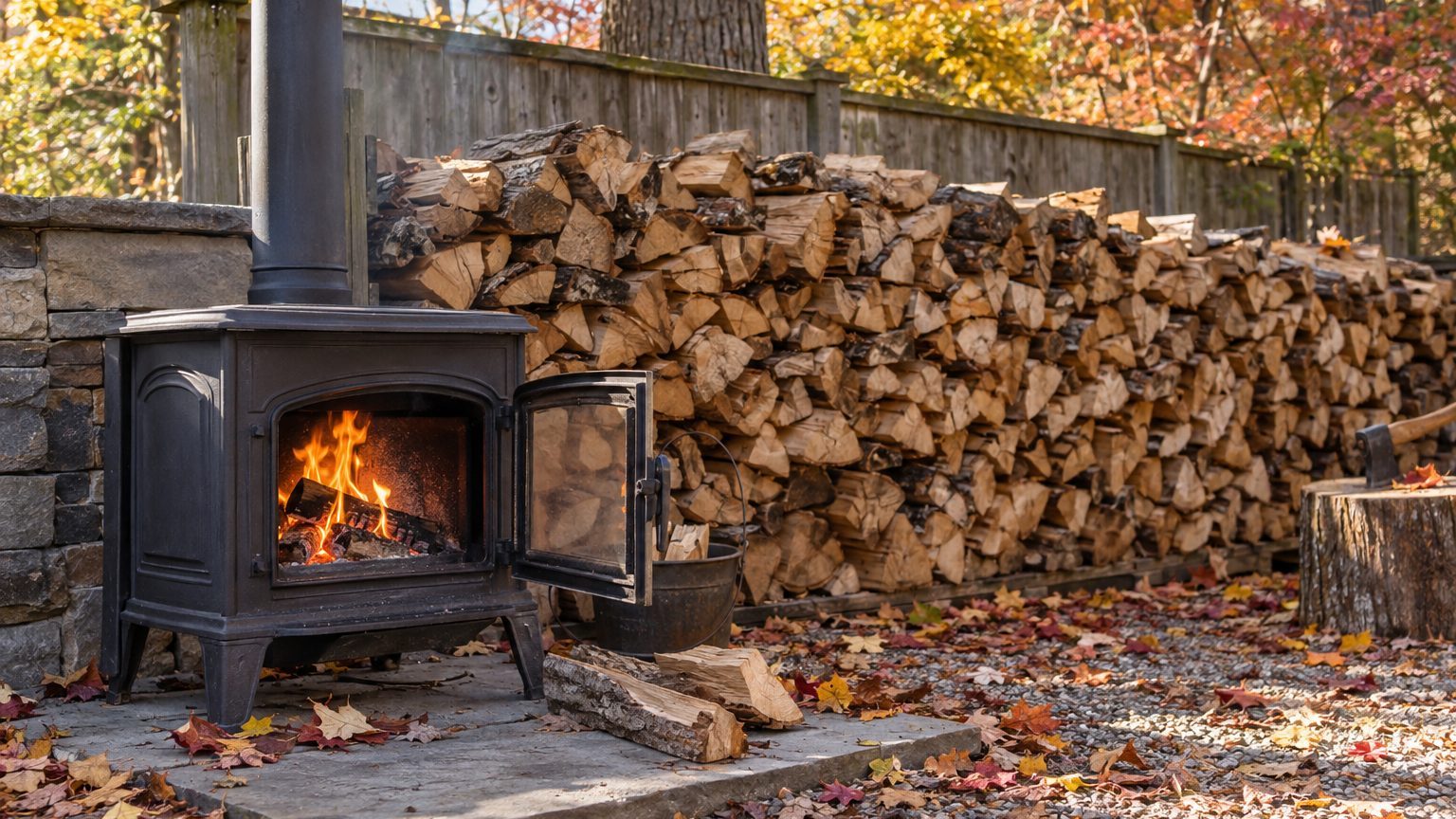

Pecan firewood smokes little and throws no sparks, so it suits a closed stove and an open fireplace alike. Both ratings come from University of Missouri Extension : G5450 « Wood Fuel for Heating » (revised January 2023). The one condition applies to every species: the wood has to be dry. A green oak burns worse than a seasoned aspen, and wet pecan will disappoint in the same way.
How much heat Pecan gives
The figure that normally goes here is heat output per cord, measured in millions of BTU. For pecan, that number is not reproduced in the data behind this page, so I won’t print one. The publication to check is University of Missouri Extension : G5450 « Wood Fuel for Heating », which is the single source this page relies on. Guessing a figure from memory would only add another version to a topic that already has several.
What can be said is where pecan sits. It belongs to the hickory genus, and the hickories are dense hardwoods, the kind that land in the upper part of any species table. The range is wide. Oak gives nearly twice what cottonwood gives, and the gap comes mostly from density. A cord is a stack of 128 cubic feet (4 by 4 by 8 feet), but the wood inside it is not the same amount of fuel from one species to the next. A cord of dense hardwood holds far more wood than a cord of a light one, and more wood means more heat. Pecan belongs with the heavy end of that spread, not with the cottonwoods and poplars.
Dense wood also changes how a fire behaves. Fewer reloads, longer burns, a bed of coals still glowing at 6 a.m. On a cold January night in Oklahoma or Missouri, that matters more than the number on a chart.
Published figures for the same species differ from one source to another. Moisture content, wood density and testing method all shift the result, and two honest tables can disagree on pecan by a noticeable margin. The smart move is to pick one source and stay with it, which is why this page sticks to G5450. Averaging two tables produces a number nobody measured.
One thing outranks the whole table: seasoning. Green wood spends its heat boiling off its own water before it can warm a room. A reader who picks the hottest species and burns it wet gets less heat than one who seasons a modest wood properly. With pecan the species is not the weak link. The moisture is.
Smoke, sparks, and which stove suits it
BTU charts stop at heat. The decision that matters in a living room is what the wood does inside the appliance you already own. For pecan, G5450 rates smoke as low and sparks as none. That combination is the friendliest one a species can have.
| Appliance | Sparks (none) | Smoke (low) | Fit |
|---|---|---|---|
| Open fireplace | No popping embers to reach the rug | Less to roll into the room on a weak draft | Good match |
| Closed stove or insert | Irrelevant behind glass and steel | Cleaner glass and flue when dry | Good match |
| Outdoor fire pit | Fewer embers drifting toward dry grass | Pleasant for a crowd | Good match |
Open fireplace
This is where spark ratings count. A species that spits embers can be dangerous in an open hearth, where a glowing fragment can land on carpet or a couch before anyone notices. A rating of none removes that worry. A fireplace screen is still smart, because any burning log can roll or shift, but pecan does not add its own hazard on top.
Smoke is the other open-hearth issue. Fireplaces draw poorly when the house is tight or the flue is cold, and a heavily smoking species can push fumes into the room. A low smoke rating helps. It does not cure a bad draft, so a pecan fire still needs a warmed flue and enough air.
Closed stove or insert
Sparks are harmless behind a closed door, so the none rating matters less here. Low smoke still pays off. Cleaner burning means less buildup inside the flue, and that buildup is what feeds chimney fires. Dense wood does well in a stove because the firebox holds heat and the burn lasts, though a smaller load will avoid overfiring a compact unit.
The rating describes how the wood behaves in the firebox. It says nothing about the smell or flavor of barbecue smoke, which is a different use. Pecan chunks are popular for smoking meat, but that is a cooking tradition and not a heating rating.
Low smoke also assumes dry wood. Damp pecan will smoke more than G5450’s rating suggests, and a glass door will show it within a week.
How long it takes to season

Firewood has to be below about 20 percent moisture before it gives real heat. Until then the fire is busy boiling water out of the wood, and that consumes the energy you wanted for the room. Burn it too early and you get a hissing log, a smoky glass door and a dirtier chimney.
G5450’s figures do not include a drying time for pecan, so I won’t invent one. What can be said is that dense hardwoods in the hickory family generally dry more slowly than light woods. Tight, heavy wood releases water slowly, and the water only escapes easily through the cut ends. A pecan round left whole will hold its moisture for a long time. Plan on more than a single short summer for split pecan, and treat the calendar as a rough guide only. Weather, splitting size and stacking matter as much as the date on the log.
Splitting is the cheapest speed-up. Smaller pieces expose more surface, and bark protects wood from drying, so splits dry faster than rounds. Stack them in a single row, off the ground, with the top covered and the sides open to wind and sun.
You do not need a meter to check whether wood is ready. Look at the end grain. Seasoned wood shows cracks running out from the center, and the ends turn gray or darker than the fresh face of a new split. Try the bark: on seasoned pecan it should lift or peel away by hand, not cling. Weight helps too, since dry logs feel lighter than they look. Knock two pieces together. A hollow crack means dry, and a dull thud usually means wet.
A pocket moisture meter, pressed against a freshly split face, settles any doubt. A reading around 20 percent or lower is the target.
Getting hold of it
Pecan is a southern and central tree. It is native to the Mississippi River valley and the southern plains, and orchards are scattered across states such as Georgia, Texas and Oklahoma. If you live there, pecan firewood is realistic. Orchard growers prune and replace trees, tree services haul away storm-felled limbs, and yard trees come down after ice storms. Those are the usual sources, and they often cost less than split firewood from a dealer.
Farther north or west, pecan is scarce. A seller offering it in Minnesota or Oregon is probably trucking it a long way, and that distance is the problem. Moving firewood is how invasive pests spread. The emerald ash borer reached the Midwest in transported firewood and has since killed more than fifty million ash trees. Because the insects ride inside the bark and wood, a stack that looks perfectly clean can carry them. Many states restrict moving firewood across county or state lines, so check your state’s rules before hauling anything.
The practical rule is simple. Buy local, ask where the wood was cut, and skip any seller who cannot answer. If pecan is not grown near you, a regional species will serve you better and carry no pest risk. The Firewood by Species hub compares what is available by region. For the Pacific Northwest, Red alder as Firewood: Heat, Smoke and Sparks covers a common local option, and eastern readers can read Black cherry as Firewood: Heat, Smoke and Sparks.
Common questions
Does pecan spark in an open fireplace?
According to University of Missouri Extension : G5450 « Wood Fuel for Heating », pecan throws no sparks. That makes it one of the safer choices for an open hearth. Keep the screen in place anyway, since rolling logs are a risk with any wood.
Is pecan smoky?
Smoke is rated low in the same publication. That holds for properly seasoned wood. Wet pecan smokes more, and a cold flue can still push fumes into the room.
Can I burn green pecan?
You can, but you will not like it. Green wood uses its heat boiling off its own water, so it warms the room poorly and leaves more residue in the chimney. A seasoned, humbler wood will outperform it.
Is pecan hotter than oak?
This page does not carry a pecan BTU figure, so it cannot give a verified comparison. Both are dense hardwoods that belong in the upper tier. For the exact numbers, read the G5450 table directly, and remember that moisture will change the result more than the species will.