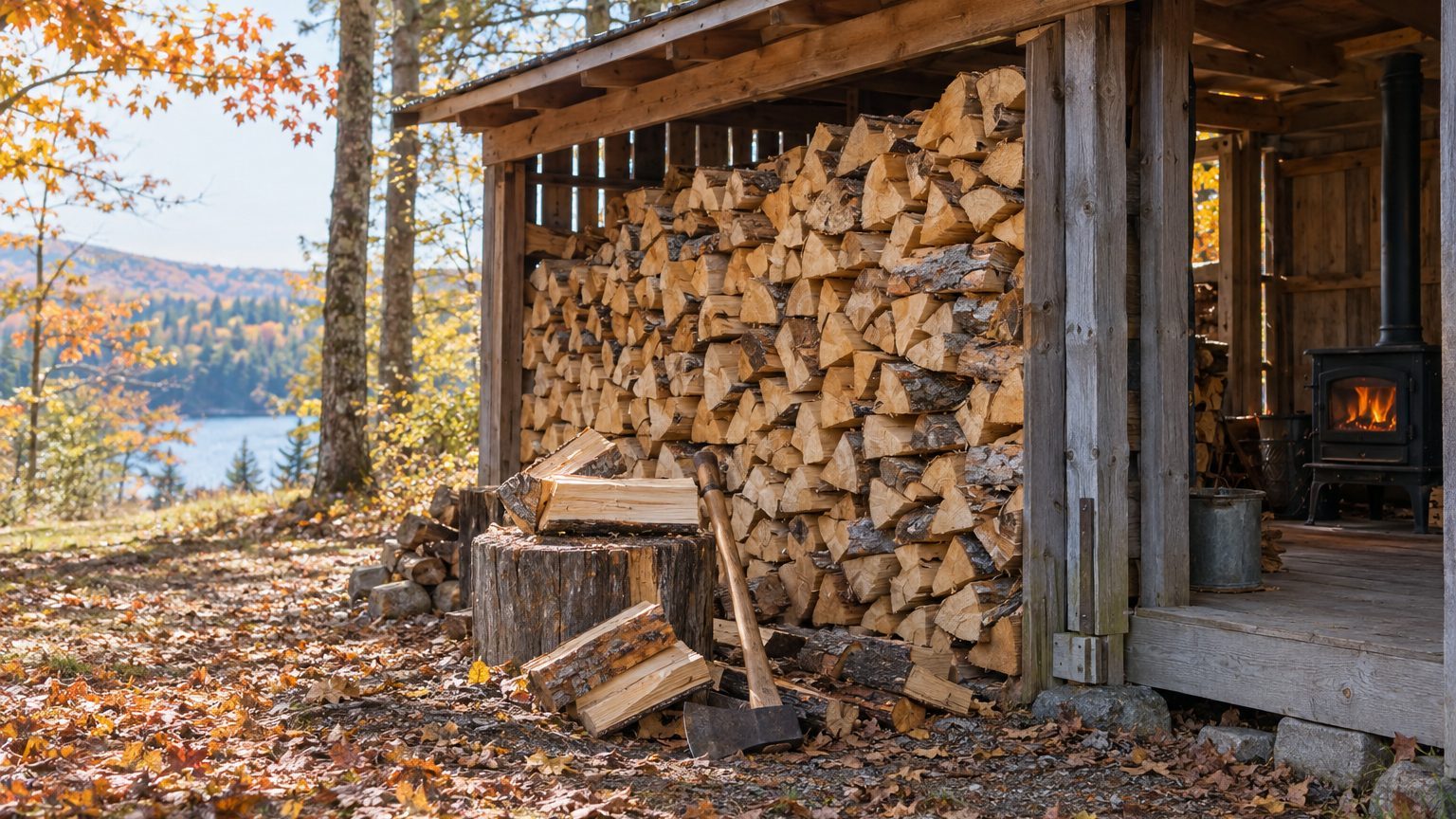

Tamarack (eastern larch) firewood delivers 21.8 million BTU per cord of seasoned wood, according to Utah State University Extension. That puts it in the middle of the species on this site: not the wood you chase for the coldest nights, not one you’d write off either. The same source does not publish smoke or spark ratings for it, so this page says what is known and marks what is not. Seasoning will matter more than the species.
How much heat Tamarack (eastern larch) gives
The figure comes from Utah State University Extension, “Wood Heating,” Table 1 Firewood Facts: 21.8 million BTU per cord of seasoned wood. That is the number used throughout this page. Other public sources sometimes list a different value for the same species, because moisture content, density and testing method all vary from one lab or region to the next. Averaging two published figures would give a number nobody measured, so none of that happens here.
What the number means
A BTU figure alone tells you very little. Across common firewood species the spread is wide: a cord of oak gives nearly twice the heat of a cord of cottonwood. Tamarack sits mid-range, well clear of the bottom of that spread and short of the top. Fill a woodshed with it and you get a respectable winter’s worth of heat, but you will burn through more cords than a household feeding a stove with the densest hardwoods.
Why would a cord of one wood outperform a cord of another, if wood is wood? Pound for pound, nearly every species releases roughly the same heat. What differs is density. A cord is a fixed volume of stacked wood, so a dense species packs more pounds into the same space. You buy volume and you burn weight. A dense hardwood wins the BTU chart because each cord holds more fuel by mass, not because its fibers burn hotter.
Why seasoning outranks the chart
The table is not the biggest variable, though. Seasoning is. Green wood spends its heat boiling off its own water before it can warm a room, so a green oak burns worse than a seasoned aspen. Someone who picks the hottest species on the list and burns it wet gets less heat than a neighbor who seasoned something modest. A mid-range figure like 21.8 million BTU is only reachable with dry wood, and the next sections explain how to get there.
Smoke, sparks, and which stove suits it
Here is the gap that no BTU chart fills. The source that gives tamarack’s heat value does not publish smoke or spark behavior for this species. It would be easy to guess from density, or from how a related conifer behaves, but a guess is not documentation, and this page does not offer one. Anyone telling you flatly that tamarack pops or smokes is working from their own hearth, not from the table above.
Species and appliance are a pair
The way to think about it is as a crossing of wood and appliance. A species that throws many sparks is a hazard in an open fireplace and harmless behind the closed door of a stove. A species that smokes heavily can heat as well as the best and still be unpleasant indoors, especially in a leaky old fireplace. So the useful question is never “is this wood good?” but “is this wood good in my appliance?” Because tamarack’s smoke and spark ratings are unknown, the safe plan changes with what you own.
- Open fireplace: treat the wood as an unknown. Use a properly fitted spark screen, keep the hearth rug and furniture clear, and watch the first few fires before you leave the room.
- Closed wood stove or insert: the door contains whatever the wood throws, so sparks matter far less. Smoke is the thing to watch, through the glass and at the chimney top.
- Outdoor fire pit: keep a hose or bucket nearby and mind the wind, since sparks carry farther than people expect.
Test a small batch before committing a whole season to any species you haven’t burned. Run a few armloads in your own appliance, note how it behaves, then decide.
Dry wood also reduces smoke from nearly any species, because the energy is going into heat instead of steam, and wet fuel is a leading contributor to creosote buildup in a chimney. If you are comparing tamarack with other species in the same series, see Firewood by Species, and for two others that get the same heat, smoke and spark treatment, Tulip poplar (yellow-poplar) as Firewood: Heat, Smoke and Sparks and Lodgepole pine as Firewood: Heat, Smoke and Sparks. Check each page for whether its smoke and spark data is actually published before you compare.
How long it takes to season

Wood has to fall below about 20 percent moisture before it gives real heat. Below that line the fire can concentrate on burning wood. Above it, the water has to boil off first, and that consumes the energy you wanted for the room. Different species dry at different speeds, partly because of how their cells are built. Some give up water slowly through dense structure, others lose it quickly. For tamarack, a seasoning time is not documented in the source used here, so no number of months is offered. Your climate, the size of the splits and how you stack matter at least as much as the species.
What you can control is simple. Split the wood, since bark is a good moisture barrier and whole rounds hold water for a long time. Stack it off the ground, in sun and wind if you can, with the top covered and the sides open to air. Leave gaps between rows. Then test it rather than trusting the calendar.
You do not need a moisture meter for a decent check. Look at the end grain of a split: seasoned wood shows cracks radiating from the center, and the ends look gray rather than fresh and pale. Check the bark, too. If it lifts away by hand with little resistance, the wood has been drying for a while. Pick up two pieces of the same size and compare weights. Dry wood feels noticeably lighter than a freshly cut piece. And when you knock two splits together, dry ones ring with a hollow, sharp sound, while wet ones give a dull thud.
A moisture meter, if you want one, is inexpensive and settles any argument. Split a piece fresh and test the newly exposed face, not the weathered outside, which reads misleadingly dry.
Getting hold of it
Tamarack is a northern tree, found mostly in cold, wet ground across the northern tier of the country, from the Great Lakes region through the Northeast. If you live there, local firewood sellers and tree crews may have it. Elsewhere you are unlikely to see it for sale at all, and nothing about a mid-range heat value is worth hauling it across state lines for. Ask sellers what species they are actually selling; a “mixed load” may or may not include it.
Insist on local wood regardless of the species. Moving firewood is how invasive insects travel. The emerald ash borer reached the Midwest that way and has killed more than fifty million ash trees. This page has no named source for that figure in its fact set, so treat it as a widely reported number and check your state forestry agency for current quarantine rules. Many states restrict firewood movement, and some require it to be heat-treated or certified. The common guideline is to buy and burn wood from the area where you will use it, ideally within a short drive of where it was cut.
When you buy, ask how long the wood has been split and stacked, and whether it was kept covered. “Seasoned” on a sales sheet is a claim, not a measurement. Apply the end-grain and weight tests before you pay, and if a seller will not let you check a few splits, that tells you something. A cord is a stacked volume, so ask how it was measured and delivered, since a loosely thrown pile is not a cord.
Common questions
Is tamarack good firewood?
It depends on what you ask of it. At 21.8 million BTU per cord of seasoned wood (Utah State University Extension, “Wood Heating,” Table 1 Firewood Facts), it is mid-range for heat. Its smoke and spark behavior is not documented in that source, so how well it suits your stove or fireplace is something to learn by burning a small test batch.
Is tamarack safe to burn in an open fireplace?
Its spark rating is not published in the source used here, so no claim can be made either way. In an open fireplace, use a fitted screen and stay close during the first fires. In a closed stove, sparks are largely contained by the door.
Can I burn tamarack right after cutting it?
You can, but you should not expect much from it. Green wood spends its heat boiling off its own water, which is why green oak burns worse than seasoned aspen. Wait until it tests below about 20 percent moisture, or check with the end-grain cracks and lifting bark.
Should I buy tamarack from another state?
No. Transported firewood is how the emerald ash borer reached the Midwest and killed more than fifty million ash trees. Buy locally, and check your state’s rules, since some restrict moving untreated wood across county or state lines.