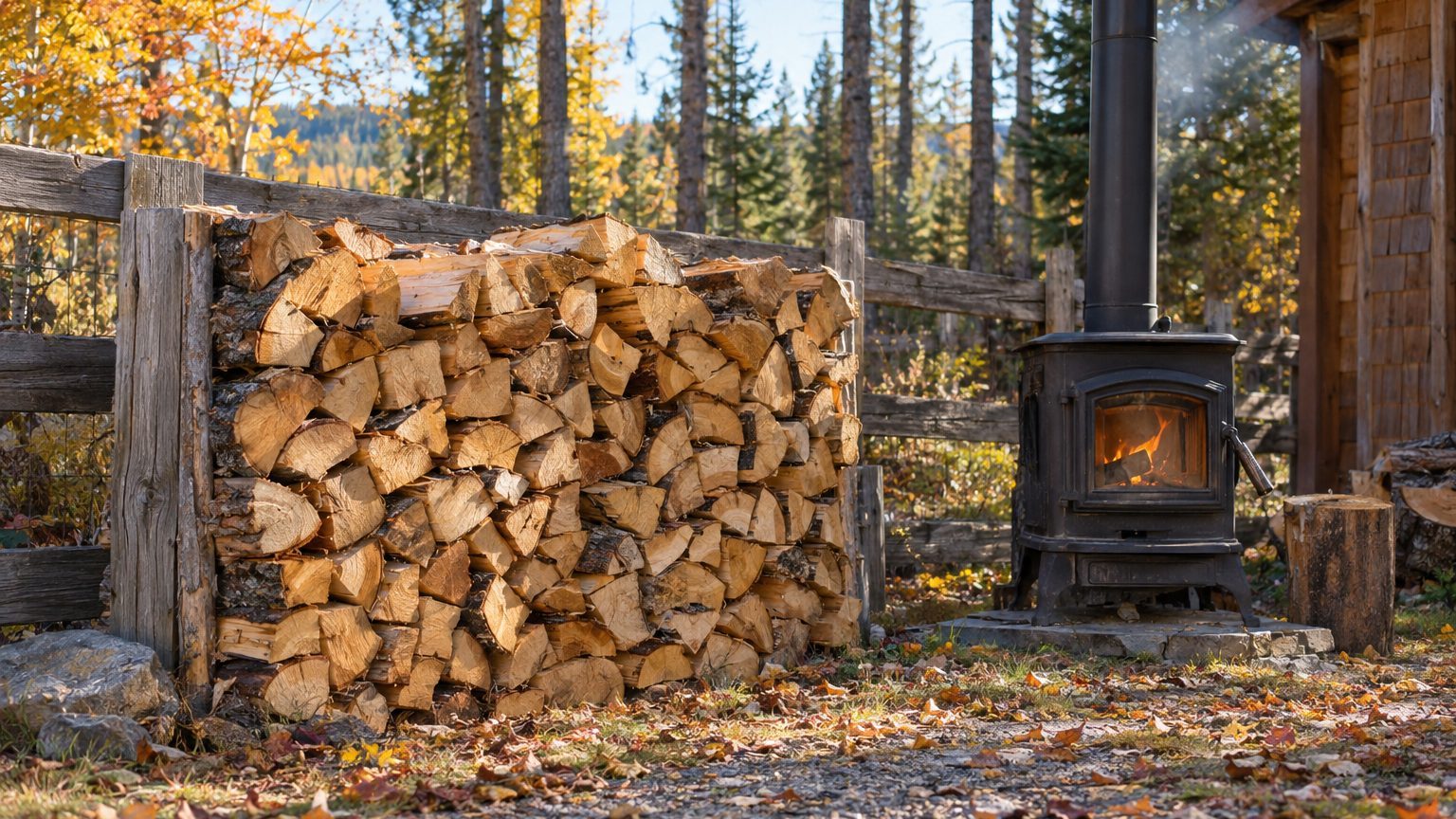

Lodgepole pine firewood yields 21.1 million BTU per cord of seasoned wood, according to Utah State University Extension in its “Wood Heating” publication (Table 1, Firewood Facts). That puts it mid-range among the species on this site: a decent heater, not a record-setter. The same source does not document how much this wood smokes or throws sparks. For anyone burning in an open fireplace, that gap Matters More Than the BTU number.
How much heat Lodgepole pine gives
The figure is 21.1 million BTU per cord of seasoned wood, taken from Table 1 of “Wood Heating,” published by Utah State University Extension. A BTU is the heat needed to raise one pound of water by one degree Fahrenheit, and a cord is a stack measuring 4 by 4 by 8 feet, or 128 cubic feet. Burn a full cord of seasoned lodgepole and, on paper, you release 21.1 million of them.
A number alone tells you little, so here is the context. Across the species tables, the spread is wide. Oak delivers nearly twice what cottonwood does per cord. Lodgepole pine sits in the middle of that spread, which makes it a reasonable primary fuel for a shoulder-season stove and a fair one for midwinter if you stack enough of it. You will carry and load more wood than you would with the densest hardwoods to get the same warmth from the stove.
You buy volume, you burn weight
The reason is counter-intuitive. Pound for pound, nearly every species of wood gives roughly the same heat. What separates them is density. A cord is a fixed volume, so a dense wood packs more pounds into those 128 cubic feet, and more pounds means more total heat. A less dense wood fills the same space with less mass. You pay for volume at the lumberyard or from the seller, but the stove burns weight.
That is why a mid-range cord means something practical: more trips to the woodpile, more loading, and a stove that may need refilling more often overnight than it would with a dense hardwood.
Why other charts show different numbers
If you search around, you will find other published figures for this species. Moisture content, density of the sampled trees, and testing method all vary between sources, and no two tables agree on everything. The figure used here, 21.1 million BTU, comes from Utah State University Extension. I have not blended it with anyone else’s number, because an average of two tables is a figure nobody measured.
One thing outranks the whole table: seasoning. Green wood spends its heat boiling off its own water before it can warm a room, so a green oak burns worse than a seasoned aspen. Pick the hottest species on the chart and burn it wet, and you get less heat than the neighbor who seasoned something modest. For lodgepole, the 21.1 figure applies only to seasoned wood.
Smoke, sparks, and which stove suits it
The extension source that gives lodgepole’s heat value does not publish smoke or spark ratings for it. That is the honest state of the record, and I am not going to fill the gap by guessing from the tree’s density or from what another species does. Inference like that sounds authoritative and is often wrong.
The useful question is how to burn an undocumented wood safely. Smoke and sparks are a crossing of species and appliance. A wood that pops and throws embers is a real hazard in an open fireplace, where those embers can land on a rug, and harmless behind the closed door of a stove. A wood that smokes heavily can heat as well as the best on the chart and still be unpleasant in a room where the draft is weak. So the answer depends on what you own, which is why no single rating settles it.
Matching an untested wood to your appliance
Until you know how a load behaves, treat the first burn as a trial and match the precautions to the appliance:
- Open fireplace: keep a fitted screen or glass doors closed, clear flammables from the hearth area, and burn a small first load while you watch it.
- Closed wood stove or insert: the door contains sparks, so the main watch item is smoke and chimney buildup. Burn dry wood hot and check the glass and flue over the first few weeks.
- Outdoor fire pit: sparks and smoke matter less to you than to neighbors, but wind and dry brush are the concern, and local burn restrictions apply.
Dry wood helps in every case. Wet wood smolders, smokes, and deposits creosote in the flue, which is the fuel for chimney fires. Annual chimney inspection is standard advice whatever species you burn, and more important when you are trying a wood without published behavior.
Start with a few pieces mixed into a fire of a wood you already know. If it pops, you will see it, and you can decide whether this wood belongs in your fireplace or only in your stove. For comparison, the Mesquite as Firewood: Heat, Smoke and Sparks page walks through the same appliance question for a much denser species.
How long it takes to season

Wood must drop below about 20 percent moisture before it gives its heat, because the water has to boil off first, and that boiling consumes the energy you wanted for the room. A stack at 40 percent or more moisture spends a large share of each fire on drying itself out. That is also when smoke and creosote get worse.
Seasoning time for lodgepole pine is not given in the Utah State University Extension table, so I will not quote a number of months. Some species dry slowly because of their cell structure, and some dry fast, and the only reliable way to find out for your wood is to test it. What shapes the outcome is mostly under your control: how small you split it, how well air moves through the stack, and how much sun and wind your site gets. A dry Mountain West summer is a very different environment from a humid Southeast one.
The test that works without a meter
A moisture meter costs little and is worth owning, but you can judge a stack without one. Look at the ends of the splits for three signs:
- Cracks radiating from the center of the end grain, wide and dark rather than hairline.
- Bark that lifts or peels away by hand.
- A light, hollow weight, and a clear knock when two pieces are struck together instead of a dull thud.
Stack off the ground, split side exposed to wind, with the top covered and the sides open. Then check again. If a fresh split feels damp or hisses on the fire, it needs more time. Waiting is cheaper than burning wood that fights you.
Getting hold of it
Lodgepole pine is a tree of the western mountains, so your odds of finding it depend on where you live. In Rocky Mountain states such as Colorado, Wyoming, Montana, and Idaho, and in parts of the Pacific Northwest and the Sierra Nevada, it is common enough that local sellers and permit programs may offer it. In the Midwest, South, and East, you are unlikely to find it nearby, and that is usually a sign you should burn something else.
If you live in the West, the places to look are firewood sellers, and public land programs where firewood cutting is allowed. Many national forests and some state agencies issue personal-use permits with local rules on where, how much, and what kind of wood you may take. Rules and fees differ by forest and by year, so check with the local ranger district rather than assuming. I do not have those details here.
Why local wood matters
Insist on local wood, even if a distant seller has a better price. Firewood moves pests, and moving it is how the emerald ash borer reached the Midwest and went on to kill more than fifty million ash trees. A load that seems harmless can carry insects and disease to a forest that has no defense against them. Buy wood cut near where you will burn it, and do not carry your own across state lines for a camping trip or a cabin.
If you are weighing options, the Firewood by Species index lays out the alternatives by heat, and a species like Tamarack (eastern larch) as Firewood: Heat, Smoke and Sparks may suit readers in the northern tier better than a western pine.
Common questions
Is lodgepole pine good firewood?
It is mid-range for heat at 21.1 million BTU per cord of seasoned wood, per Utah State University Extension. It does well at that job. Whether it suits your appliance depends on smoke and spark behavior, which the source does not document.
Can I burn lodgepole pine in an open fireplace?
Spark behavior is not published for this species, so use a fitted screen, clear the hearth, and test with a small load. A closed stove is the safer place to try an undocumented wood.
Does green lodgepole pine burn as well as seasoned?
No. Green wood spends its heat boiling off its own water before it can warm a room. The 21.1 million BTU figure applies only to seasoned wood, below about 20 percent moisture.
Why do different charts show different BTU numbers for the same wood?
Moisture, density, and testing method differ between sources. This page uses one figure, from Utah State University Extension’s “Wood Heating,” Table 1 Firewood Facts, rather than averaging several.