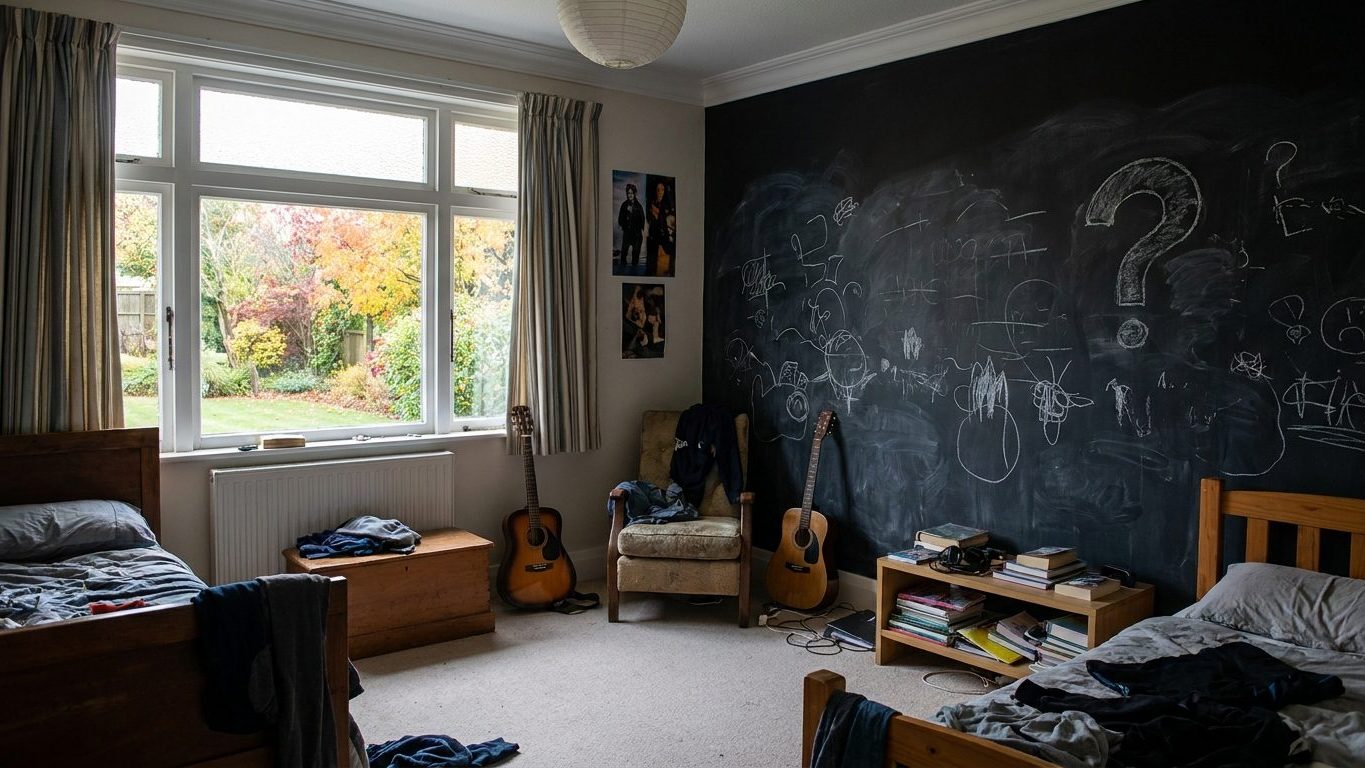

One black wall, not four, is what makes this request survivable. The window a room has, more than any color chart, decides whether a dark wall reads as moody or as a cave. Pick the wall opposite the window, the one that gets bounced light all day, and test a large sample board there before you commit a whole gallon.
What actually decides it

Light and orientation
A dark wall works or fails depending on how much daylight the room already has to spend, not on which black or charcoal ends up on the swatch. A bedroom with a large window facing the afternoon sun and pale floors can absorb a dark wall and still feel bright by midafternoon. The Same Color in a small room with one narrow window, especially one that faces away from the sun most of the day, reads flat and heavy no matter how good the paint is. The amount and direction of daylight the room receives decides more than the color itself does.
Ceiling and trim
Ceiling height matters almost as much. A low ceiling painted the same dark color as the walls closes the room in further, while a high ceiling gives the eye somewhere to travel and makes the dark walls feel like a choice instead of an accident. Trim plays a similar role. White or pale trim around a dark wall gives the room an edge to read against, so the color looks intentional rather than unfinished.
How many walls, and what the room is used for
How many walls take the color is the other half of the decision. Painting all four walls in a dark charcoal or navy changes the room’s whole character and commits the space to that mood around the clock. Painting one wall, usually the one the bed sits against or the one facing the door, gives the same drama with an escape route, since the other three walls still bounce whatever daylight comes in.
Artificial light has to make up for whatever the room loses when a dark color goes up. A room that relies on one overhead fixture reads darker again once the sun goes down, so lamps at different heights around the room matter more here than in a lighter room. None of this requires any new wiring. A floor lamp and a couple of table lamps placed away from the fixture already in the ceiling do the job.
This is also where the room’s actual use comes in. A guest room, which nobody sleeps in for more than a night or two, can carry a color that would wear thin fast in a room lived in every day. See A Guest Room Is the One Room You Do Not Live In for how that tradeoff plays out when the room is occasional rather than daily. A teenager’s bedroom is used for homework, sleep, and everything between, so the color has to hold up under all three kinds of light.
Most people find that a dark color earns its keep when the room already has good natural light to spare. Where the room is dim to begin with, a dark wall does not create moodiness so much as subtract the light the room needed for everyday use.
In practice
| Situation | What usually works | What goes wrong if skipped |
|---|---|---|
| Large window, sun-facing exposure, pale floor | All four walls in a deep charcoal, navy, or bottle green, with white or pale trim to hold the edges | Skipping the trim leaves no boundary, so the room reads like one dark box rather than a considered choice |
| Small room, one window, limited direct light | One wall dark, ideally the one behind the bed, the other three in a lighter tone from the same color family | Painting all four walls here removes the light the room needed to begin with and the room feels smaller, not cozier |
| Low ceiling, standard window | Dark walls with a ceiling one or two shades lighter than the walls, not stark white | A stark white ceiling against dark walls creates a hard line overhead that draws attention to how low the ceiling actually is |
| Room used mainly after dark, one overhead fixture | A dark wall plus two or more lamps at different heights around the room | Relying on the single overhead fixture leaves the room dim and flat once daylight is gone, dark color or not |
The ceiling and the finish
The ceiling deserves its own thought once the walls go dark, since a flat white ceiling against charcoal or navy walls can look like an afterthought rather than a decision. A ceiling painted a shade or two lighter than the walls, still within the same color family, keeps the room from splitting into two unrelated halves. That question comes up on almost every dark bedroom, and The Ceiling Does Not Have to Be White covers how far to take it.
Finish matters as much as color once a teenager actually lives in the room. A matte or eggshell finish on a dark wall shows scuffs and touch-ups less than a flat finish does, which matters in a room that takes posters, tape, and the occasional foot against the wall. A semi-gloss reads shinier and shows every roller mark and repair, which is fine on trim and wrong on a whole wall.
Most of this decor decision comes down to matching the color to how the room is actually used, not to how it photographs on a moodboard. See Decor for how the same light-and-use logic applies to other rooms before you get to this one.
Where this goes wrong
The all-dark room with one window
The failure mode is specific and easy to see coming: a bedroom with one modest window and limited direct light, all four walls painted the same near-black or deep navy, and no plan for extra lighting. The room stops reading as moody and starts reading as a cave. Homework gets done under one desk lamp because the rest of the room swallows whatever light is left. Clothes disappear into a closet painted the same color as the walls. The bed, the desk, and the floor all recede into the same dark field, and the room feels smaller than it did before, not bigger and not cooler. A room like this often looks fine in a photo taken at midday with a flash, since the flash covers up exactly the flatness that a person standing in the room notices right away.
The cost of undoing it
The other place this goes wrong is on the way out, not the way in. Dark colors, especially near-black and deep navy, are hard to cover once someone decides to repaint. Getting a dark wall back to a lighter color usually takes more coats than the first coat of dark took to go up, because the pigment in a dark color is dense enough to bleed through one or two coats of a lighter color painted over it. A parent who agreed to one black wall in eighth grade can be looking at several coats of primer and paint years later to get the room ready for a new occupant or a move.
This is also the point where trim and ceiling choices that seemed like a small extra step turn out to matter. A room where the trim was left white and the ceiling untouched is a much smaller repaint than a room where the color crept onto the closet doors, the window casings, and the ceiling as well. The more surfaces that took the dark color, the more surfaces that need several coats of something lighter before the room reads normal again.
None of this means a dark wall is a mistake. It means the mistake is doing it on every wall in a room with only one modest window, and doing it without any thought for what repainting it back looks like a few years on.
Before you open a can
The sample board test
A color read off a paint chip under store lighting is not the color that will end up on the wall at seven in the morning or nine at night. Paint chips are small, glossy compared to a painted wall, and lit by fixtures that have nothing to do with the room’s actual window. The only way to know what a dark color will do in this particular room is to put it on the wall itself, at a scale big enough to judge.
Buy the smallest sample size available and paint out a board at least two feet square, not a patch on the wall itself. Move that board to two or three different spots in the room and look at it in the morning, at midday, and again after dark with only the lamps on, since a color that looks rich at noon can go muddy or flat once the sun moves past the window. A color that reads black in the store can turn out to carry a green or blue undertone once it sits next to the room’s actual daylight, and that undertone is exactly what a small chip never shows.
Test it with the door open and the door closed, too. A teenager’s room usually gets used with the door shut for hours at a stretch, and a color that looks fine with hallway light spilling in can read completely different once that light is cut off entirely.
This single step, more than any rule about how many walls to paint or which family of color to choose, is what prevents most of the regret that comes with a dark teenage bedroom. It costs one sample can and a few days of patience against the cost of repainting a room that turned out darker, or greener, or flatter than anyone expected. Do this before buying enough paint for the whole room, not after.
Common questions
Will a black wall hurt resale value?
Most people find a single dark accent wall has little effect on resale, since it is one of the cheapest things in a house to change before a sale. Four dark walls in a small bedroom with limited natural light are more likely to be repainted by a buyer or an agent before the house goes on the market, which is a cost worth weighing before you commit to that version.
Do I need a special primer for black or navy paint?
A tinted gray primer, made for use under dark colors, reduces the number of finish coats needed compared to painting straight over a standard white-primed wall. It will not eliminate the extra coats a dark color typically needs, but it cuts down how many.
Can a windowless basement room have a dark accent wall?
The paint question is the easy part. Whether a windowless room can be called a bedroom at all is a separate matter governed by local building rules, and that is a question for your local building or code enforcement department before you plan the room around it.
What if he changes his mind in six months?
A large panel of fabric or paper pinned or lightly adhered to the wall gives the same dark effect without committing to paint, and it comes down in minutes. If paint is already on the wall, treat the next repaint as a several-coat job rather than a quick weekend refresh, since that is what dark colors actually require to cover.