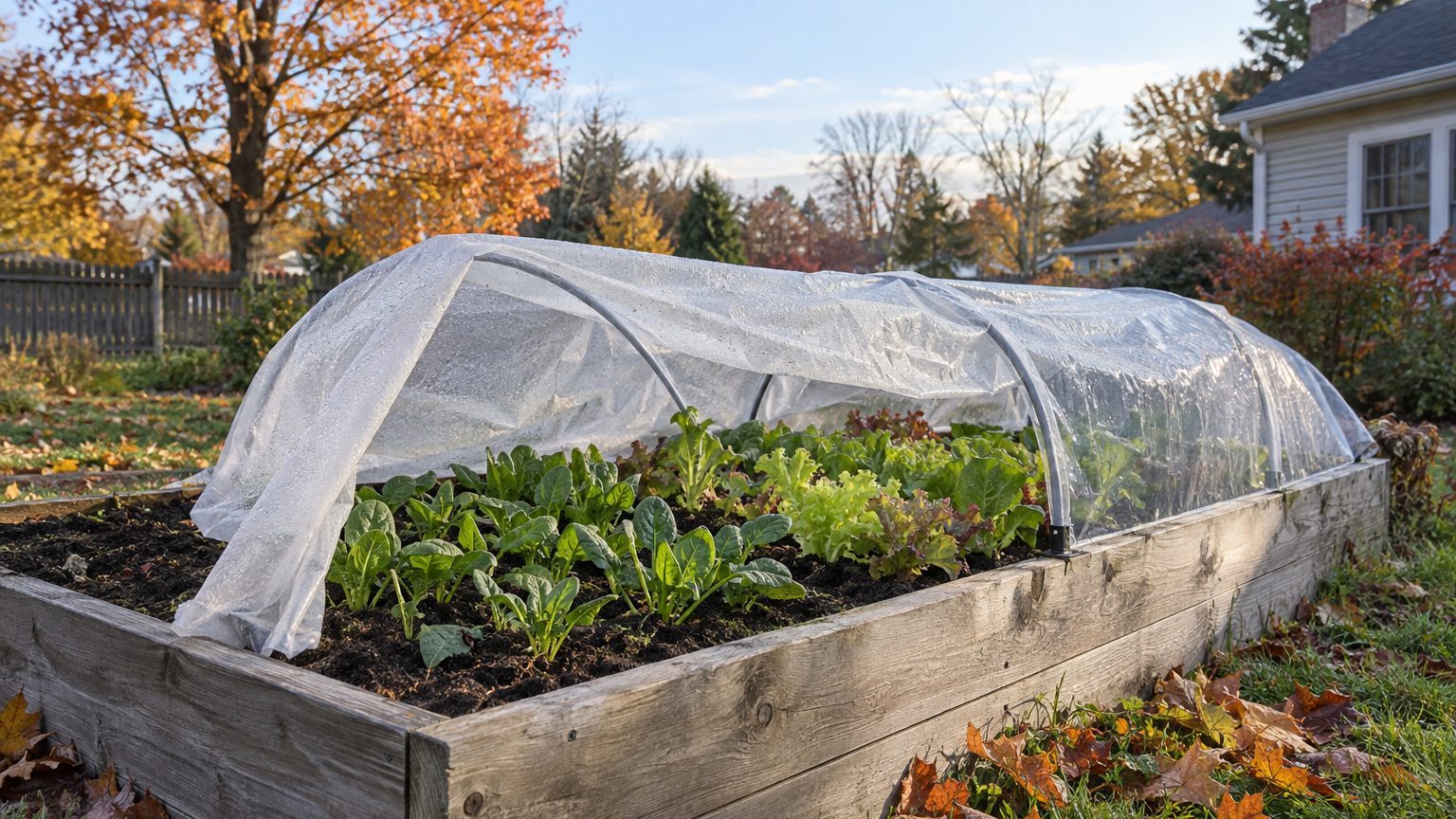

In Sioux Falls, the last spring freeze falls between April 29 and May 9, and the first fall freeze between September 24 and October 4. Season extension in South Dakota works inside those bookends. A cover can move each edge by days or a few weeks, never by months, and it never removes the limit. Cold and short days, more than summer heat, decide what is possible here.
When the soil is warm enough in South Dakota
The frost date is a proxy
Every gardener asks the date question first, so here it is. NOAA’s 1991-2020 Climate Normals put the last spring 32F freeze at Sioux Falls (station USW00014944, the 30-70% probability band) between April 29 and May 9. That is a probability, not a promise, and a late freeze after the window is always possible. Details are in the NOAA station data.
The date is also the wrong thing to wait for. Frost is a proxy. Warm-season seedlings and most seeds are waiting on warm soil, and soil lags the air. It warms after the frost risk has ended, not with it. A bed can be frost-free for two weeks and still be too cold for roots to move.
Those dates also belong to the airport. Suburban and rural gardens usually see the last spring frost later, often by one to two weeks, and more at elevation. If you garden outside Sioux Falls, check your own county’s normals before you mark a calendar.
What a cover does to the soil
A cover works on the ground first and the air second. Soil soaks up sun all day and releases that heat slowly after dark. A fabric or plastic layer traps some of it and holds the air still, so the warmth stays around the plants instead of drifting off. Put a second layer inside the first, such as fabric under a hoop, and you add another pocket of still air.
The gain is real but variable. It depends on the material, the night, the wind, and whether the ground was warm to begin with. A calm, clear night is the hardest test, because heat escapes upward fastest then. Two weeks of cover over a bed before planting warms the soil more than cover thrown on the evening before a cold snap.
Any closed structure needs ventilation, and that is not optional. A closed cold frame in spring sun can cook its contents within an hour, even when the air outside is cold. Prop it open on any sunny morning. This site’s approach is passive throughout, so no heaters, lamps or candles go inside any cover. A cover shifts the limit. It does not make a crop frost-proof, and one hard clear night can still take a bed.
How long the season lasts here
Subtracting the two dates in the same station’s normals gives the window. April 29 to September 24 is 148 days. May 9 to October 4 is also 148 days. Pair the earliest spring date with the latest fall one and you get 158 days. Pair the latest spring date with the earliest fall one and you get 138.
| Pairing (Sioux Falls station) | Window |
|---|---|
| April 29 to September 24 | 148 days |
| May 9 to October 4 | 148 days |
| April 29 to October 4 (longest) | 158 days |
| May 9 to September 24 (shortest) | 138 days |
Rural gardens will likely land at the short end or below it. If both ends move by one to two weeks, as is typical outside the airport, a country garden loses roughly two to four weeks of that window.
The length matters because of what it allows. A window near 148 days is long enough for a first sowing of quick crops and a second one behind it, with the second timed to finish before the fall freeze. It is not long enough to be casual about long-season crops. A window that trims toward 138 days or less makes the first sowing the only one for many of them.
That changes the transplant question. Seedlings carry a head start, but every transplant risks a root check, a stall while damaged roots recover. When the window is short, a stall costs a larger share of the whole season. Start long-season crops indoors and harden them off, but direct-sow anything that dislikes root disturbance. Cover can claw back a little at each end of the window, which is where it earns its keep here.
The succession sowing guide on this site shows how to space second sowings against a fall date like this one. Rural readers should work from their own county’s frost dates, not the airport’s.
Heat and water in South Dakota
Light and cold set the limits
The governing fact in South Dakota is not summer heat. It is light and cold together. Sioux Falls sits at 43.59 degrees north (NOAA, the same station as the frost dates). Latitude fixes how fast daylight shrinks in fall. Day length, not warmth, is also what tells an onion to stop making leaves and start making a bulb. A gardener in the far north of the state is on a different clock, so check your own latitude if you live near an edge of South Dakota.
Once daylight falls below the growing threshold, a cover stops growing plants and starts holding them alive. Hardy greens under a cover in late fall are in storage, not in production. The dates when that happens come well after the first freeze, and they vary by latitude.
The coldest month settles the next question. The mean daily minimum in January at Sioux Falls is 8.5 F (NOAA Climate Normals 1991-2020). That is an average low, not a record, so real nights go colder. At that level a light fabric is nowhere near enough for deep winter. Fabric suits the shoulder seasons, the weeks around the frost dates. Anything meant to hold a crop through January calls for a framed structure, and even that only holds hardy crops, not tender ones. USDA’s 2023 Plant Hardiness Zone Map spans 3b to 5b across South Dakota. Cite your own area, not the range.
What this page cannot tell you about summer
The verified figures for this page do not include a count of days above 90 F or a summer rainfall total, so I will not guess at either. A count like that would belong to one reference station, not the whole state, and it would not describe your garden. Your nearest NOAA station and your county extension office can give you both.
What I can say is what the pattern looks like when summers run cool and damp. Mildew moves in, fruit ripens slowly, and leaf diseases spread through crowded, wet foliage. A garden in that kind of season needs airflow more than shade. In a hot, dry stretch the problem flips to bolting and thirsty soil. Which one you get varies by year and by county.
Which season extension suit South Dakota
Choose by type, and let the facts above steer. A short window with a hard January favors the earliest types of crops, ones that mature quickly and tolerate cold soil. It also favors the simplest covers, because the gains are mostly at the edges of the season.
- Row cover fabric over beds in the weeks around the frost dates, to warm soil before planting and trim the edge off a light freeze.
- Low tunnels, which add a second pocket of still air and stand up better to wind when well anchored.
- Cold frames, for hardening off and holding hardy greens into the cold, always propped open on sunny days.
- Taller framed structures, the only type that makes sense for holding crops through the coldest month, and still no guarantee on a hard night.
Where summers are humid, disease resistance becomes the first criterion for what goes under cover. Closed, still air is exactly where mildew thrives. Where they run hot, favor types with airflow and shade at the root. The verified record on this page leans cold and short, so start with the earliest types and add the others only if your own season calls for them.
This page names no cultivars, on purpose. The only variety recommendation that means anything is one trialled under local conditions, and this page does not have those trial results. South Dakota State University Extension does, and its guidance reflects your region’s frost, disease and soil, not a national average.
Readers comparing northern territories can read Extending the Season: What a Cover Buys, and What It Cannot for the general case. For other cold-winter states, see Extending the Growing Season in Idaho and Extending the Growing Season in Maine.
Common questions
How long is the growing season at Sioux Falls?
Between 138 and 158 days, depending on which spring and fall dates you pair. Matching the earliest ends or the latest ends gives 148 days. Those are airport figures, and rural gardens usually have less.
Does a row cover make plants frost-proof?
No. It traps heat that the soil releases and holds still air around the plants, which shifts the limit by an amount that varies with material, wind and the night. A hard, clear, windless night can still beat a cover.
When can I plant warm-season crops outside?
After the frost window of April 29 to May 9, and then after the soil has warmed. The soil lags the air, so frost-free does not mean ready. Rural gardens often wait one to two weeks longer than the airport figures suggest.
Can I grow through winter in a cold frame?
Only hardy crops, and mostly held alive, not growing. With January’s mean daily minimum at 8.5 F in Sioux Falls, expect growth to stall once daylight shortens. Vent the frame on sunny days even in winter, and keep every heat source out of it.