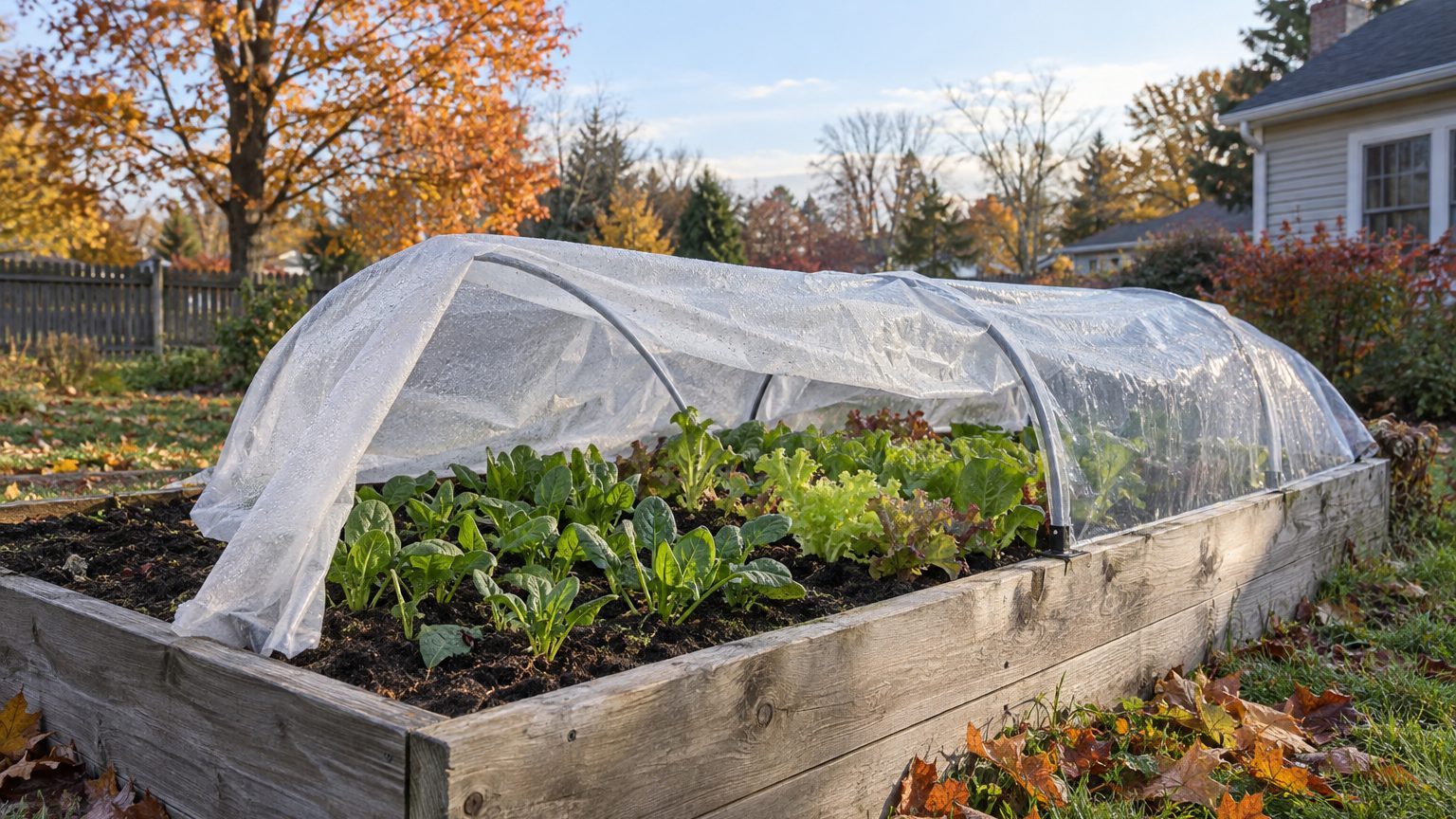

Wisconsin gardeners can start earlier and finish later with covers, but the gain is measured in weeks, not months, and it stops where the soil and the daylight stop cooperating. At the Milwaukee reference station, the freeze-free stretch runs roughly six months. A low tunnel or a cold frame nudges both ends of that window. It cannot turn April into May, or December into June.
When the soil is warm enough in Wisconsin
Start with the date everyone asks about. For the Milwaukee reference station (NOAA station USW00014839), the 1991-2020 Climate Normals put the last spring 32F freeze between April 16 and April 29. That span is the band where the odds of one more freeze sit between 30 and 70 percent. It is a probability, not a promise, and a hard freeze in early May is entirely possible.
Frost is a proxy, not the target
The frost date is a stand-in. A cover gardener is really waiting for warm soil, and soil lags the air. Spring sun warms the air within days, but wet, cold ground in southern Wisconsin holds winter longer, and it warms after the frost risk ends, not alongside it. Seeds sown into cold soil sit, rot, or sprout unevenly. Transplants stall because roots stop working long before leaves look unhappy.
A soil thermometer at planting depth, read in the morning, tells you more than the calendar. Compare the reading with the minimum soil temperature on the seed packet or in your extension service’s planting guides.
What a cover actually does
A cover works on heat the soil has already stored. During the day the ground absorbs sun; at night it radiates that heat upward. A tunnel or fabric layer traps part of it and keeps the air still, so the warmth stays around the plants instead of drifting off. Adding a second layer, such as fabric inside a tunnel, slows the loss further. The gain is real, but it varies with the material, the night, the wind, and whether the ground was warm to begin with. A windy, clear night after a cold, wet week gives you much less than a calm night after sunny days.
Covering the bed a while before planting is the cheapest trick available, because it lets the soil bank warmth before the crop arrives. But a cover shifts the limit; it does not remove it. A hard freeze on a clear night can still take everything under it.
Everything here is passive. Put no heater, lamp, or candle inside any covered structure. The fire and carbon monoxide risks are real, and the sun and the soil already supply what you need.
Ventilation is part of keeping the crop alive. A closed cold frame in spring sun can cook its contents within an hour, even on a day that began near freezing. Prop the lid in the morning and close it again before the afternoon cools.
How long the season lasts here
Milwaukee’s last spring freeze falls April 16 to April 29, and the first fall freeze falls October 17 to October 29 (same NOAA station and normals). Subtracting gives the window.
| Pairing | Last spring freeze | First fall freeze | Days between |
|---|---|---|---|
| Early dates | April 16 | October 17 | 184 |
| Late dates | April 29 | October 29 | 183 |
| Shortest case | April 29 | October 17 | 171 |
| Longest case | April 16 | October 29 | 196 |
Call it about six months, give or take two weeks. That is the equivalent of roughly 26 weeks between the last frost and the first.
What six months allows
A window that long allows a second sowing. A bed of lettuce, radishes, or spinach can be sown in April, cleared in June, and sown again in August for a fall harvest. Frost-tender crops such as tomatoes and peppers fit within the window if you start them indoors and set them out once the soil has warmed, but they use most of it. Our succession sowing guide on this site lays out the spacing between sowings in more detail.
A shorter window removes the second chance. There, the first sowing is the only one, and transplanting becomes a question of whether the root check is worth the head start.
Where the window shrinks
Milwaukee sits on Lake Michigan, and the lake delays the first fall freeze along the shore. Inland southern Wisconsin typically freezes in early October, and the north freezes far earlier. A garden a couple of counties inland may lose a week or two from the fall end. If you garden away from the lakeshore, treat the October figures as the best case. For a comparison with other northern states, see Extending the Growing Season in New Hampshire and Extending the Growing Season in Montana.
Heat and water in Wisconsin
The verified figures for this page do not include a count of days above 90 F or a summer rainfall total, so I won’t print either. What the climate pattern suggests is that heat is not the governing fact here. Hot spells happen, but a northern lake-influenced state is more likely to hand you a cool, damp stretch in summer than a sustained scorcher. Cool, damp weather brings its own problems: mildew on squash and cucumbers, slow ripening on fruiting crops, and fungal disease where foliage stays wet. Covers make that worse if they hold humidity in, which is another reason to vent them.
Light sets the autumn limit
What governs the late end of the season is light and cold together. Milwaukee sits at 42.95 degrees north (the coordinates of the same NOAA station). Latitude fixes the date in late autumn when day length falls below what plants need to grow. After that date, a cover holds a crop alive; it does not make it grow. Spinach, kale, and carrots left under cover in December are being stored in the garden, not produced. Plan to have the crop near harvest size before light drops off, because it will not size up afterward.
That latitude belongs to Milwaukee only. Wisconsin spans several degrees, so a gardener in the far north is working with shorter winter days, and one near the Illinois line has a little more light. Check the latitude of your own town, and compare it with a sunrise and sunset table for the dates you care about.
The coldest month picks the structure
The mean daily minimum of the coldest month at Milwaukee is 17.2 F, per the 1991-2020 normals. That is an average, so many nights run colder. The USDA Plant Hardiness Zone Map (2023) puts the state in zones 3b to 6a, a wide range because it covers the whole state and rests on a single variable, the average annual extreme minimum.
The practical meaning is that a light fabric alone is a fall and spring tool here. It can carry a crop through an early frost, but in the depth of winter, with nights routinely well below freezing, only a framed structure has a chance of holding hardy greens. Even then, vent it on any sunny day, because a closed frame heats quickly in winter sun and the temperature swing can damage the plants.
Which season extension suit Wisconsin
Choose by type, starting with the constraint that bites hardest. Wisconsin’s constraint is a six-month window with cold at both ends, so the earliest types matter most. Look for crops and varieties labeled early or quick to maturity. Cool-season crops such as lettuce, spinach, peas, and radishes do well under a light cover in April and again in September. Fabric over hoops is the simplest structure and the one most likely to be worth your money. A framed cold frame suits late fall and early spring harvests of hardy greens, as long as you can open it every sunny day.
Heat matters less than elsewhere, but a hot spell under a cover is dangerous. Choose types and layouts that allow airflow, and give roots some shade and mulch in July. Pull fabric off warm-season crops once nights stay mild so they are not cooking under it.
The damp-summer side of the climate makes disease resistance the first criterion for anything you grow into July. Look for varieties bred against mildew and leaf spots, space plants generously, water at the base, and open covers on humid mornings to let foliage dry.
This page names no varieties, and that is deliberate. The only variety recommendation that means anything is one tested in your own climate, and this page does not have those trial results. Wisconsin’s range from zone 3b to 6a, the lake effect, and the gap between lakeshore and inland all change what performs. University of Wisconsin Extension and its county offices know what has been trialed locally, and they can tell you which types fit your county and soil.
For the general principles behind all of this, including what a cover buys and what it cannot, read Extending the Season: What a Cover Buys, and What It Cannot. Whatever you build, keep it passive: sun, soil, and still air, with no heater or flame inside.
Common questions
When can I plant in Wisconsin if I use a cover?
The last spring freeze at the Milwaukee reference station falls between April 16 and April 29, but the real trigger is soil warmth. A cover pre-warms the bed, so you may plant hardy crops earlier than usual. Check soil temperature at planting depth first, and remember that a freeze is still possible.
Will a cover protect my plants from frost?
It can help, but it cannot guarantee anything. A cover traps heat stored in the soil and slows its loss at night. How much it helps depends on the material, the wind, the night, and how warm the ground was beforehand. A hard freeze on a clear night can still kill what is under it.
Do I need to vent a cold frame?
Yes. Ventilation keeps the crop alive. A closed frame in spring sun can overheat within an hour, and in humid weather a closed frame encourages disease. Open it on sunny mornings and close it as the afternoon cools.
Can I grow vegetables through a Wisconsin winter under a cover?
You can hold some hardy crops alive, not grow them. In the depths of winter, day length at Milwaukee’s latitude is too short for growth, and the coldest month’s average nighttime low of 17.2 F favors a framed structure over a light fabric. Plant so the crop is nearly full size before late autumn, then harvest from the garden as needed. Inland and northern gardens face earlier cold and shorter days than the lakeshore.