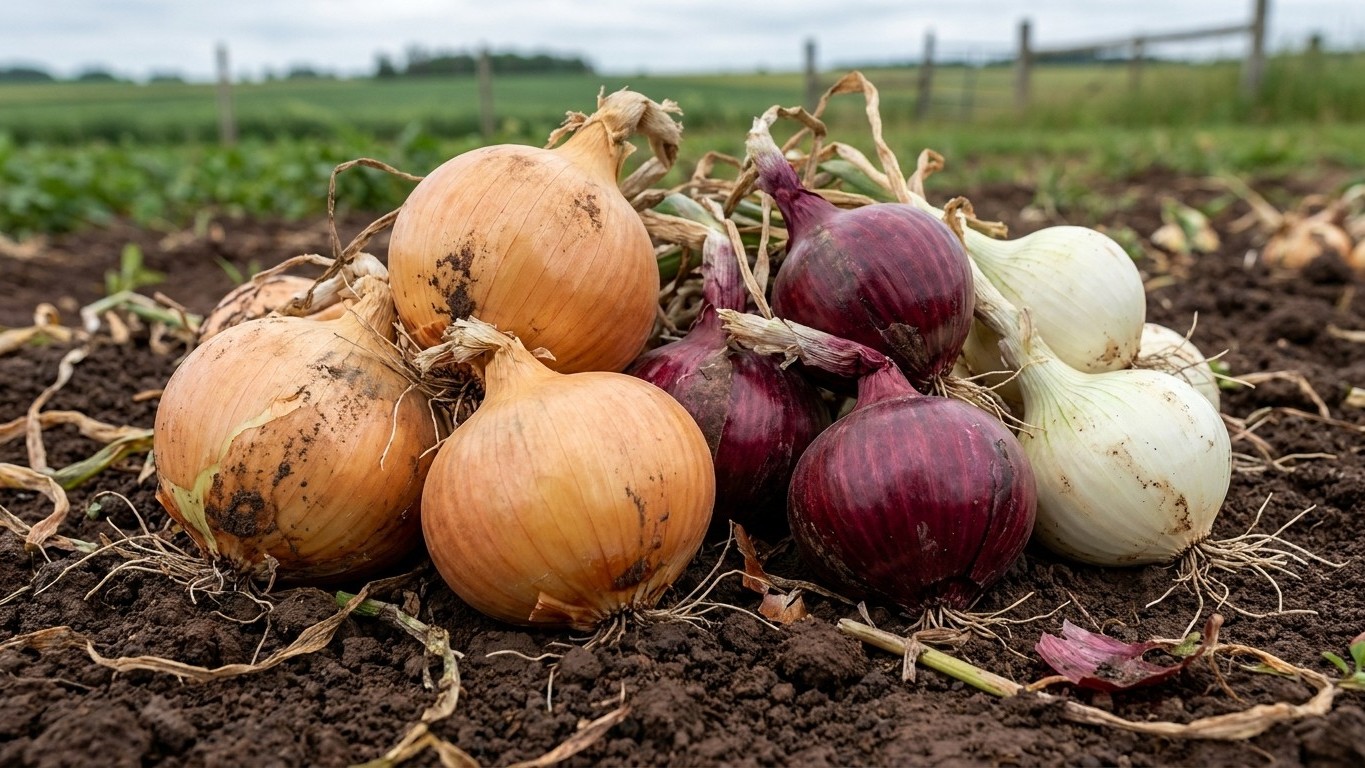

Lift onions in Massachusetts once the tops have flopped over and gone yellow, usually in late summer, then cure them before anything goes into storage. The order matters more than the date. A bulb pulled green and stacked in a cellar rots from the neck down, while one that cured properly can keep for months. Curing is the step most beginners skip, and it decides whether you are eating onions in January or composting them.
The short answer for Massachusetts
Boston sits at 42.36 degrees north, and on the longest day of the year it gets 15 h 06 of daylight. That figure is a geometric calculation, so real daylight runs about seven minutes longer. It drives your whole onion calendar, because bulbing is set off by day length, not by warmth. A long-day onion waits for 14 to 16 hours of light before it stops making leaves and starts swelling a bulb, and Boston clears that bar with room to spare. A short-day type starts bulbing at about 12 hours (the threshold Clemson Cooperative Extension publishes), a mark Massachusetts reaches around the spring equinox.
In practice, onions set out in spring spend May and early June building leaves. Bulbing begins as days approach their peak around the solstice, and the harvest follows once the tops give out.
Reading the tops
Every leaf above ground eventually becomes a ring inside the bulb, which is why the size of the plant at bulbing decides the size of the onion. When the necks soften and most of the row has tipped over, the plant is finished. Choose a dry day, loosen the soil with a garden fork, and pull the bulbs with the tops still attached. Check each one as it comes up. Bulbs with soft spots or maggot damage go to the kitchen first, and What Eats Onion in Massachusetts, and When explains which pests leave that kind of mark.
Curing before storage
Spread the bulbs in a single layer somewhere airy, shaded and out of the rain: a covered porch, a garage with the door cracked, a barn bench. Brush off loose dirt, but skip the hose. Curing takes weeks, not days, and you are done when the necks are tight and dry and the outer skins rustle like paper. Only then trim the roots and cut the tops down to a short stub.
Clemson Extension puts the target for storage this way: “Ideal conditions are between 45 °F and 55 °F, and 50 to 60 percent humidity” (Clemson Cooperative Extension, Home & Garden Information Center). Onions want it dry. A damp root cellar that suits carrots will rot them.
What will not work here
At 15 h 06, Boston’s longest day is long enough that no onion group fails to bulb outright. The failures here are quieter: bulbs that stay small, or bulbs that look fine in September and turn to mush by December. Most of them trace back to the same few mistakes.
- Short-day varieties planted in spring. They start bulbing at about 12 hours of daylight, long before the plant has grown much foliage, so you get tennis-ball-sized onions at best.
- Late planting. A late start does not push the harvest back, it shrinks it. Whatever size the plant has reached when day length triggers bulbing is the size of the bulb, and the calendar will not wait for a late transplant.
- Sweet onions meant for winter. They have fewer of the sulfur compounds that protect a bulb in storage, so they sag and sprout by midwinter.
- Bulbs going from garden to cellar uncured. Open, moist necks let rot organisms straight into the bulb.
- A damp cellar. Humidity well above the 50 to 60 percent range invites mold and sprouting, even on a well-cured bulb.
- Bruised bulbs. A dropped or fork-stabbed onion rots first and can spread it to its neighbors. Eat these right away.
The fix for the first two is variety choice and planting date, which The Best Onion Varieties for Massachusetts covers in detail. The other four are habits, and they cost nothing to change.
What changes across Massachusetts
All the figures above come from Boston (the NOAA NCEI station USW00014739), which is a single point in a state that stretches from the islands and the Cape in the southeast to the Berkshires and the New Hampshire and Vermont line in the north. The spread in latitude is modest by national standards, so day length shifts by minutes rather than hours. Exact figures for individual towns are not published here, so the table shows direction only.
| Area | Latitude | Longest day | What it changes |
|---|---|---|---|
| Boston (reference city) | 42.36 degrees north | 15 h 06 | Long-day range reached; baseline for this page |
| Cape, islands and south coast | Below 42.36 | A few minutes shorter | Still long-day country; milder, later fall frost |
| Towns near the New Hampshire line | Above 42.36 | A few minutes longer | Same group; shorter season, so plant as early as soil allows |
Nobody in Massachusetts crosses into a different onion group because of latitude. What moves is the calendar. A gardener on the north edge of the state or up in the hills can see ground thaw weeks after one near the coast, and that pushes planting later. A later start means smaller plants when bulbing arrives. Hill towns with cold air pooling in the valleys often face this more than latitude would suggest.
Harvest follows the same logic. Lift when your own tops fall, not when a neighbor’s do, and not on a date from a state-wide chart. The broader picture for the state is in Onions in Massachusetts.
Sweet now, or onions that last
The bite of an onion comes from volatile sulfur compounds, and those same compounds are what defend the bulb while it sits in storage. A sweet variety carries fewer of them. That makes it better raw and worse in the cellar. University of Missouri Extension states the rule plainly: “As a rule, ‘sweet’ onions do not store as well as the more pungent types.” No amount of careful curing changes the chemistry.
Day length lines up with this trade. Short-day types run sweeter, and long-day types keep longer. Southern gardens, limited to short-day onions, get onions to eat soon. Massachusetts, with 15 h 06 on the longest day, can grow the long-day kind that feed a household into late winter, though it can also grow sweet ones if you accept they are for summer and early fall.
So look ahead to March. If you planted only sweet onions, your pantry shelf is empty by then, or holds a few soft, sprouting bulbs. If you planted a pungent long-day variety and cured it well, you still have a basket of hard, tight-skinned onions that sting your eyes when you slice them. Most gardeners do best with both: sweet onions in the first rows to eat through the fall, and a larger block of pungent ones for storage. Never expect one onion to do both jobs.
Checking this against your own garden
Everything above is anchored to Boston. If you garden far from it, a few quick checks will tell you how closely the advice applies. Your county extension office (UMass Extension serves the state) can help with each of them.
- Find your latitude. Any online map will show it. Compare it with 42.36 degrees north and note whether you are meaningfully north or south of Boston.
- Look up your local frost dates through your extension office. Do not borrow a state-wide date, because it will not describe your garden.
- Check your variety tag or order record to see whether it is short-day or long-day, and match that against the 12-hour and 14-to-16-hour thresholds.
- Put a thermometer and a hygrometer in the spot you plan to store onions and read them for a few days. You want 45 to 55 °F and 50 to 60 percent humidity.
- Press a neck on a bulb you have been curing. If it is tight and dry and the skin is papery, it is ready. If it is soft, it is not.
Common questions
Can I lift onions before the tops fall over?
You can, and they will taste fine, but they will not store. Onions pulled green have wet necks that cannot cure properly, so eat them first.
Should I wash onions before curing?
No. Brush off dry soil and leave the rest. Water on the skins and necks slows curing and invites rot.
Can onions share a cellar with carrots?
Not well. Onions want 50 to 60 percent humidity, and carrots want the opposite, so one space cannot hold both at their best.
Will a sweet onion last until spring?
Almost never. Fewer sulfur compounds means less protection in storage. Use sweet onions fresh and rely on pungent varieties for winter.