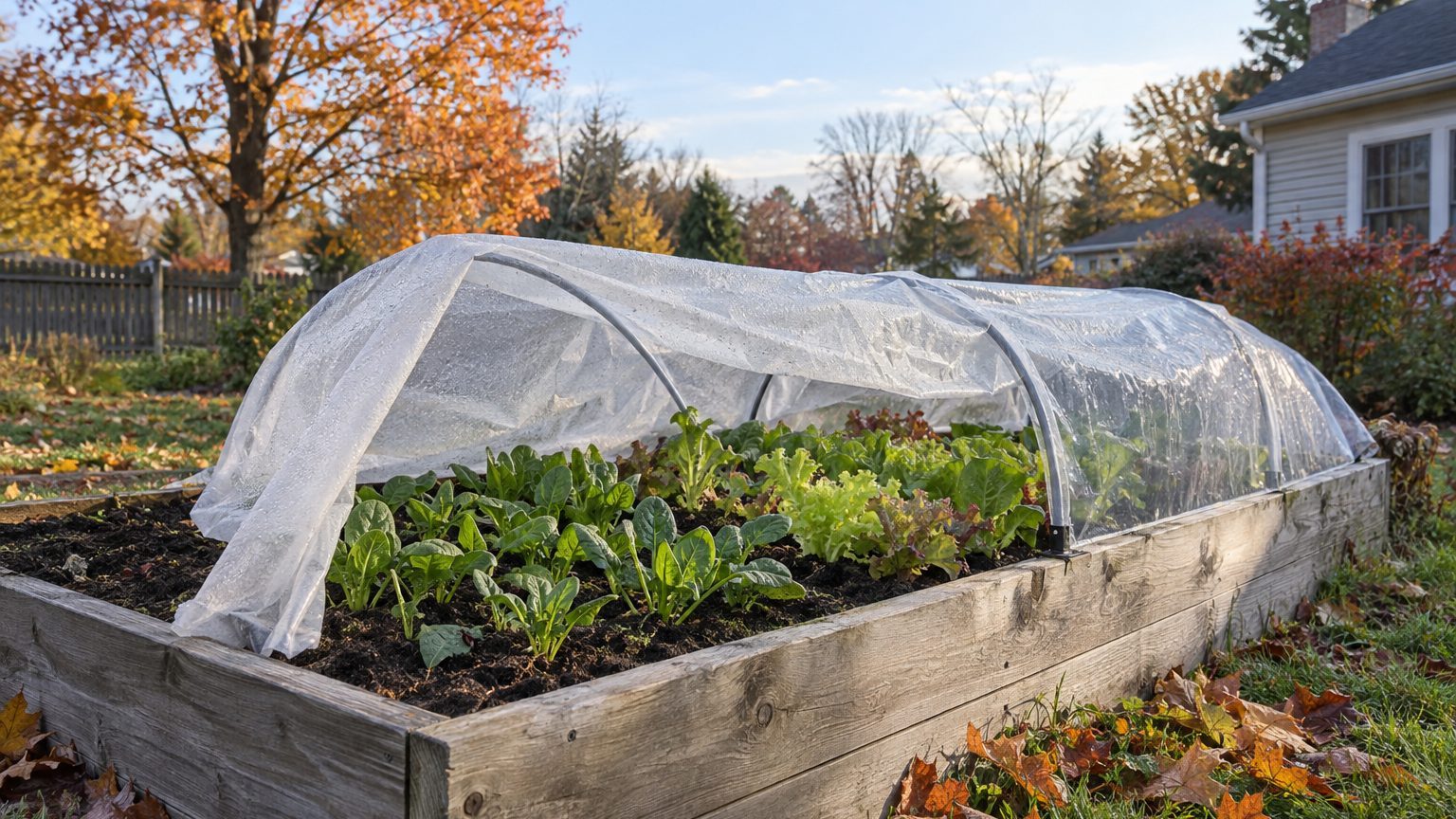

For Nashville, the last spring freeze falls between March 31 and April 12, and the first fall freeze between October 28 and November 8. A cover, a low tunnel or a cold frame can stretch that window at both ends, but only by days or weeks, and the gain depends on how Tennessee’s soil, light and humidity behave. What follows covers the dates first, then the limits.
When the soil is warm enough in Tennessee
The date most Tennessee gardeners want is the last spring frost. For Nashville, NOAA’s 1991-2020 Climate Normals (32F freeze probabilities, 30-70% band, station USW00013897) put it between March 31 and April 12. That is a probability, not a promise, and a late cold snap can still arrive after the band closes. The band also belongs to Nashville. East Tennessee and the Cumberland Plateau run cooler and later in spring, so a gardener there should shift every date in this article forward.
Frost is only a proxy
Season extension does not wait for the last frost. It waits for warm soil, and the soil warms after frost risk ends, not alongside it. Air can turn mild by midday in early April while the ground, which holds winter’s chill like a cellar, stays cold enough to stall a seed or sulk a transplant. Seeds that sit in cold, wet soil rot instead of sprouting. Seedlings set into it stop growing for weeks, with roots too chilled to take up water.
The practical test is a soil thermometer pushed to planting depth in the morning, compared against the minimum germination temperature on the seed packet. Cool-season crops (peas, spinach, radishes, many greens) tolerate cold ground and can go in well before the frost band closes. Tomatoes, peppers, squash and beans cannot, and for them the soil reading matters more than the calendar.
What a cover actually does to soil
A cover works by trapping heat. Soil absorbs sun all day, then radiates that warmth back at night. Fabric, plastic or a glazed frame slows the loss, holds a pocket of still air near the plants, and (with a second layer) adds one more barrier between the crop and the open sky. Laid over a bed in the weeks before planting, the same cover also pre-warms the ground, which can bring a planting date forward.
The gain is real but variable. It depends on the material, the wind, how clear the night is, and whether the soil held warmth to begin with. A cover shifts the limit; it does not remove it. A clear, still night after a cold day can take a covered bed down with the uncovered one, so a cover is never a reason to ignore the forecast.
Closed structures bring a second risk. A cold frame shut in spring sun can cook its contents within an hour, even when the air outside is cool. Ventilation is part of keeping the crop alive: prop the lid or open the ends on any sunny morning, and close up again before evening. Everything on this page is passive. No heaters, lamps or candles belong inside a covered structure, because the fire and carbon monoxide risks are not worth a few degrees. For the wider picture, see Extending the Season: What a Cover Buys, and What It Cannot.
How long the season lasts here
Both ends of the frost window come from the same NOAA station, so the subtraction is safe. Counting from the late end of spring to the early end of fall, the Nashville growing window is about 199 days (April 12 to October 28). Counting from the early end of spring to the late end of fall, it is about 222 days (March 31 to November 8). That is roughly 28 to 32 weeks, depending on which way the year breaks.
| Case | Last spring freeze | First fall freeze | Window |
|---|---|---|---|
| Shortest | April 12 | October 28 | about 199 days |
| Longest | March 31 | November 8 | about 222 days |
Frost-free days are not the same as growing days. Early in the window, cool soil slows everything down, and near its end, shorter days do the same. The count describes how long a bed can stay uncovered, not how long it is productive.
What does a window this long allow? Mainly a second sowing. A spring crop of lettuce, beets or beans can finish and be followed by another planted in late summer, which then matures in the cooler weeks before the fall freeze. The window is long enough that a gardener who plans for succession gets two harvests from the same bed instead of one, and the succession sowing guide on this site shows how to space those plantings.
It also changes the transplanting question. In a short season, buying or growing starts is the only way to get a heat-loving crop to ripen, and the root check from moving it is a price worth paying. Here, with room to spare, root crops and fast greens can simply go in as seed, with no transplant check at all. Transplants earn their place for the crops that need a head start before summer stress, such as tomatoes and peppers. A cover in March or early April makes that head start safer, and again in October it can carry a late bed past the first light freeze. Neither use changes the fact that a cover moves dates by days or weeks, not by months.
Gardeners on the Cumberland Plateau or in the east should expect a shorter window than these figures, with the first fall freeze often arriving sooner and spring running later.
Heat and water in Tennessee
The brief for this page called for a count of days above 90 F and a summer rainfall total. Neither figure is in the verified data behind this article, and guessing would be worse than leaving them out. For a number measured at a specific station, the NOAA normals linked on the NCEI data service are the place to look, along with the county office of the state extension service.
What heat and humidity mean for a cover
Without the count, the pattern is still familiar to anyone who has gardened here. Summers are hot and humid, and the trouble for a covered bed is trapped heat and trapped moisture. Fabric or plastic left on past late spring raises temperatures around the crop, and still, damp air is where mildew and leaf disease start. A cover that helps in March becomes a liability by June. Pull it, or switch to something that breathes, shades the root zone and lets air move.
Contrast that with the other end of the map. The Extending the Growing Season in Nevada page deals with dry heat and big temperature swings, and the Extending the Growing Season in Manitoba page deals with a season so short that cold limits everything. Tennessee sits between them, and its problem is a long, humid middle.
Light and cold set the winter limit
For winter, the governing facts are light and cold together. Nashville sits at 36.12 degrees north (a figure for that city, not the whole state; gardeners near the northern or southern edge should check their own latitude). At that latitude, daylight falls below what most crops need to grow sometime in late fall and returns in late winter. During that stretch a cover holds a crop alive but does not make it grow. Planting a late bed and expecting winter growth under fabric misreads the sun, not the temperature. Day length also tells an onion when to stop making leaves and start making a bulb, so the onion type matters here as much as the planting date.
The cold side is set by the mean daily minimum of the coldest month, 30.1 F at Nashville, which is just under freezing. Averages hide the cold nights, and the real lows in a hard snap fall well below it. On the milder nights, light fabric over hardy greens is often enough. When a real cold snap arrives, a framed, closed structure (properly vented on sunny days) is the safer choice. The USDA Plant Hardiness Zone Map 2023 spans zones 5b to 8a across Tennessee, a wide range, so judge by your own county and elevation, not by the statewide label.
Which season extension suit Tennessee
Choose by type, not by cultivar name. Tennessee’s facts point three ways. The window is moderately long, summers are hot, and humidity is the background condition of the year. Each of those favors a different kind of tool.
- Floating row cover or light fabric: the right first step for early spring and late fall. It adds a modest, variable gain, breathes, and does not trap enough heat to cook a bed if left on a mild day. It suits the long window here better than anything heavier.
- Low tunnels with hoops: a second layer over a bed, useful for fall greens and for pre-warming soil ahead of spring planting. Vent them on sunny days.
- Cold frames: best for starts and hardy greens in the coldest weeks. A closed frame in spring sun can cook its contents in an hour, so open it daily.
- Shade cloth and mulch: not season extension in the usual sense, but in a hot, humid summer they protect the root zone and carry a second sowing through August.
Disease resistance should be the first criterion when choosing crops to grow under cover. Humid air is the normal condition, and the varieties that shrug off mildew and leaf spot are the ones worth the bed space. Give plants airflow, space them for it, and water at the base, not overhead.
This page names no varieties, and that is deliberate. The only recommendation that means anything is one from trials run in Tennessee’s own soils and climate, and this page does not have those results. The University of Tennessee Institute of Agriculture Extension does, through county offices that know local frost timing, soil, and which crops hold up under humidity. Start there before spending on seed.
Common questions
When can I plant tomatoes in Tennessee?
After the last freeze band closes and the soil has warmed. For Nashville, that band runs from March 31 to April 12, but tomatoes care more about soil than the date. A cover can pre-warm a bed beforehand, and hardening off the transplants still matters.
Is a frost date a guarantee?
No. The Nashville dates are a probability band from the 1991-2020 normals, not a promise. Eastern Tennessee and the Cumberland Plateau run later in spring and earlier in fall, so check local conditions.
Can I grow vegetables through a Tennessee winter?
Hardy greens can survive under fabric or in a vented cold frame, but they will mostly hold, not grow, once daylight drops below what plants need. Nashville’s coldest-month mean minimum is 30.1 F, and cold snaps go lower.
What is the biggest mistake with covers here?
Leaving them closed. A shut frame can overheat within an hour in spring sun, and covers left on into summer trap humid air that encourages disease. Hardiness zones also vary widely, from 5b to 8a statewide, so what works in Nashville may not work in the mountains.