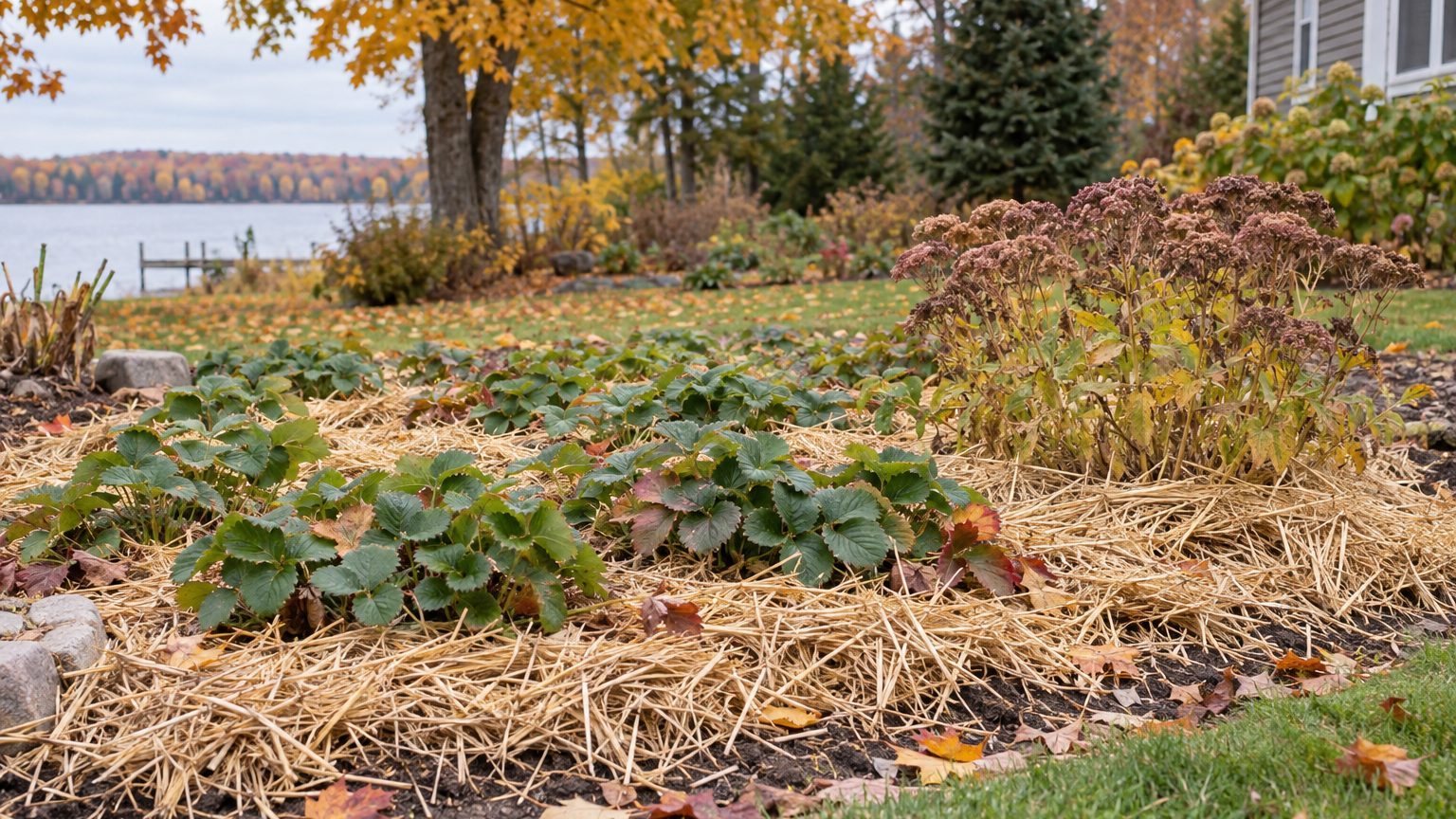

Wait for the freeze. In Nashville, the first fall frost arrives between October 28 and November 8 (NOAA NCEI 1991-2020 Climate Normals, the 30-70% probability band for a 32°F freeze). Winter mulch for strawberries and borderline perennials goes on after that window closes, once the soil surface has actually frozen a few times. Mulch is a blanket for cold soil, not a heater. Spread it early and it traps warmth and moisture, which is how crowns rot and voles move in.
When to put winter mulch down in Tennessee
Most gardeners reach for the mulch in October, when the leaves are down and the beds look finished. That’s too soon. Soil in fall still holds the heat of summer. A clear-night frost kills basil and tomato vines, yet the ground a few inches down stays well above freezing. Mulch laid over that warm, damp soil insulates the wrong thing.
The goal runs opposite to what the word “blanket” suggests. Winter mulch is meant to keep the soil frozen once it freezes, and to hold it steady through a sunny afternoon. Frost heave happens when soil thaws and refreezes, thaws and refreezes, and each cycle lifts shallow roots and crowns a little farther out of the ground.
Middle Tennessee gets plenty of those cycles. NOAA’s 1991-2020 Climate Normals for Nashville put the mean daily minimum of the coldest month at 30.1°F. That’s barely under freezing. Nights dip just below 32 and afternoons climb back above it, so the ground rarely locks up the way it does in the northern states. It flickers between frozen and thawed instead, and that is the pattern that damages plants.
The window, counted from first frost
The same NOAA normals, for the Nashville station, put the first 32°F freeze in a band from October 28 to November 8. A single frost night isn’t the signal, though. Mulch after that first-frost range has passed and the soil surface has frozen on several nights, not before. In practice that means the weeks after the range closes, when forecast lows sit at or below freezing night after night and the crust of the bed is stiff in the morning.
Is it needed at all? For strawberries and for young or borderline plants, yes. Established perennials that are comfortably hardy in your spot can usually go without. Some winters will stay mild, and in those years mulch is still doing quiet work: holding moisture, blocking weeds, and serving as a ready cover for the one night that turns bitter.
Colder ground, earlier start
East Tennessee and the Cumberland Plateau run cooler than Nashville and stay cold later into spring. Their first fall frost arrives earlier than the Nashville range above, so the mulching window opens earlier there, and the uncovering in spring comes later. Look up your own county in First and Last Frost Dates in Tennessee, then count from that date rather than from the calendar page. More seasonal timing for the state lives in the Tennessee guides.
Strawberries
A strawberry plant keeps its growing point in the crown, a short woody stem sitting right at soil level. Nothing protects it. Bare cold can injure the crown directly, and repeated freeze-thaw swings push the whole plant upward until the roots dangle in open air and dry out. A bed that looked fine in December can show a row of lifted, limp plants by February.
That’s why strawberries are the one crop in the garden where winter mulch is close to a standard practice in Tennessee, even with winters as marginal as Nashville’s 30.1°F coldest-month minimum (NOAA NCEI 1991-2020 normals). The mulch doesn’t need to keep the plants warm. It only needs to keep the soil temperature from swinging.
What to use and how deep
Clean straw is the standard choice. “Clean” matters: hay is full of seed heads and will seed the bed with grass and weeds, while straw is the stalk left after the grain is harvested. Fluffy, loose straw lets air move and sheds water. Shredded leaves can work but pack down when wet, and whole leaves mat into a slimy sheet.
FACTS give no strawberry-specific depth, so the best anchor is the NC State Extension Gardener Handbook (chapter 11), which says: “A 2-inch to 3-inch layer of mulch suppresses most annual weed seeds and makes it easy to hand-pull any that do germinate.” That range is the ceiling to respect. Straw fluffs up and looks deeper than it is, so measure after you’ve spread it and resist the urge to keep piling. A loose cover that hides the crowns and most of the leaves is the target. More straw doesn’t add protection, it adds rot.
Pulling it back in spring
Uncovering is half the job. Strawberries start growing before the last frost is safely behind you, and plants buried under straw turn pale and yellow as new leaves stretch toward light. Pull the straw off the crowns when you see that first pale growth, and rake it into the aisles. It becomes a path mulch that keeps berries off the dirt. Keep the extra within reach, because a late frost during bloom can kill the flowers, and a quick covering of straw on a cold night saves the crop. In East Tennessee and on the Cumberland Plateau, where spring runs later than in Nashville, wait longer before uncovering. The full growing calendar is in Growing Strawberries.
Perennials and borderline plants
Not every perennial needs winter mulch. A plant that is well within its hardiness range, and has been in the ground for a few years, will usually shrug off a Tennessee winter. The USDA Plant Hardiness Zone Map (2023 edition, built on the average annual extreme minimum temperature from 1991-2020) places the state in zones 5b to 8a. That’s a wide span, and it differs a lot between East Tennessee ridges and the Nashville basin, so check your own location rather than assuming the state average.
Three groups gain the most. Perennials planted this fall, whose roots haven’t anchored yet, are the easiest for heaving to lift. Shallow-rooted plants, such as coral bells and garden mums, tend to push up out of the soil even when they are hardy. And borderline plants, those rated near the cold edge of your zone, benefit from the evened-out soil temperature. Herbs like rosemary fall into that last category in much of the state, and Getting Perennial Herbs Through the Winter covers how to treat them.
A ring, not a pile
Mulch goes around the crown in a ring, not on top of it. Piled against stems, it holds moisture on the bark and the base of the plant, which invites rot and gives rodents a covered way to the tender tissue. Leave a collar of bare soil touching the crown, and spread the mulch outward from there.
On depth, the same NC State handbook gives a second line, written about trees: “Provide a 3-inch layer of mulch to reduce water loss and maintain uniform soil moisture and temperature around roots.” Between the two quotes, the pattern is clear: a layer of 2 to 3 inches in a ring around the crown, never a mound over it. Don’t stretch the range upward. Deep mulch is how a ring turns into a volcano, and the details of getting it right are in Mulching Without Killing the Plant.
Shredded leaves, pine straw and shredded bark all work for perennials. Whatever you choose, apply it on the same schedule as the strawberries: after the first-frost window and after the soil surface has begun freezing. Pull the ring back from the crown in spring as new growth appears.
What goes wrong
Mulching too early is the most common mistake, and it looks harmless. Spread over warm October soil, mulch holds heat and moisture against the crown. Come spring, the plant looks mushy at the base or never leafs out. Prevention is simple: hold off until the first-frost range of October 28 to November 8 (Nashville, NOAA NCEI 1991-2020) is behind you and the surface has frozen repeatedly. Colder parts of the state, where the first frost lands earlier, move that wait earlier too.
Matting is the second problem. Whole leaves, wet grass clippings and fine bark packed deep form a sealed layer that sheds air, not water. Underneath, it stays cold and soggy and breeds fungus. If you can peel the layer off like a wet blanket, it’s too dense. Fluffy straw, shredded leaves and coarse pine straw stay open.
Voles are the third. A thick, undisturbed layer of mulch is exactly what a vole wants: a roof over a tunnel. They chew crowns and bark through the winter, and the damage only shows in spring. Keep mulch to the 2-inch to 3-inch range from NC State, keep it off the stems, and keep the ring tidy so there’s no deep cover to nest in.
Last comes forgetting to uncover. Mulch that stays on into warm weather smothers new growth and holds the soil cold when it should be waking. Uncover as soon as new growth shows, and keep the straw close for a late-frost night. Spring comes later in East Tennessee and on the Cumberland Plateau, so the uncovering date there moves later, too.
Common questions
Can I mulch right after the first frost?
Not yet. A first frost chills the air, but the soil is still warm underneath. In Nashville the first 32°F freeze falls between October 28 and November 8 (NOAA NCEI 1991-2020 normals), and the mulch should wait until the soil surface has started freezing on repeated nights.
Is straw better than leaves for strawberries?
Clean straw is the safer pick. It stays loose and sheds water. Whole wet leaves mat down and hold moisture against the crowns. If you only have leaves, shred them first and keep the layer within the 2-inch to 3-inch range.
Do I need winter mulch if the winter turns out mild?
Nashville’s coldest-month mean minimum is 30.1°F (NOAA NCEI 1991-2020), only a little under freezing. A mild winter reduces the damage but doesn’t remove the freeze-thaw swings, so strawberries and new plantings still benefit. The mulch also holds moisture and blocks weeds, and it’s on hand for any cold snap.
Does East Tennessee mulch earlier than Nashville?
Yes. East Tennessee and the Cumberland Plateau run cooler, so their first fall frost arrives earlier than the Nashville range and mulching starts earlier there. Spring is the reverse: those areas stay cold later, so the straw comes off later.