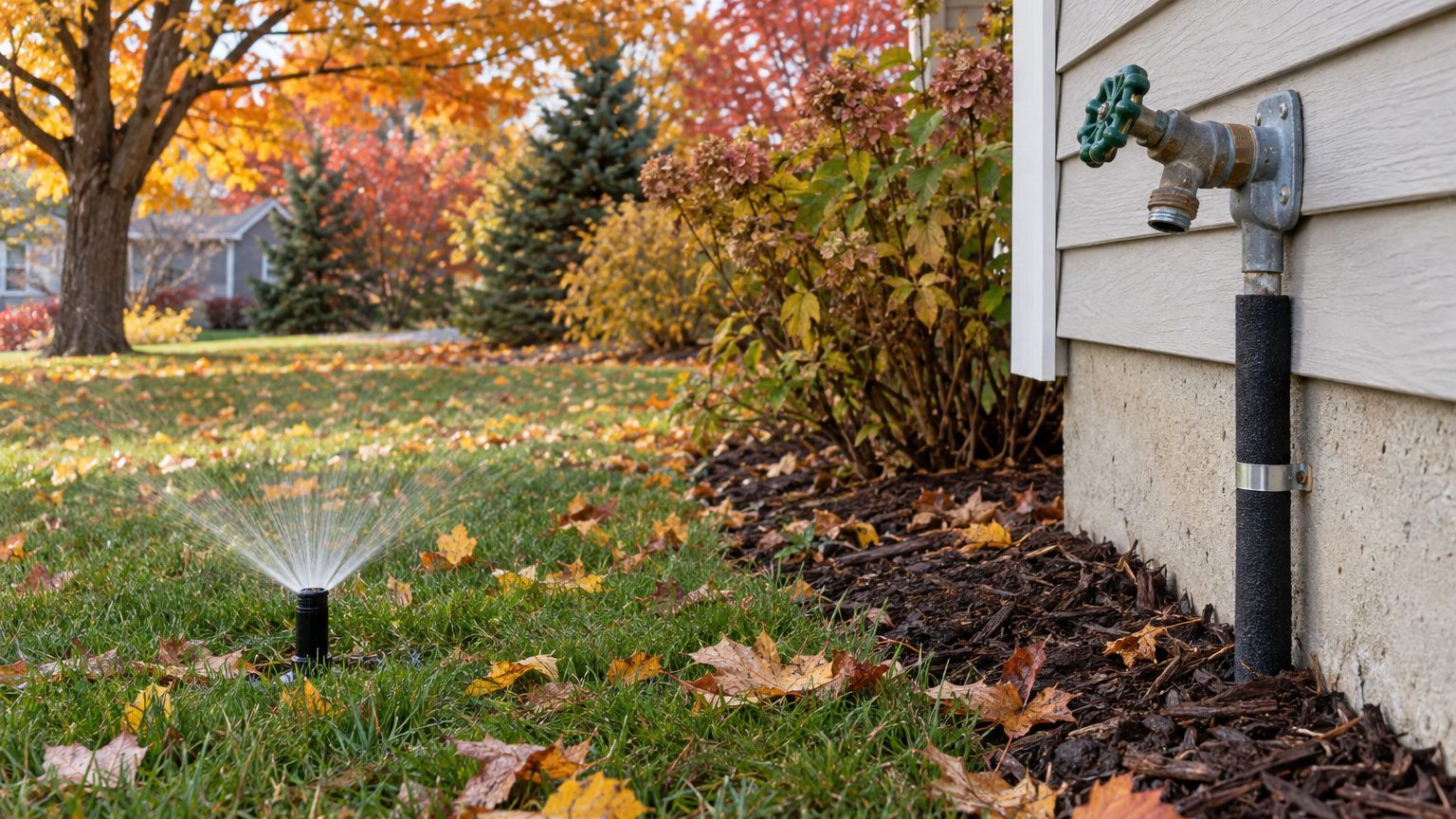

Plan to winterize Tennessee sprinklers and outdoor faucets in the weeks leading up to late October, ahead of the first hard freeze. The Nashville area sets the pace, and cooler ground in East Tennessee and on the Cumberland Plateau runs on an earlier clock. The job takes an afternoon. Skipping it can mean a cracked valve in the yard or a pipe leaking inside a wall by spring.
When to do it in Tennessee
The NOAA NCEI 1991-2020 Climate Normals for Nashville (station USW00013897) put the first fall 32°F freeze in a 30 to 70 percent probability band from October 28 to November 8, so finish winterizing in the weeks before October 28 to November 8. The rule is before the first hard freeze, not after the first light one. A light frost is the warning, and the hard freeze is the deadline you are working against.
Read the band as odds, not a promise. By the early date, the chance that Nashville has already dipped to 32°F sits near 30 percent. By the later date it is near 70 percent. In roughly one fall out of three, then, the first freeze shows up before anyone has touched a valve. With today being October 10, there is still room to work, but not enough to put it off until the weekend a frost advisory appears.
What the winter numbers say
The mean daily minimum in Tennessee’s coldest month is 30.1°F at the Nashville reference station (NOAA NCEI Climate Normals, 1991-2020). That is only a notch under freezing. The average January night is not brutal, but freezing nights are routine, and one stretch of them is plenty to split a fitting that still holds water. The state is not warm enough to skip winterizing. It is mild enough that the cheap steps carry most of the protection.
Those steps are the same everywhere in the state: shut off the water feeding the irrigation system, drain the pipe and the backflow device above ground, disconnect every hose, and let outdoor taps empty. A full compressed-air blowout is one tool among several, and the next section covers when it earns its keep. Many Tennessee systems with working drains can be put to bed without one.
Cooler ground runs earlier
Nashville is the reference, not the whole state. The USDA Plant Hardiness Zone Map (2023 edition) lists Tennessee at 5b to 8a, a system built on the average annual extreme minimum temperature, which tells you the state is far from uniform. East Tennessee and the Cumberland Plateau run cooler than Nashville, and for fall chores that means an earlier first freeze. If you live there, treat the Nashville range as the late edge and aim to be finished before it opens.
The same weeks are when the lawn needs its fall attention, so it makes sense to bundle the chores. The Winterizing Outdoor Faucets Before the First Freeze walkthrough covers the spigot side in detail, Winterizing a Lawn covers the turf, and the other Tennessee guides cover the rest of the seasonal calendar.
Sprinkler lines: drain or blow out
Ice takes up more room than the water it came from. A sprinkler system is a network of buried pipe, fittings, valves and a backflow device above ground, and any of them holding water can be forced apart when it freezes. Rigid fittings and valve bodies usually fail first, with a hairline crack you will not see until the system is pressurized in spring. Buried lines are slow to cool, which is why a single light frost seldom hurts them. The parts above the soil line, including the backflow preventer and its exposed pipe, take the hit first.
Three ways to empty the system
Manual drain means opening small valves at the low points of the lines and letting gravity do the work. It is free and quiet, but it only works if the pipes were laid with a slope toward those valves, and you need to know where they are. Automatic drain valves do the same job on their own: when supply pressure drops, they open and let each zone empty out. They work well until grit holds one open or closed, or until a low spot in a flat yard lets water sit in the pipe anyway.
Compressed-air blowout pushes the water out of each zone with air, one zone at a time, through the heads. It is the most thorough method, and the only dependable one for systems with no drains or lines that dip and rise. The risks are real. Too much pressure can damage heads and fittings, and air should never be sent through a zone with anyone standing over a head. Volume of air matters more than pressure, so a small home compressor is often not up to the job.
| Method | How it works | Best fit | Watch for |
|---|---|---|---|
| Manual drain | Open low-point valves, let gravity empty the lines | Systems built with a slope and labeled drains | Forgetting a valve, or lines that hold water in dips |
| Automatic drain | Valves open when pressure falls | Sloped yards with well-maintained valves | Stuck valves, pooling on flat ground |
| Compressed-air blowout | Air pushes water out zone by zone | Flat lots, systems without drains, any doubt | Excess pressure, too little airflow, working near heads |
Which one Tennessee calls for
With a coldest-month average minimum of 30.1°F at Nashville, hard freezes here come in spells rather than as one long season. That makes a well-built manual or automatic drain system a reasonable choice for many yards. A blowout is the safer option when you do not know how the system drains, when the lot is flat, or when the lines have been repaired or extended over the years. East Tennessee and Plateau yards, with the earlier and colder falls, lean harder toward the thorough method.
Hire a professional when the system has no drains, when you cannot find the valves, when the backflow preventer is complex, or when you do not own a compressor that can move enough air. A service visit costs far less than digging up a cracked zone valve. If you go that route, book the blowout early enough that it is done before the October 28 to November 8 range, since fall schedules fill up, and an early cold snap tends to bring everyone calling at once.
Whichever method you choose, finish by shutting off the irrigation supply, putting the controller in rain or off mode so it does not run dry zones, and draining the backflow device. Leave the drain valves or test cocks partway open so nothing refills during winter.
Outdoor faucets and hoses
A hose left on a spigot is the most common way outdoor taps freeze in a mild climate, and it is the one chore that takes thirty seconds. The routine involves only turning valves and unscrewing hoses, and nothing here calls for tools or pipe work:
- Disconnect every hose, splitter and sprayer, then drain and coil them.
- Close the interior shutoff valve that feeds the outdoor tap, usually in a basement, crawl space or utility room.
- Open the outside tap and leave it open so the line between the two valves can empty.
- If the interior valve has a small bleeder cap, open it briefly to let the last water out, then close it.
That is the full list. If the interior valve is missing, stuck, or drips after you close it, stop there and call a plumber. Cutting pipe, replacing a valve or adding a shutoff is licensed work.
Why a frost-free faucet still fails
A frost-free faucet has a long stem that puts the shutoff seat inside the warm side of the wall. When you close it, the water in the barrel is meant to drain out the spout. Attach a hose, and especially one with a nozzle or a sprayer, and the water is trapped in the barrel with nowhere to go. It freezes in the one part of the faucet that is exposed, and the barrel or the pipe behind it splits. The damage often happens inside the wall, so the first sign is a spray when you open the tap in spring or a stain on the interior drywall.
The faucet also has to tilt slightly downward to drain. If a faucet that has been in place for years sags the other way, it can hold water even without a hose, which is worth mentioning to a plumber at the next visit. The Frost-Free Outdoor Taps page explains how to tell what you have and how to check the slope.
Disconnect every hose before the October 28 to November 8 range opens, even if the faucet is labeled frost-free. In East Tennessee and on the Plateau, where the first freeze can come earlier than in Nashville, do it sooner. A simple foam cover over the spout is a worthwhile extra for older taps, but it works only when the hose is off and the tap is drained.
What goes wrong here
The most common failure is the early cold snap. That 30 to 70 percent band means some autumns bring a hard freeze before the early edge of October 28, and nobody has drained anything because the calendar said there was time. In spring it shows up as a geyser at the backflow preventer when the system is first turned on, or as a zone that will not shut off. The prevention is to treat late October as the deadline and finish by the first cold forecast, not the first freeze.
The forgotten hose is the quiet failure. One hose left on a back spigot, behind the shrubs or around the side of the house, can break the faucet or the pipe inside the wall. You might not notice until the tap is turned on and water drips inside the house, or a wet patch appears on the ceiling below. Walk the whole house, including the garage, crawl space vents and any tap you do not use, before declaring it done. If a pipe has already frozen, the Frozen Pipes page explains what to do and what to leave to a plumber.
The valve box flooding is the failure that hides. Irrigation valves sit in boxes in the lawn, and when those boxes fill with water, the valves sit in it all winter. A cracked valve body is the usual result, and it leaks or sticks open when the system is first run in spring. Open the lid in fall, check that water is not pooling, clear any debris from the bottom, and leave the valves drained. Check the boxes again after heavy rain before the freeze.
When you restart in spring, open the supply valve slowly and walk the yard before running any zone. Spraying water, a wet box, or a hissing connection means shutting it off and calling someone before the problem becomes a flooded yard.
Common questions
Is a blowout necessary in Tennessee?
Not always. A system with properly sloped lines and working manual or automatic drains can be emptied without compressed air. A blowout is the safer option when the system has no drains, when the yard is flat, or when you are unsure how the lines were laid out. The coldest-month average minimum at Nashville is 30.1°F (NOAA NCEI Climate Normals, 1991-2020), so freezing nights are normal enough that guessing is a poor strategy.
Can I wait for the first frost to winterize?
You can wait for the forecast, but not for the frost itself. The Nashville first-freeze band runs from October 28 to November 8, and in some years the freeze arrives before the band begins. A light frost may not hurt buried lines, but it is a signal that the hard freeze is close. Finish before it, not in response to it.
Do I need to winterize if my faucet is frost-free?
Yes, though the job is smaller. Remove the hose, close the interior shutoff if there is one, and let the tap drain. A frost-free faucet still fails when a hose holds water in the barrel, and the sloping of the faucet matters too. Without a hose attached, it generally does what it was built to do.
Does East Tennessee follow the same dates?
Not exactly. The range of October 28 to November 8 comes from the Nashville station. East Tennessee and the Cumberland Plateau run cooler, which pushes the first fall freeze earlier, so the work should be finished sooner there. The USDA Plant Hardiness Zone Map (2023) lists Tennessee as 5b to 8a, and that spread is a reminder that no single date fits the whole state. If your area is colder than Nashville, count the Nashville range as your latest possible window.