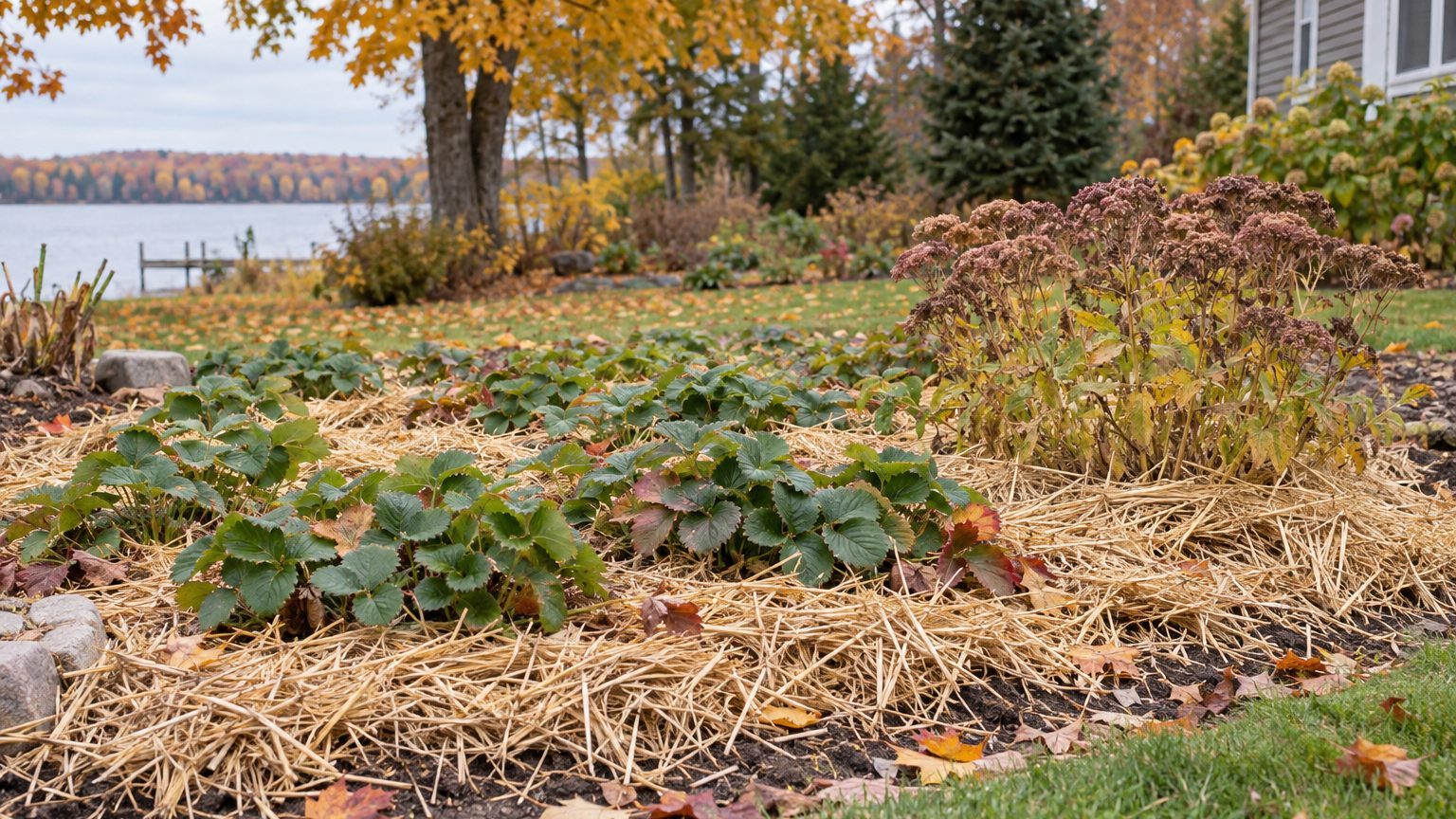

In Oklahoma City, NOAA’s 1991-2020 normals put the first fall 32°F freeze (the stretch where the odds sit between 30 and 70 percent) between October 29 and November 8. Winter mulch for strawberries and borderline perennials goes on after that window, once the soil surface is cold and starting to freeze. Mulch laid earlier is the usual mistake. Gardens outside the city, and those farther north or higher up, tend to freeze sooner, so check your own county.
When to put winter mulch down in Oklahoma
Most gardeners treat winter mulch as a blanket. A blanket keeps you warm because you generate heat. Soil doesn’t, so mulch does something different: it slows the swings. A layer of straw or shredded leaves keeps frozen ground frozen and keeps cold ground from warming up every sunny afternoon. That matters in Oklahoma because the cold here comes in bursts. NOAA’s Climate Normals for Oklahoma City put the mean daily minimum of the coldest month at 27.0°F. Nights routinely dip below freezing, and many days climb back above it.
Those repeated freeze-and-thaw cycles are what hurt plants. Soil expands as it freezes, shrinks as it thaws, and shallow-rooted plants get nudged upward a little each round. Mulch added while the ground is still warm doesn’t prevent that. It just holds in the heat and moisture that make the soil a comfortable home for rot and rodents.
The window to write down
The reference point is the NOAA first-frost range for Oklahoma City: October 29 to November 8. Mulch after that first-freeze window has passed, once nights are holding cold and the top of the soil feels stiff or crusty in the morning. In a typical year that means well into November rather than the end of October. A single light frost doesn’t count as the trigger. You want the soil itself to have chilled down and the plants to have slowed or gone dormant.
Mulching isn’t optional for everything. Strawberries and newly planted or borderline perennials gain a lot from it. Established, locally hardy perennials mostly don’t need winter protection, though a modest layer still helps with moisture and weeds.
Adjusting for your own county
The October 29 to November 8 range comes from the Oklahoma City airport station, and NOAA’s own data tell you it’s a city figure, not a statewide guarantee. Suburban and rural gardens usually see the first fall frost one to two weeks earlier than the airport does, and higher ground sees it earlier still. The colder parts of the state, farther north or at elevation, hit their first freeze sooner, which pulls the mulching window earlier too. The rule stays the same: after the first hard freeze, not before it. For your local numbers, the guide to first and last frost dates in Oklahoma is the place to start.
Strawberries
Strawberry crowns sit right at the soil surface, with almost nothing to shield them. That’s why they’re the plant most worth mulching in an Oklahoma winter. A hard freeze after a mild spell can lift the crown and shallow roots out of the ground, leaving them exposed to drying wind and cold air. A bed that looked fine in December can look dead in March, and the cause is often heaving and exposure rather than disease.
Bare cold does its own damage. Crowns that go through the coldest nights with no cover risk injury to the growing point, which is where next season’s flowers form. Mulch softens the temperature swings and keeps the soil from cycling between frozen and thawed. For a broader look at the crop, see growing strawberries.
What to use and how deep
Clean straw is the standard choice. It’s light, it doesn’t pack down as tightly as wet leaves, and it lets some air through. “Clean” is the key word. Straw is the stalk left after grain is harvested, while hay is cut forage full of seed. Hay brings a crop of weeds into the strawberry bed.
For depth, stay in the range the extension literature gives for mulch generally. The NC State Extension Gardener Handbook says: “A 2-inch to 3-inch layer of mulch suppresses most annual weed seeds and makes it easy to hand-pull any that do germinate.” It’s a North Carolina source written about woody ornamentals, but the depth logic carries over. Loose straw fluffs up when you spread it and then settles, so pile on a little extra and let it compress to roughly that range. Piling it much deeper doesn’t add protection. It makes a soggy mat that holds water against the crowns. Lay it over the plants and between the rows so the whole bed is covered.
Pulling it back in spring
Spread the straw after the October 29 to November 8 first-freeze window has passed, and rake it off the crowns when new leaves begin pushing up through it in late winter or early spring. Pale, yellowish growth under the straw is the signal. Leave the straw in the aisles, not in the compost pile, because Oklahoma springs love a warm week followed by a late freeze, and open blossoms are easily hurt. On a frost night, pull the straw back over the plants, then uncover them the next morning. The straw also keeps ripening berries off the dirt later in the season.
Perennials and borderline plants
The USDA Plant Hardiness Zone Map (2023 edition, built on 1991-2020 normals) puts Oklahoma across zones 6a to 8a. The zone is based on a single variable, the average annual extreme minimum temperature. That means a plant can be fine in Oklahoma City and marginal in a colder pocket of the state. Check the plant tag against your own spot on the map rather than assuming the state is uniform.
Mulch earns its keep on plants that are young, newly divided or planted late, and on those sitting near the edge of their hardiness. Plants in their first winter haven’t built the root systems that tolerate heaving, so they benefit most. Established perennials that are rated well below your local cold can usually go without, though mulch still helps with moisture and weeds.
| Plant type | What mulch does for it | How to apply it |
|---|---|---|
| Newly planted or divided perennials | Keeps roots from heaving out of loose soil | Ring of mulch after the first-freeze window, gap at the crown |
| Garden mums planted in fall | Steadies soil temperature while roots are still settling | Light ring after the ground chills, keep it off the stems |
| Young roses | Protects the lower canes and base from cold swings | Mulch or mound around the base after hard freezes begin |
| Borderline herbs such as rosemary | Moderates soil cold, keeps moisture even | Light mulch, keep it well away from woody stems |
| Established, locally hardy perennials | Mainly moisture and weed control | Optional thin ring, no piling |
Depth follows the same extension guidance as for strawberries. For woody plants, the NC State handbook adds: “Provide a 3-inch layer of mulch to reduce water loss and maintain uniform soil moisture and temperature around roots.” Treat those two sentences as the ceiling, not a starting point. More is not better, and deep mulch is how a neat ring turns into a volcano.
Shape matters as much as depth. Build a ring around the crown, not a pile on it. Pull the mulch back a few inches from stems and crowns so there’s a clear band of bare soil right at the plant. Mulch piled against stems stays wet, which invites rot and gives rodents a covered route to the bark. Lay a ring no deeper than 2 to 3 inches, thinning to nothing at the crown, after the first-freeze window of October 29 to November 8 has passed. For woody plants, the same ring can reach 3 inches.
Herbs get their own treatment in the guide on getting perennial herbs through the winter. Mediterranean herbs hate wet feet, so for them the goal is cold protection without trapped moisture.
What goes wrong
Most winter-mulch failures trace back to timing and depth, not to the material. Four problems account for nearly all of them.
The first is mulching too early. Mulch laid in warm fall weather holds heat in the soil, keeps the plant growing when it should be slowing down, and creates a damp cover where crown rot thrives. The plant looks fine until spring, then collapses. The fix is to hold off until after the first-freeze window of October 29 to November 8 (earlier in colder or higher parts of the state), and to wait for the soil surface to chill.
Mulch that mats is the second. Whole leaves, especially oak and maple, flatten into a wet sheet that blocks air and rots crowns underneath. If you use leaves, shred them first, and favor loose straw over anything that packs. When a rainy stretch has flattened the layer, fluff it with a rake. There’s more on material and depth in mulching without killing the plant.
Voles and mice are the third. A deep layer of straw or leaves in contact with the plant is a ready-made shelter, and rodents will nest there and chew crowns and bark through the winter. Keeping the layer within the 2-to-3-inch range, leaving a gap at the crown, and waiting until the ground is cold all make the setup less inviting. Damage tends to show up as gnawed stems or tunnels running through the mulch.
Forgetting to uncover in spring is the fourth, and the one most people only notice late. Strawberry crowns left buried under straw come up pale and weak, and they may rot or bloom late. Watch for new leaves pushing through, then pull the straw off the crowns. Keep it close by until your last spring frost has passed; the same frost date guide that helps with fall timing covers spring too.
Common questions
Can I mulch strawberries before the first frost to be safe?
It isn’t safer. Straw laid over still-warm soil traps heat and moisture, and the plants stay soft and slow to settle into dormancy. It also gives rodents an early place to move in. Buy or stack the straw in October if you like, and keep it nearby, but spread it after the October 29 to November 8 first-freeze window has passed at the Oklahoma City station. In colder or higher parts of the state, that’s a little earlier.
Do perennials rated for my zone still need winter mulch?
Usually not for cold alone. Established plants that are comfortably hardy where you live handle the winter on their own. A thin ring still helps with weeds and keeps moisture more even, and the NC State handbook’s 2-to-3-inch range for weed suppression applies. Young plants, late plantings and anything near the edge of its range are the ones that really benefit.
Are the Oklahoma City frost dates right for my garden?
They’re a starting point. The October 29 to November 8 range comes from the airport station and describes the city, not the state. Suburban and rural gardens often see the first fall frost one to two weeks earlier, and higher ground earlier still. Your county’s local data, plus what your own garden does, should override the city number. More state-level material is collected in the Oklahoma guides.
Can I use shredded leaves instead of straw?
Shredded leaves work well on perennials, and they cost nothing if you have trees. Shredding is the important step, because whole leaves mat into a wet layer that smothers crowns. For strawberries, straw is still the better pick since it stays loose. Whatever you use, check the layer after heavy fall or winter rain, since a compacted, soggy mulch does more harm than none.