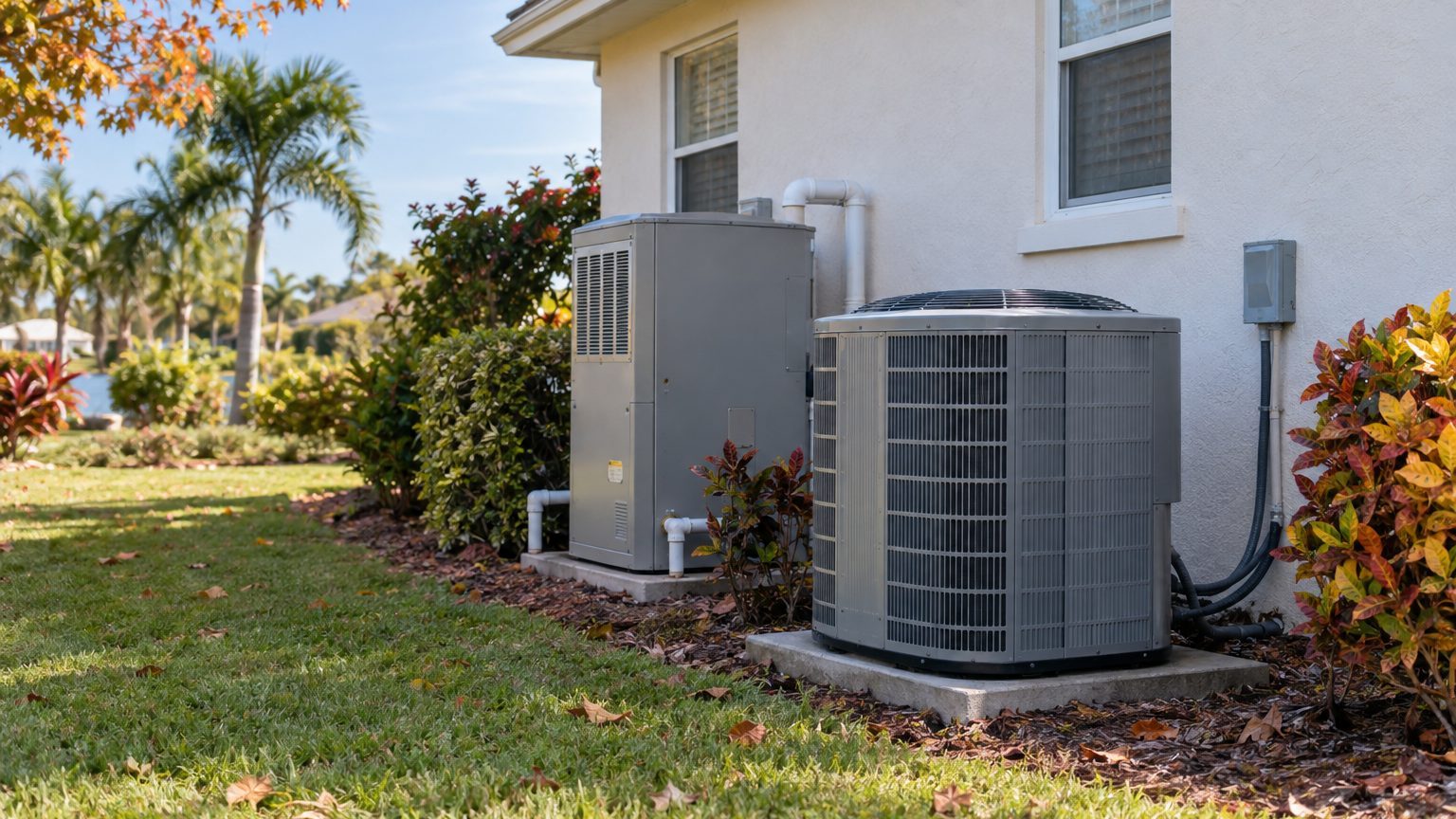

In Oklahoma, a heat pump and a 95% gas furnace cost almost the same to run. The heat pump comes out slightly ahead on the numbers, but the margin is small. Equipment price, air conditioning needs and whether a gas line already reaches the house will usually matter more than the fuel bill.
The short answer for Oklahoma
Per million Btu of heat delivered to the house, the heat pump costs $16.77. A natural gas furnace at 95% AFUE costs $16.96. That puts the heat pump $0.19 per million Btu ahead, a figure computed from EIA average residential prices and ENERGY STAR efficiencies. Electric resistance heat, whether baseboard or an electric furnace, sits far behind at $39.80.
Be clear about what these numbers are. They compare fuels on the same unit of delivered heat. They are not a yearly bill, because that depends on the size of the house, its insulation and the thermostat. They are not the price of the equipment either. The heat pump figure also uses the ENERGY STAR minimum of 8.1 HSPF2, a seasonal average that a better unit can beat and that real cold will pull down on the worst nights.
So the useful reading is this: on running cost alone, treat the heat pump and the high-efficiency gas furnace as a near tie, and let installation cost, cooling needs and existing gas service make the call. What would actually move the result is a rate change, an unusually efficient heat pump, or a house with electric resistance heat today.
What each option costs to run in Oklahoma
| System | Efficiency used | Cost per million Btu delivered |
|---|---|---|
| Electric resistance (baseboard) | 100% efficient | $39.80 |
| Heat pump | 8.1 HSPF2 (seasonal COP about 2.4) | $16.77 |
| Natural gas furnace | 95% AFUE | $16.96 |
The electricity side of the math rests on a statewide residential average of 13.58 cents per kWh, from the U.S. Energy Information Administration’s Electric Power Monthly (Table 5.6.B), covering year-to-date through July 2026. The gas side uses EIA’s average residential natural gas price for Oklahoma, converted at about 1,037 Btu per cubic foot. Both are statewide averages, so a particular utility or rate plan can land above or below them. Your own bill shows your actual rate for each fuel, and fixed monthly charges are not part of this comparison.
Efficiency matters as much as the fuel price because a kilowatt-hour is not worth the same heat in every machine. Resistance heat turns each kilowatt-hour into 3,412 Btu and stops there. A heat pump with a seasonal COP of about 2.4 moves more heat into the house than the electricity it draws, which is how electricity at 13.58 cents ends up delivering heat for less than half the resistance cost. A gas furnace at 95% AFUE wastes only a small share of the gas it burns.
The 8.1 figure is worth understanding before shopping. ENERGY STAR requires at least 8.1 HSPF2 from ducted split systems and single-package units, and 8.5 from non-ducted (ductless) split systems. A ductless unit has no duct losses, so it starts with an advantage and has to be better to earn the same label. HSPF2 rates heating and SEER2 rates cooling, so compare the same letter between two units. The longer story is in What HSPF2 Measures, and Why Ductless Asks for More. Because 8.1 is only the minimum to earn the label, a unit rated higher should beat the $16.77 figure, and that is the number to ask installers about.
How cold it gets, and what that does to a heat pump
The reference station is Oklahoma City Will Rogers airport. NOAA’s 1991-2020 Climate Normals give it about 3,615 heating degree days a year, measured against a 65°F base. Each degree day counts how far a day’s mean temperature sat below 65°F, so the total is a rough measure of how much heating a house needs. The coldest month’s average daily low is 27.0°F. That is below freezing, yet it describes a typical night, not the record cold. Other parts of the state can run colder or milder than this one city, so treat these as reference-city figures.
The $16.77 figure uses a seasonal efficiency, an average across the whole winter. In deep cold a heat pump’s efficiency drops, and it has to work harder to pull heat from outside air. The coldest nights are when that average does not apply, and a backup carries the load. That backup is usually resistance strips built into the air handler, or a gas furnace in a dual-fuel setup. Strips run at the $39.80 rate, which is why the number of very cold hours matters more than the winter’s average temperature. The details of how performance falls off are in How Cold Is Too Cold for a Heat Pump.
No temperature threshold applies to every unit, because models differ in how they hold up in cold. Ask any installer how the specific model performs on the coldest nights and what backup it uses, rather than relying on a single cutoff number. In a state with a 27.0°F coldest-month low, the backup should run only occasionally, which keeps the seasonal average a fair estimate.
What homes in Oklahoma already heat with
The Energy Information Administration’s 2020 Residential Energy Consumption Survey reports that 69% of Oklahoma homes heat mainly with a furnace and 11% with a central heat pump. By fuel, natural gas heats 52% of homes and electricity 39%. These shares describe what was installed, which mostly reflects what fuel was cheap when the houses were built. They are not a recommendation.
The gap between 39% electric and 11% central heat pump suggests a lot of homes use electric heat that is not a heat pump, such as electric furnaces or baseboard. The survey tables here do not split that out, so the exact makeup is unknown. For any house in that group, swapping resistance at $39.80 for a heat pump at $16.77 is a far bigger saving than swapping a gas furnace for a heat pump.
A house without a gas line changes the question altogether. The comparison is then heat pump against resistance, and the heat pump wins easily on running cost. Gas service means a new line and meter, which is a bigger project than a furnace swap.
Boilers and radiators are a different matter. The survey reports no figure for steam or hot-water boilers because too few households were found to publish one, which does not mean none exist. A house with radiators needs a different conversion path, since a standard heat pump does not plug into hot-water piping. If your home runs on a boiler, treat a heat pump as a full system change, not a furnace swap. The survey does not publish a figure for propane (the estimate was suppressed as unreliable) or for fuel oil (too few households), so those fuels fall outside this comparison. For the wider picture, see Heating a Home in Oklahoma.
When the other choice wins
Running cost is only one input, and several situations favor the option that is not cheapest to run.
Start with air conditioning. Oklahoma City logs about 1,867 cooling degree days a year in the NOAA normals, a lot of summer. A heat pump is also an air conditioner, so replacing a failing cooling system and a furnace with one machine often makes more sense than buying a furnace and a separate air conditioner. A house with ducts can take a central heat pump, and one without ducts may suit ductless. Ductless or Central covers that choice.
A dual-fuel setup pairs a heat pump with a gas furnace and uses each where it is cheapest. The heat pump carries the mild stretches and the furnace takes over on the coldest nights, so the backup never has to run on resistance strips. It hedges against price swings in either fuel, though it means maintaining two systems.
An old system with years left is the other case. A furnace that still runs well and is properly maintained may not justify a replacement just to chase a $0.19 per million Btu difference. The decision to repair or replace turns on the age, condition and repair history of the equipment, and Repairing a Furnace or Replacing It walks through it. Where a working gas furnace is in good shape and you have gas service, keep it until it needs replacing, then price a heat pump against a new furnace. Incentives and installed prices vary, so get local quotes before deciding.
Common questions
Is a heat pump really cheaper to run than gas in Oklahoma?
Slightly. EIA-based figures put the heat pump at $16.77 per million Btu delivered and a 95% AFUE gas furnace at $16.96, a difference of $0.19. That is a near tie, and your own utility rates could tip it either way.
Does 8.1 HSPF2 mean a good heat pump?
It means the unit meets the ENERGY STAR minimum for ducted systems. Non-ducted systems must reach 8.5 to earn the same label. Both are floors for earning the label, so higher-rated models should cost less to run than the $16.77 figure.
Will a heat pump keep up on the coldest nights?
The coldest month’s average low at the Oklahoma City reference station is 27.0°F. Heat pump efficiency drops in deep cold, so a backup carries the coldest nights, either resistance strips or a gas furnace. Ask how a specific model and its backup are set up.
What if my house has no gas line?
Then the realistic comparison is a heat pump against electric resistance, at $16.77 against $39.80 per million Btu. Running a new gas line is its own project, so the heat pump is usually the simpler path.