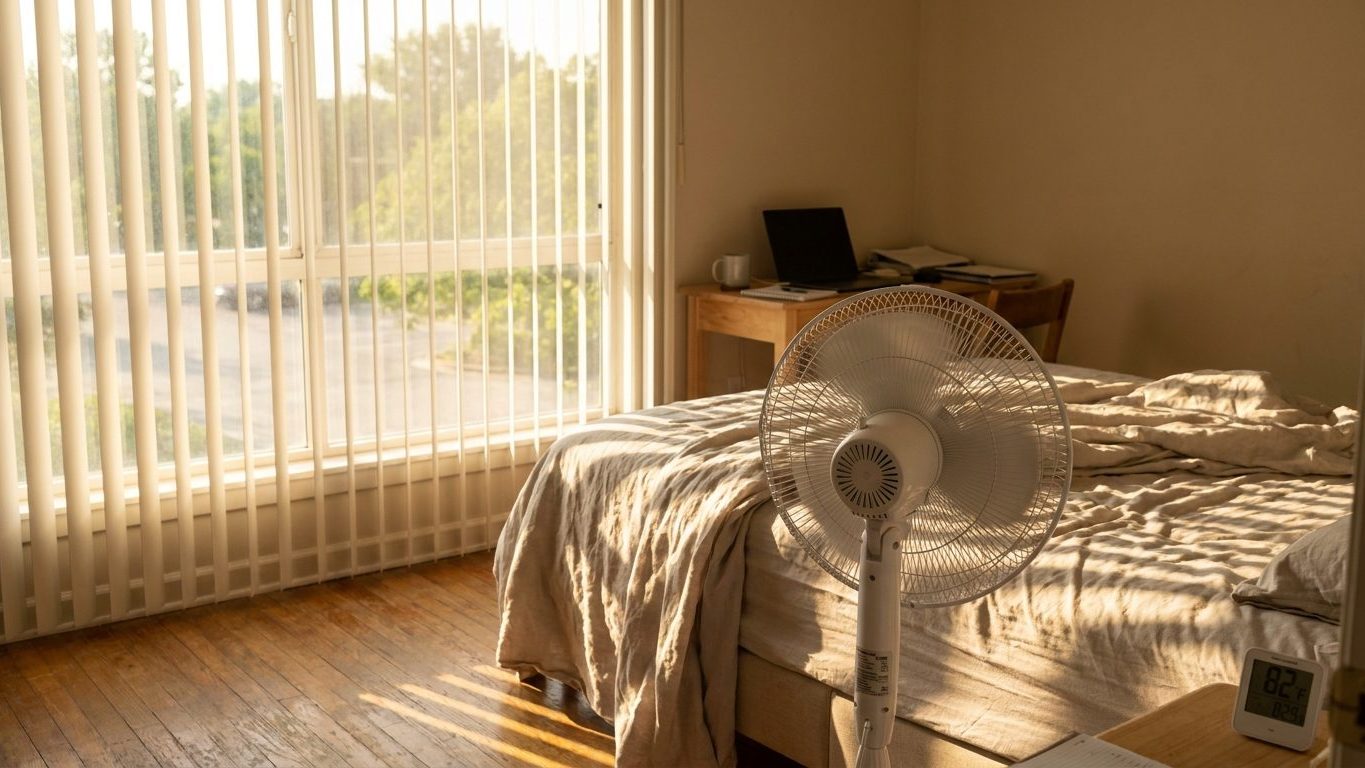

The fastest fix costs nothing: block the sun during the day, then swap the air at night when it’s actually cooler outside than in. Move anything that generates heat out of the room, and point a fan so it pulls that cool night air through rather than just stirring what’s already there. If the room still runs hot after that, a window unit, portable, or mini-split head sized to the square footage is the next step.
What actually removes heat, and what does not
Most advice on this topic blurs three very different things. A fan does not cool a room. It moves air across skin, which speeds up evaporation of sweat and makes a person feel a few degrees cooler, but the air temperature in the room stays exactly where it was. Turn on a fan in an empty room and nothing happens to that room’s heat load. It just gets stirred.
An evaporative cooler, sometimes called a swamp cooler, works on a different principle: it adds moisture to the air, and that evaporation pulls heat out. In a dry climate, that’s genuinely effective. In a humid one, it adds moisture the air can’t absorb, and the room feels heavier and stickier than before. This is a regional tool, not a universal one.
The only device that actually removes heat from a room and rejects it outside is one running a refrigeration cycle: a window unit, a through-the-wall unit, a portable, or a mini-split. That’s the mechanical fact underneath all the marketing language. Everything else in this article, the blinds, the night air, the fan placement, is about reducing how much heat a room accumulates in the first place, so that either no mechanical cooling is needed or a smaller unit can handle what’s left.
How American households actually cool their homes bears this out. According to the U.S. Energy Information Administration’s 2020 Residential Energy Consumption Survey, 89% of U.S. homes use some form of air-conditioning equipment. Of those, 67% run a central system, and 26% rely on individual equipment: a ductless mini-split, a window or wall unit, or a portable. That gap between “has air conditioning” and “has a central system” is exactly the population this guide is written for, the households cooling one room at a time rather than a whole house through ducts.
That share of individual-equipment households varies a lot by state. Connecticut has air conditioning in 90% of homes, but only 34% of them run it centrally, meaning a large share lean on window or portable units room by room. Hawaii runs the other direction: 57% of homes have cooling equipment, and 48% of homes run it as individual units rather than central. In both cases, single-room cooling isn’t a fallback, it’s how a big share of the housing stock actually stays livable in summer.
The free measures, in order of effect
The sequence below matters more than any single tip in it. Do these in order, because each step is undone if the one before it gets skipped.
- Close blinds or curtains on the sunlit side during the day. Keeping heat out beats trying to remove it later. A window facing direct sun for several hours can add more heat to a room than a running lamp, and none of that heat leaves once it’s inside.
- Open the room up at night, once outside air is actually cooler than inside, and shut it again in the morning. This is the step people get backwards. Opening windows too early, while the outside air is still warm, pumps heat into the room instead of taking it out.
- Move heat-producing appliances and lights out of the room. Incandescent bulbs, laptops, game consoles, even a phone charger left plugged in, all release heat continuously. A room with electronics running all day starts every evening with a head start it doesn’t need.
- Use a fan to move that night air through the room rather than around it. Positioned in a window pulling air in, or opposite an open door pushing stale warm air out, a fan turns a passive breeze into real air exchange.
The rule that makes step two work is simple but easy to get wrong: night ventilation only helps while outside is genuinely cooler than inside. In much of the country that window opens sometime after sunset and closes again shortly after sunrise, before the outdoor temperature climbs back past the indoor one. Doing this at the wrong hour, say, opening windows at 4 p.m. because it “feels like evening,” brings heat in rather than out. The whole strategy depends on tracking outside temperature against inside temperature, not on the clock or the calendar.
None of these four steps require any equipment, and together they can knock several degrees off a room that spends the day baking under direct sun. They also determine how much work any mechanical cooling has to do afterward, which affects both comfort and how large a unit actually gets needed.
The equipment options
When the free measures aren’t enough, four kinds of equipment can serve a single room without any ductwork. Each has a different physical requirement and a different weak point.
| Type | What it needs | Does well | Does badly |
|---|---|---|---|
| Window unit | A suitable double-hung or sliding window, structurally able to hold the weight | Strong cooling for the footprint, straightforward install | Blocks that window’s light and view; limited to windows of the right size and shape |
| Through-the-wall unit | An exterior wall opening, usually cut once and used permanently | Frees up the window entirely, stays put year to year | Permanent modification to the wall; not something to move between rooms |
| Portable unit | A nearby window or wall opening for the exhaust hose, a power outlet, and often a condensate drain | Moves between rooms, no permanent install | The exhaust hose loses efficiency over any distance; takes up floor space |
| Ductless mini-split head | An outside wall for the line set, a spot for an outdoor condenser, and dedicated electrical work | Quiet, no window blocked, efficient for the room it serves | Highest upfront installation complexity of the four; typically needs a professional |
Two safety points apply across the first three options, worth saying once. A window unit’s weight rests on the sill and the sash; on an upper floor or a window without adequate support, that weight is a real hazard, not a minor detail. And running any of this equipment off an extension cord, rather than a wall outlet built for the load, is a known cause of overheating cords and, in worse cases, fire. Both belong to the same general rule: cooling equipment is not lightweight, and its power draw is not casual. An electrician or a window’s manufacturer specifications can settle either question for a specific room.
Sizing, and where a mini-split’s outdoor half or a portable’s drain routine fit in day to day, are covered room by room elsewhere in this guide’s window and portable air Conditioner pages. What follows here is the starting point every one of these options shares: matching capacity to the room.
Sizing whatever you choose
Whichever of the four types gets chosen, the same starting chart applies, because it’s about the room’s square footage, not the equipment type. ENERGY STAR publishes it as a direct pairing of area to cooling capacity, measured in BTU per hour:
| Area to be cooled (square feet) | Capacity needed (BTU per hour) |
|---|---|
| 100 up to 150 | 5,000 |
| 150 up to 250 | 6,000 |
| 250 up to 300 | 7,000 |
| 300 up to 350 | 8,000 |
| 350 up to 400 | 9,000 |
| 400 up to 450 | 10,000 |
| 450 up to 550 | 12,000 |
| 550 up to 700 | 14,000 |
| 700 up to 1,000 | 18,000 |
| 1,000 up to 1,200 | 21,000 |
| 1,200 up to 1,400 | 23,000 |
This chart is a starting point published by ENERGY STAR, not a load calculation. It doesn’t factor in ceiling height, how much sun a room gets, or how many people typically use it, because the source itself doesn’t adjust for any of those. A room with a wall of west-facing windows and a room of the same square footage with no direct sun at all land on the same row of this table, even though their actual heat loads differ.
Sizing up “to be safe” is the mistake worth naming directly, because it feels like caution and isn’t. An oversized unit cools the air fast, satisfies its thermostat, and shuts off, over and over, in short cycles. That short-cycling means it never runs long enough to pull humidity out of the air along with the heat. The result is a room that reads cold on a thermometer but feels clammy and damp, which is the opposite of what oversizing was supposed to buy. The right-sized unit, by contrast, runs longer at a lower output and dries the air out as a side effect of doing its job properly.
Common questions
Will a fan actually cool down an empty room overnight?
No. A fan moves air; it doesn’t remove heat. Left running in a closed, unoccupied room, it does nothing to the room’s temperature. It only helps once it’s exchanging air with somewhere cooler, such as pulling in night air from an open window, or helping a person feel cooler through evaporation while they’re in the room.
Does an evaporative cooler work in a humid climate?
Not well. Evaporative cooling depends on dry air absorbing moisture as it evaporates, which pulls heat out in the process. In already-humid air, that evaporation slows or stalls, and the added moisture can make a room feel more uncomfortable rather than less.
What size room can a 5,000 BTU unit handle?
Per the ENERGY STAR chart, 5,000 BTU per hour is rated for 100 up to 150 square feet. That’s a starting point based on floor area alone, not a guarantee for every room of that size, since it doesn’t account for sun exposure or ceiling height.
Is a bigger air Conditioner always better for a hot room?
No, and this is a common misread. An oversized unit cools quickly, shuts off, and cycles on and off frequently, which means it never runs long enough to remove humidity. The room can end up cold and damp instead of comfortably dry, which is why matching capacity to square footage matters more than buying extra capacity as a cushion.