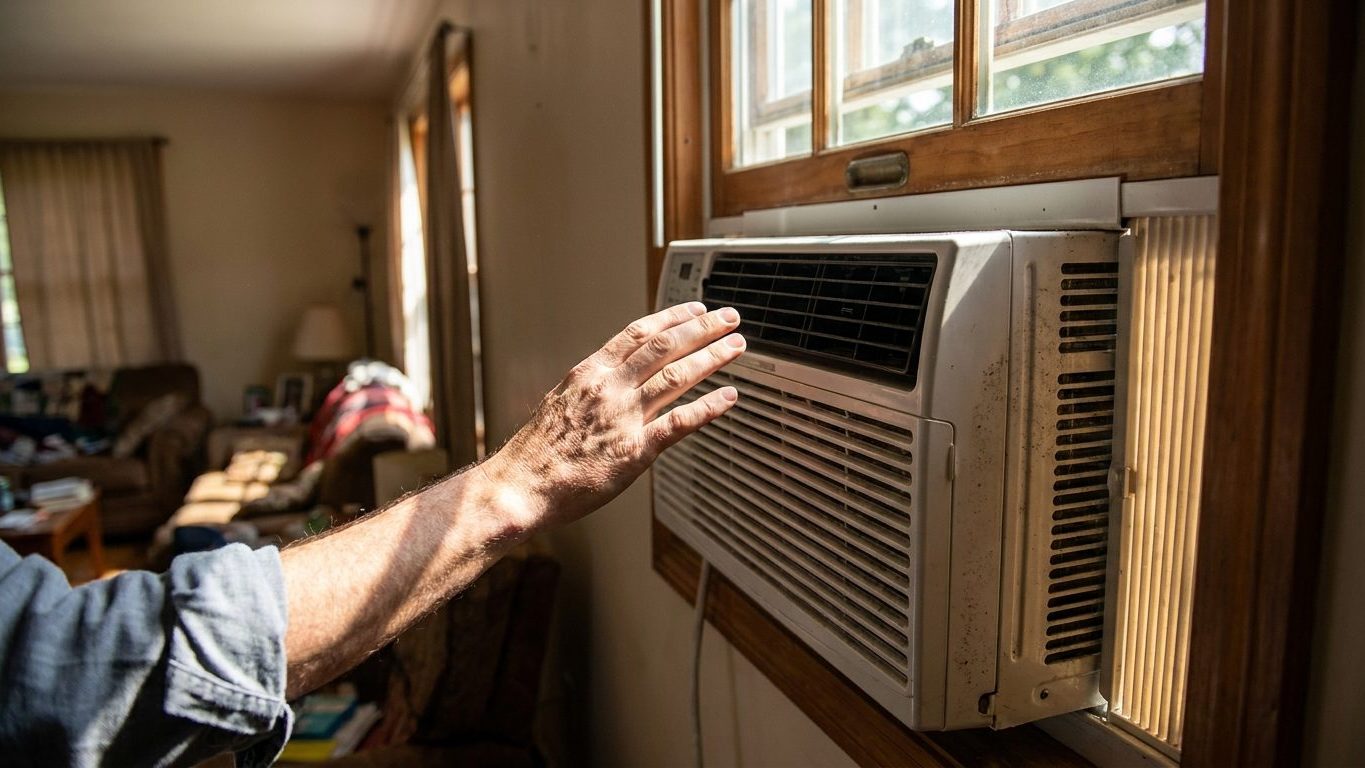

A window air conditioner that won’t cool usually falls into one of two categories: the airflow itself is warm, which points to a blocked filter, a bad mode setting, or a frozen coil, or the air is cold but the room never drops in temperature, which is almost always a sizing mismatch rather than a broken machine. Work through the cheap checks first, in order, before assuming the unit needs service.
Two different complaints
These two complaints get lumped together as “not cooling,” but they point to different problems, and mixing them up wastes time. The first is mechanical: you hold your hand up to the front grille and the air coming out is room temperature or barely cool. Something inside the unit isn’t doing its job. The second is thermal: the air blowing out is genuinely cold, maybe uncomfortably so if you stand right in front of it, but the room as a whole stays hot. That’s a very different situation, and it doesn’t mean the unit is broken.
A room loses cooling faster than the unit can replace it whenever there’s more heat coming in than the compressor can remove. Afternoon sun through an uncovered west-facing window, a kitchen running upstream, a door propped open to a hallway, or simply too much square footage for the BTU rating on the unit will all produce this exact symptom. The air conditioner is working exactly as designed. It’s just outmatched.
This distinction matters because a lot of people start unscrewing panels on a unit that has nothing wrong with it. If the air at the grille is cold, the compressor is running, the refrigerant cycle is functioning, and the electronics are doing their job. What’s failing is the match between the equipment and the room, not the equipment itself. That’s a sizing question, and it’s addressed later in this piece with the actual ENERGY STAR capacity numbers.
If, on the other hand, the air coming out is warm or only faintly cool, the problem is almost certainly inside the machine: restricted airflow, a wrong setting, or a coil that’s iced over and can’t transfer heat anymore. Those are the situations worth troubleshooting, and there’s a specific order to check them in that saves time and avoids unnecessary parts replacement. Figuring out which of the two complaints you actually have takes thirty seconds and determines everything that follows.
The checks, cheapest first
Once you’ve confirmed the air itself is warm, work through these checks from least to most involved. Each one takes a few minutes, and most units turn out to have one of the first three problems on this list rather than anything mechanical.
- The filter. Pull it out and hold it up to a light. If you can’t see light through it, it’s restricting airflow enough to hurt cooling. ENERGY STAR advises to “inspect, clean, or change air filters once a month in your central air conditioner, furnace, and/or heat pump.” That sentence is written for central systems, but the underlying habit applies just as directly to a window unit’s washable filter: check it monthly, rinse it, let it dry fully before reinstalling.
- The front intake. Curtains, blinds, furniture, or a plant pushed too close to the unit will choke the air it needs to pull in. Give it clear space on the room side.
- The outside half. Shrubs, a storm screen, or debris blocking the exterior grille prevent the unit from rejecting heat outside. Walk outside and look.
- The mode setting. It sounds too simple to matter, but a dial or button accidentally left on FAN only will move air without cooling it at all. Confirm it’s set to COOL.
- The setpoint. If the thermostat is set at or above the current room temperature, the compressor may not be running at all. Drop it several degrees below room temperature and listen for the compressor kicking on.
- The fins. Look at the metal fins on the front coil. If they’re bent flat against each other rather than standing in even rows, airflow through them is restricted. A fin comb straightens them.
- The coils themselves. Dust and grime buildup on either coil reduces heat transfer. This is the last item to check because it usually requires removing the front cover, and by this point you’ve already ruled out the faster explanations.
ENERGY STAR notes that “airflow problems can reduce your system’s efficiency by up to 15 percent,” and every item on this list, from a clogged filter to bent fins, is a version of the same airflow restriction. Fixing the cheapest one first is not just about saving money on parts you don’t need. It’s that most units with weak cooling turn out to have nothing more complicated than one of these seven items.
Ice on the coil
If you’ve worked through the list above and found the front coil covered in a layer of ice or frost, that’s worth stopping on, because it’s counterintuitive: a machine that’s supposed to cool your room is instead freezing itself, and the ice is actively making the problem worse. The mechanism is straightforward once you see it. Either too little air is moving across the coil, or the unit is low on refrigerant, and in both cases the coil runs colder than it’s designed to. Moisture in the air freezes onto that cold metal, and once ice starts building up, it blocks the very airflow the coil needs to stay at a normal temperature. The fault feeds itself, and the ice gets thicker the longer the unit keeps trying to run.
The right move is to switch the unit to FAN only, or turn it off entirely, and let the ice melt completely before doing anything else. This can take several hours. Running the compressor while the coil is iced over doesn’t help it catch up. It makes things worse, since the ice is already blocking airflow and adding compressor operation on top of that just deepens the freeze and puts strain on parts that are already struggling. Switching off is the safer and faster path back to normal operation.
Once the coil is fully thawed and dry, go back through the airflow checks: filter, intake, outside grille, fins. If those are all clear and the unit still ices over again once it’s running, the cause is more likely refrigerant related. That’s a real leak, since refrigerant doesn’t get “used up” in a sealed system, and a unit that’s low on it has lost some through a leak somewhere in the lines or coil. That kind of repair involves recovering and recharging refrigerant, which isn’t homeowner work and requires a certified technician. Trying to add refrigerant to a window unit without the right equipment and certification isn’t a workable DIY fix.
Or it was never big enough
If none of the mechanical checks turn up anything, and especially if the unit blows genuinely cold air while the room stays warm, it’s worth stepping back and asking whether the unit was ever sized correctly for the space in the first place. ENERGY STAR publishes a chart matching room square footage to the cooling capacity, measured in BTUs per hour, needed to handle it. It’s a starting point for shopping and troubleshooting, not a substitute for a full load calculation that accounts for ceiling height, sun exposure, or how many people typically use the room.
| Area to be cooled (square feet) | Capacity needed (BTU per hour) |
|---|---|
| 100 up to 150 | 5,000 |
| 150 up to 250 | 6,000 |
| 250 up to 300 | 7,000 |
| 300 up to 350 | 8,000 |
| 350 up to 400 | 9,000 |
| 400 up to 450 | 10,000 |
| 450 up to 550 | 12,000 |
| 550 up to 700 | 14,000 |
| 700 up to 1,000 | 18,000 |
| 1,000 up to 1,200 | 21,000 |
| 1,200 up to 1,400 | 23,000 |
Measure your room and check it against this table. If the unit’s rated capacity sits well below the number listed for your square footage, that mismatch explains a warm room far better than any part inside the machine.
It’s worth noting this cuts both ways. A unit that’s too large for the room isn’t a safety margin, it’s a different fault. An oversized unit cools the air quickly, satisfies the thermostat, and shuts off again before it has run long enough to pull real moisture out of the air. The result is a room that reaches temperature fast but feels cold and clammy rather than comfortable, and people describe that sensation as the air conditioner “not cooling properly” even though the thermometer says otherwise. Matching capacity to the chart in both directions, not just sizing up for safety, is what actually solves this.
Common questions
Why does my window unit blow cold air but the room stays hot?
This is usually a capacity mismatch rather than a fault. Check your room’s square footage against the ENERGY STAR chart above; if the unit’s BTU rating falls short, it simply can’t keep up with the heat entering the room.
Is it safe to run a window air conditioner with ice on the coil?
No. Running it iced up blocks airflow further and can strain the compressor. Switch to FAN only or turn the unit off and let the ice melt fully before checking anything else.
How often should I clean the filter in a window unit?
Monthly is the standard habit, the same rhythm ENERGY STAR recommends for central system filters, applied here to the washable filter built into most window units.
Can a window unit be too big for the room?
Yes, and it’s a real problem, not extra safety margin. An oversized unit cools the air fast, shuts off before removing humidity, and leaves the room feeling cold and clammy rather than comfortable.