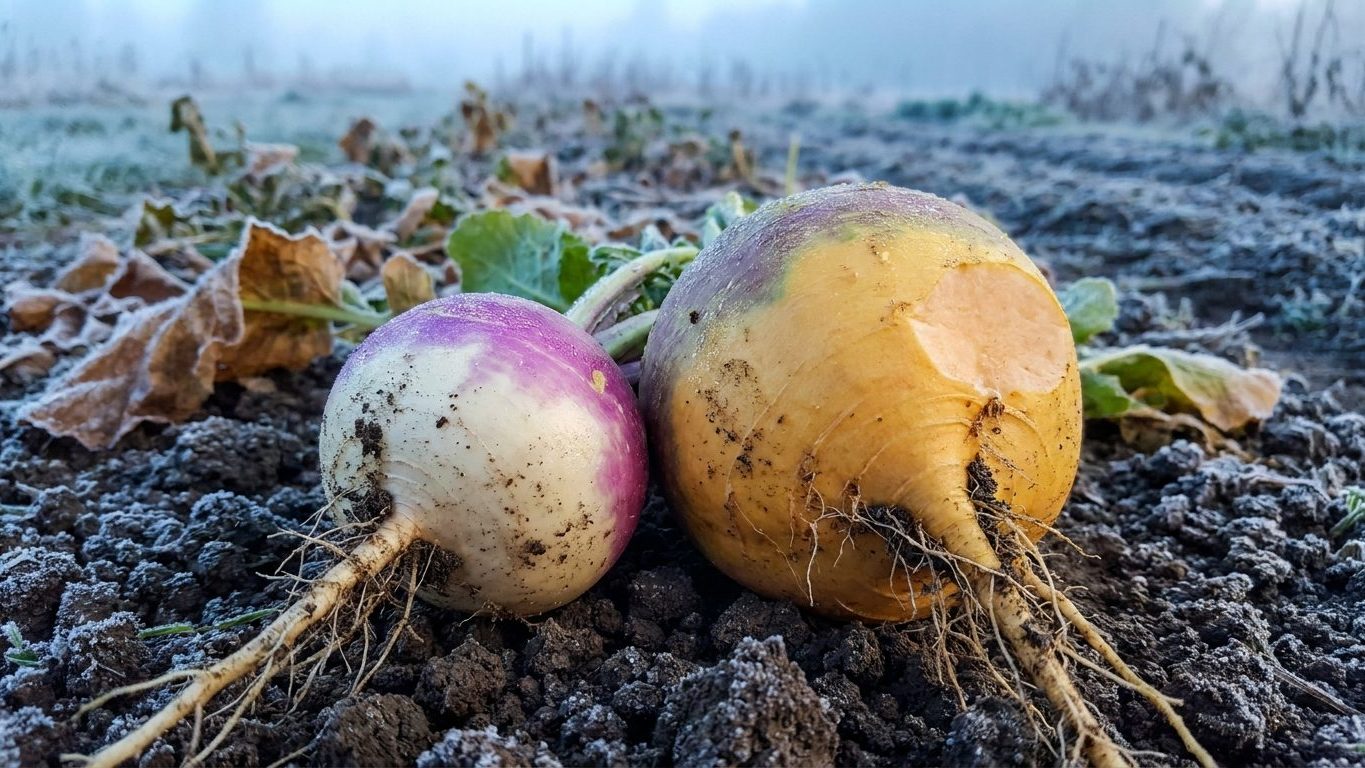

Growing turnips well comes down to two decisions: when you sow, and when you pull them. Salad-type turnips move fast enough for a spring planting, but the crop most gardeners picture when they hear the word “turnip”, and its heavier cousin rutabaga, belongs in the ground through the season’s first hard frosts. That cold snap isn’t a risk to dodge. It’s the ingredient that makes the whole crop worth eating.
Turnip and rutabaga: two crops, not one
Grocery stores bag them side by side, and seed catalogs often list them on facing pages, which is exactly why so many home plots go sideways. A turnip and a rutabaga are related, both brassicas, both root crops raised for the same cool-season window, but they live on completely different clocks. Sow rutabaga on a turnip’s calendar and you’ll lift a fibrous stub not worth peeling. Sow a fast turnip type on a rutabaga’s long timeline and it will have bolted, split, or gone woody long before you get to it.
The turnip is the sprinter. Salad-type turnips can be pulled young and tender within weeks of sowing; larger storage-type turnips take longer but still finish well within a single stretch of mild fall weather. Rutabaga is the marathoner. It needs most of a full growing season of cool conditions to bulk up its dense, yellow-fleshed root, which is why it’s sown earlier in the season and always harvested in fall, never squeezed into a quick spring slot the way a turnip can be.
| Trait | Turnip | Rutabaga |
|---|---|---|
| Time in the ground | Several weeks; can fit a spring or fall slot | Most of a full season; fall harvest only |
| Root size | Small to medium | Noticeably larger and denser |
| Flesh | White or white-and-purple, tender | Yellow-orange, firm and dense |
| Keeping quality | Moderate; best used in weeks, not months | Better suited to longer cold storage |
| Eating character | Mild, sometimes peppery raw | Sweeter, earthier, holds up in roasting and stews |
Skip cultivar names when you’re shopping. What matters more is the type: a fast salad turnip, a storage-style turnip, or a rutabaga variety trialed for your climate. Your state’s extension service publishes lists of varieties tested in local conditions, and that list will serve you better than any name printed on a seed rack three states away.
Storage deserves a plain warning. No root should be assigned a shelf life just because it looks intact when it comes out of the ground. Before you set any turnip or rutabaga aside, run your hands over the whole surface. A soft patch, a spot that weeps when pressed, or any mold at the crown means that root is done, full stop, regardless of how firm the rest of it feels.
One more thing ties both crops together: they’re brassicas, in the same family as cabbage, kale, and mustard. That means they share the same soil-borne diseases and the same insect pressure. Rotating your turnip bed into last year’s cabbage ground isn’t rotation at all, it’s just moving the same problems to a new patch of soil. The rotation guide in this series lays out how far apart brassica plantings actually need to be.
Why frost improves them
Here’s the mechanism that explains almost everything else about growing these roots: as soil temperatures drop, turnips and rutabagas convert some of their stored starch into sugars. It’s a survival response, the plant’s version of antifreeze, protecting root cells from the damage that ice crystals would otherwise cause. The result is a root that tastes measurably milder and sweeter after a few hard frosts than the same root would have tasted if pulled in warm September soil.
That’s worth repeating because it runs against instinct: this isn’t ripening. A tomato ripens as it matures on the vine, building sugar and softening over time regardless of temperature. A turnip or rutabaga does the opposite. It sits at a stable size in cool soil and only shifts its chemistry once cold weather triggers it. Pull it too early, before that shift happens, and you get a root that’s edible but flatter, sometimes almost bitter, compared to what the same plant would have given you two or three weeks later.
That’s the whole reason these are treated as an autumn crop across most of the country, and why a spring planting so often disappoints. A turnip sown in spring matures as the weather warms toward summer, running the clock in the wrong direction: heat pushes it toward bolting and bitterness instead of toward the cold that sweetens it. A fall-timed crop does the opposite by design. You sow so the roots are sizing up just as the weather cools, then let them sit through the first frosts before harvest instead of racing to beat them.
Getting that timing right depends entirely on where you live. The state pages in this guide list average first fall frost dates by region, along with the sowing window that follows from working backward from that date. That’s the number to plan around, not a generic date pulled from a seed packet grown for a different climate.
The same rules from the first section still apply here. Stick to root types rather than specific variety names when you’re choosing seed, and let your state extension service point you to what’s been trialed locally. Don’t judge a stored root as safe just because the skin looks clean; inspect it fully before it goes in the crisper or root cellar. And remember these are brassicas: whatever pest or disease pressure showed up on last year’s cabbage bed is exactly what a turnip or rutabaga planted in that same ground will meet again.
Reading a turnip crop that is going wrong
Most turnip and rutabaga problems announce themselves in the root or the leaf before the harvest ever happens, and the pattern of symptoms usually points toward a starting cause, even if it’s not the final word. Treat the table below as a first read, not a diagnosis.
| What you see | Likely cause | Where to look next |
|---|---|---|
| Woody, fibrous roots | Slow growth from heat or drought stress, or roots left in the ground too long past sizing | Watering and heat-stress guide |
| Forked or branched roots | Compacted, rocky, or recently manured soil disrupting the taproot | Soil preparation guide |
| Split or cracked roots | Uneven moisture, often a dry stretch followed by heavy rain or irrigation | Watering guide |
| Roots that never size up | Overcrowding from missed thinning, low fertility, or too short a cool-season window | Spacing and fertility guide |
| Leaves riddled with small holes | Flea beetles, a common brassica pest | Brassica pest guide |
| Plants running to flower early | Temperature swings, often a heat spell following an early cold snap, or transplants held too long before planting | Bolting guide |
Notice how many of these trace back to soil structure and watering consistency rather than the seed itself. A gardener chasing a pest spray for holed leaves while ignoring compacted soil under a forked root is treating one symptom and missing the other. When two or three of these signs show up together, it’s worth pulling a soil sample or calling your local extension office rather than guessing further from a photo comparison.
Why the answer changes with where you garden
Everything covered so far, sowing window, frost sweetening, storage decisions, funnels down to two local facts: your average first fall frost date, and how cold your coldest month typically runs. Those two numbers do most of the planning for you.
The first frost date sets your sowing window backward. Count back from it by the time your chosen type needs to size up, whether that’s a quick salad turnip or a full-season rutabaga, and that’s roughly when seed should go in the ground. Miss that window in either direction and you either harvest before the sweetening frost arrives or run out of cool weather before the root finishes sizing.
The coldest month decides what happens after harvest. In a region where winter stays reliably cold without much freeze-thaw cycling, turnips and rutabagas can often be left in the ground under a heavy mulch layer and pulled as needed through the season. In a region prone to hard, deep freezes, or one that swings between freezing and thawing repeatedly, roots left in place are more likely to suffer damage or rot than the same roots lifted before the ground locks up and stored under controlled conditions indoors.
The state pages in this guide break both of those numbers down by region, alongside the sowing windows and storage approach that follow from them. Pairing that with your local extension service, which tracks the varieties and practices that actually perform in your specific county, is the difference between a turnip bed that produces on schedule and one that’s guessing at a calendar built for someone else’s climate.
Worth noting: a root sitting under mulch through a steady deep freeze tends to hold up better than the same root left in ground that freezes and thaws repeatedly, since that cycling is what drives moisture into the root and starts the soft spots that end up ruling a harvest out at inspection time.