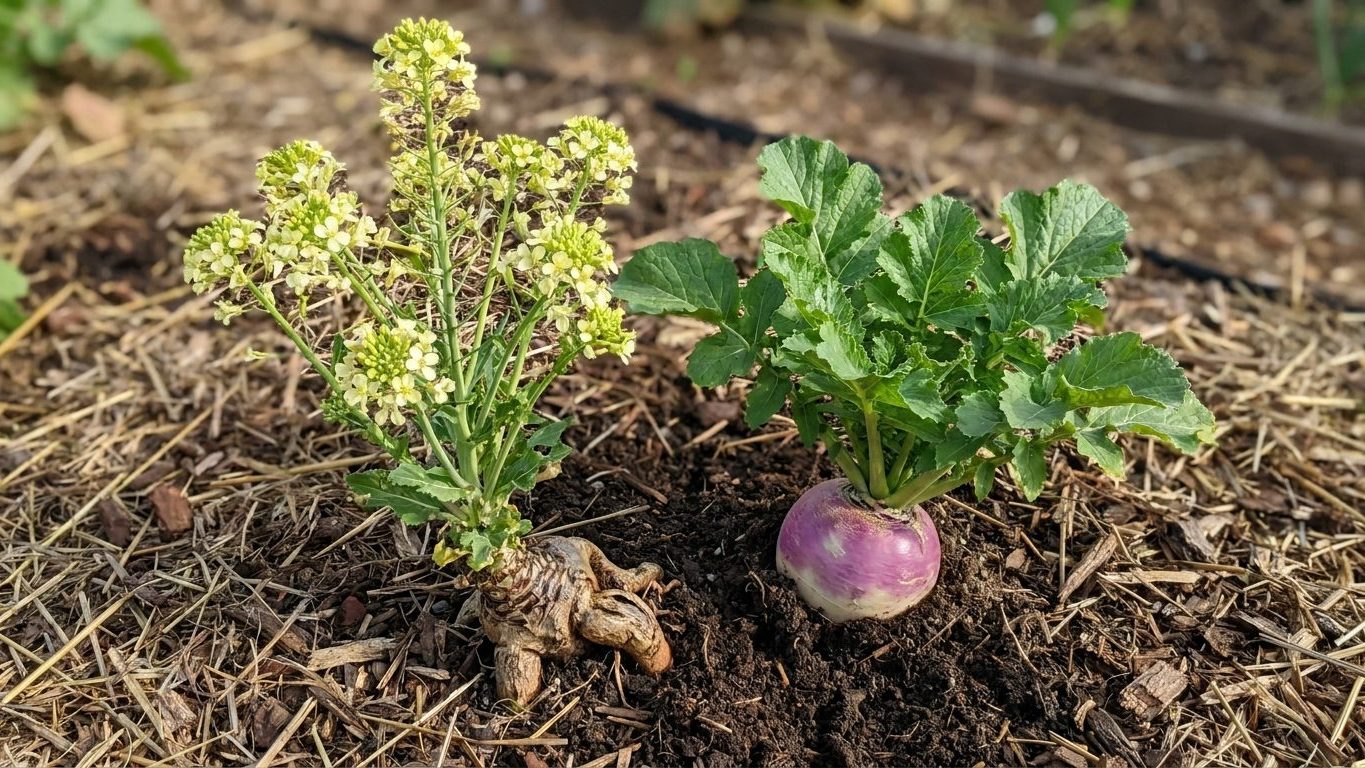

Bolting means a turnip or rutabaga skips root-building and shoots up a flower stalk instead, and the usual trigger isn’t summer heat but a spell of cold the young plant went through earlier. Once that stalk forms, the root turns woody and bitter and won’t recover. The fix is timing the sowing, not fighting the plant afterward.
What is actually going on
The thing to understand here is vernalisation: a young plant chilled for long enough reads it as a winter passed, and flowers when the days lengthen. Turnips and rutabagas are biennials by nature. In the wild, they’re built to grow a root one season, survive winter on that stored energy, then throw up a flower stalk and seed the next spring once the days start stretching out. A garden sowing that gets tricked into thinking it already lived through a winter jumps straight to the flowering step, sometimes within the same season it was planted.
The trick is size and duration. A seedling with only a few true leaves is far more sensitive to a cold stretch than an older plant with a decent root already forming. Roughly speaking, several weeks of chilly nights, the kind that hover in the 40s Fahrenheit, hitting a young seedling is enough to set the flowering switch even if warm weather follows right after. The plant doesn’t bolt during the cold snap. It bolts weeks later, once daylight starts lengthening, which is exactly why gardeners often blame the wrong thing, usually heat, when the real damage happened earlier and colder.
Heat plays a much smaller supporting role. A crop already carrying a stalk will bolt faster in hot, dry stretches, and heat stress alone can push a marginal plant over the edge in some seasons. But heat rarely starts the process on its own the way a cold snap on a young seedling does. That distinction matters because it changes what a gardener should actually watch for: not the thermometer in July, but the weather a seedling lived through back in March or April.
Turnips and rutabagas are brassicas, in the same family as cabbage, kale, and mustard. That matters here because the same cold sensitivity and flowering trigger shows up across the whole family, and because these crops share pests and diseases with the rest of it. A bed that grew cabbage or kale the season before isn’t a fresh start for turnips or rutabaga. If rotation isn’t already part of the planning, it’s worth checking the rotation guide on this site before deciding where this year’s crop goes in.
Storage sits downstream of all this, and it’s worth saying plainly: a root that’s already put its energy into a flower stalk instead of the root itself won’t store the same way, and no amount of careful cellar work fixes that. Whether a root is sound for keeping comes down to inspection, not looks alone. A soft patch, a weeping spot, or a moldy crown ends the question regardless of how good the rest of the root appears.
In the garden
Timing is most of the answer, and the same seed sown two months apart can behave completely differently. A spring sowing puts a tender seedling right in the path of the last cold snaps of the season. A late-summer sowing, aimed at a fall harvest, grows into cooler weather as an already-established plant, which is far less vulnerable, and then meets shortening days rather than lengthening ones, so the flowering trigger never really engages.
Comparing sowing windows and what goes wrong
| Sowing approach | What happens | Where it goes wrong | What to do instead |
|---|---|---|---|
| Early spring direct sowing, right after the ground can be worked | Seedlings emerge into a stretch of cool nights while still small | A prolonged cold spell on young seedlings sets the flowering switch, which shows up weeks later as a stalk instead of a root | Wait until the local extension-recommended window, once the coldest nights are behind, even if that means sowing later than feels necessary |
| Transplants started indoors and set out early | Small plants get hardened off and moved outside while nights are still cold | Transplants are often already at the size most sensitive to chilling, so an early move outdoors does more harm than starting from seed later would | Hold transplants indoors longer, or skip transplanting altogether since these crops generally do better direct-sown |
| Summer sowing for a fall crop | Seedlings grow through warm weather into an established plant before cool nights arrive | Sown too late, the crop runs out of season before the root has bulked up, especially in shorter-season regions | Count backward from the first expected fall frost using the timing your state extension service lists for the crop, and sow with margin to spare |
| A crop already bolting | A visible stalk starts forming from the center | Gardeners often wait, hoping the root will still fill out, and lose the whole crop to a stringy, bitter center | Pull and use what’s there once a stalk is visible; the root won’t improve from that point forward |
Spacing and stress add a secondary layer on top of temperature. A seedling that’s crowded, short on water, or checked hard by a transplant shock is already under strain, and strain on top of a cold spell makes bolting more likely, not less. Keeping seedlings evenly watered and thinned early removes one variable from a situation where temperature is already doing most of the damage.
Mulch and row cover show up a lot in garden advice for this problem, and they do help, but only in the sense of buffering soil and air temperature around young plants during a cold stretch, not as a guarantee. They’re a practice, not a fix. The same goes for any pest control used on the crop through the season: treat what’s actually present, follow the label directions on the product, and remember these plants share their pest and disease pressures with the rest of the cabbage family, so a control decision made here often needs to account for what else is growing nearby.
What it depends on where you are
Everything above about vernalisation is biology, and it holds everywhere turnips and rutabagas are grown. What changes by region is the calendar: how long the cold season runs, how fast spring warms up, how much of a summer heat stretch sits in the middle of the growing year, and how much rain falls during it. Those four things together decide whether a spring sowing has a real shot at avoiding a cold snap, whether a fall sowing has enough season left to bulk up a root before frost ends things, and how much buffering a gardener needs to build in either way.
A region with a short, mild spring and a long, gentle fall gives a lot of room for a summer sowing timed toward autumn harvest, which is usually the safer route for both these crops regardless of where you garden. A region where spring temperatures swing hard, warm one week and frosty the next, makes early spring sowing a genuine gamble even for an experienced gardener, since one bad week is often all it takes. Summer rainfall and heat matter too: a hot, dry stretch midseason stresses an already-bolting plant faster, and it can push a marginal seedling toward flowering when a cooler, wetter summer wouldn’t have.
This page can’t tell a reader in one state what the last frost date looks like in another, and general planting calendars printed nationally tend to average that variation away, which makes them wrong somewhere by definition. That’s exactly the gap state-level guides are meant to fill, and the state pages on this site are built to answer the seasonal timing question with the specifics a national page can’t responsibly guess at.
Beyond that, a state’s Cooperative Extension Service is worth using directly, since their trial data covers what actually performs in local soil and weather, right down to which sowing windows hold up in a given county. The USDA maintains the national framework those state services work from, but the practical, ground-level advice comes from the state office itself.
The mistake that costs the most
The single costliest mistake is sowing too early in spring because the calendar says it’s technically possible, not because the weather actually supports it. The seed packet says a date, the ground has thawed enough to work, and the sowing goes in. Weeks later, once the seedlings are established and the weather has genuinely warmed up, a stalk shows up in the middle of what should have been a root crop, and the gardener has no idea why, because the warm weather right in front of them looks nothing like the cause.
That disconnect is exactly what makes the mistake expensive. The damage happens during a cold stretch the gardener has already forgotten about by the time the bolting shows up, so the lesson doesn’t land, and the same early sowing date gets repeated the following spring with the same result. A gardener chasing an earlier harvest by sowing at the first sign of workable soil is, more often than not, trading that head start for a crop that never fills out its root at all.
The fix isn’t complicated, just less eager than it feels: sow spring turnips and rutabaga on the later side of the window a state extension service lists for the area, after the run of unstable cold nights has genuinely passed, rather than at the earliest theoretical date. For most home gardens, leaning on a summer sowing aimed at a fall harvest sidesteps the whole problem, since that timing runs into shortening days instead of lengthening ones and never really triggers the flowering switch to begin with.
One more thing worth carrying into that decision: wherever this crop lands in the rotation, it shouldn’t follow cabbage, kale, or mustard, since bolting isn’t the only thing turnips and rutabaga share with the rest of the brassica family. The pests and diseases travel with the family too, and a rotation plan that ignores that has protected the crop from cold timing only to expose it to a different set of problems already waiting in that same bed.