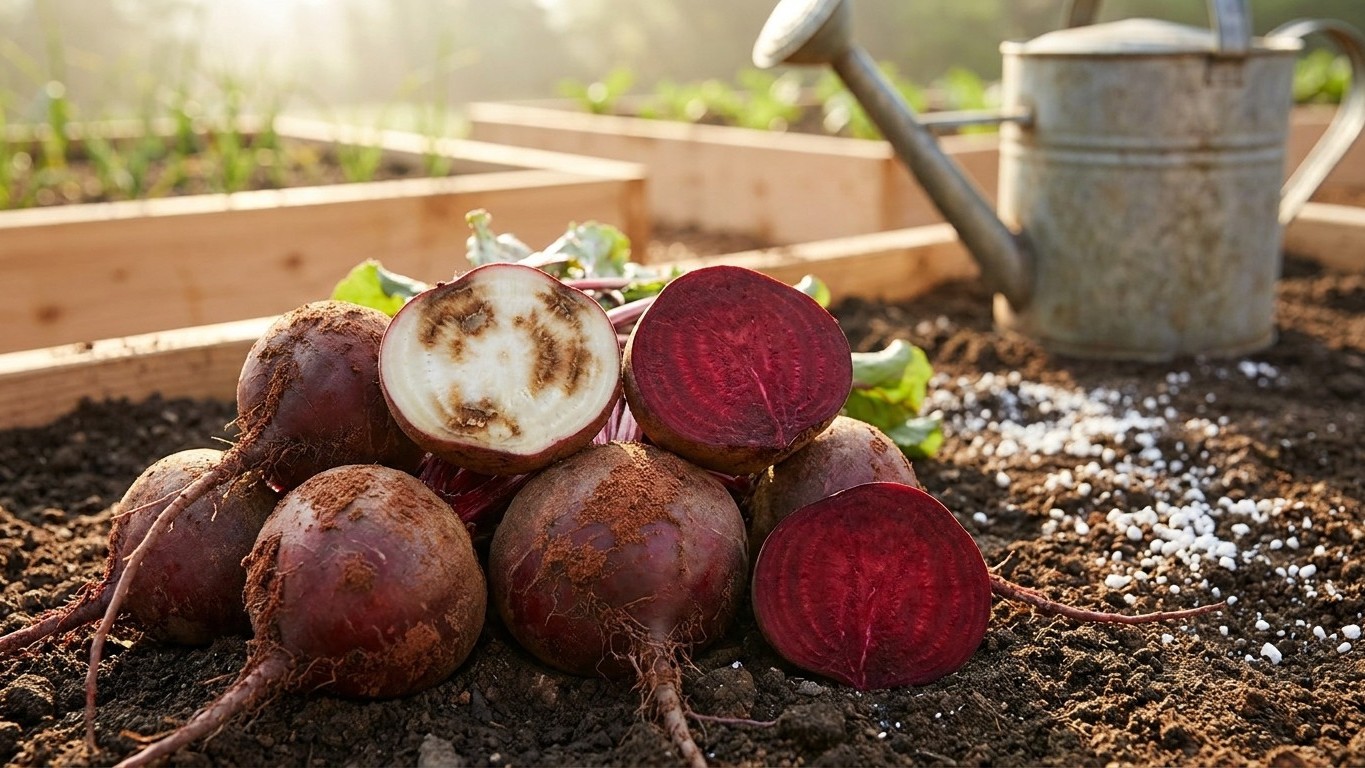

Pull beets 60 to 80 days after seeding, and plan to be done before summer heat and dry spells can toughen the roots. For storage, trim the tops right away and hold the roots at 33 to 36 F, not at the lowest temperature you can manage. That last part runs against what works for carrots, parsnips and most other root crops. Rhode Island’s soil and spring shape how the first part plays out.
The short answer
Start with the ground. The soil USDA lists as representative of Rhode Island is the Narragansett series, an Inceptisol, meaning a young soil that has not yet developed strong layers. Its surface horizon averages 34 percent sand, 6 percent clay and 60 percent silt, which puts it in the loam-to-silt range. It holds about 4.0 percent organic matter, runs a surface pH of about 5.3 (strongly acid), and is well drained. Those are USDA’s representative values for the mapped surface, not a reading from a worked garden bed. A state spans hundreds of soil series, so treat this as a starting point. River bottoms, hill country and any lot a builder has scraped or filled can differ completely.
What that soil means for a beet
Utah State University Extension describes the beet’s ideal as deep, sandy, well-drained soil rich in organic matter. Narragansett has the drainage and a decent organic-matter number, but it is mostly silt, not sand. A silty, well-drained soil lets extra water pass through. That makes it easy to miss a dry week without noticing, and the same extension source says water stress in the first 6 weeks causes premature flowering. The strongly acid surface pH is where your own soil test earns its fee. The figure above is the series average, not your pH, and a lab number for your bed will tell you whether lime belongs in the plan. The Beet Soil in Rhode Island: What the Root Will Meet page goes deeper on that.
Heat and the woody root
Woodiness is a separate problem from early flowering. Utah State Extension ties it to heat above 85 F combined with water stress, which hits roots that are already sizing up, not seedlings. How often the reference airport station passes 90 F in a year is not published in the figures behind this page, so I won’t guess at a count. The 85 F line is what matters anyway, and it sits below 90. The practical rule is that a spring sowing is best pulled before the first sustained hot, dry stretch, and a root left in the ground through one is a gamble.
Pulling for storage
If the roots are headed for storage, the handling matters as much as the date. Top them first. Bunched beets with leaves attached last only 10 to 14 days. Then keep the cold in check, which the next two sections cover in detail. Looking for a broader planting overview? Growing Beets in Rhode Island covers the whole season.
The six weeks that decide it here
Beets are sown in place, so the clock starts at seeding, never at a transplant. The usual advice is to sow 2 to 3 weeks before the last spring frost. At the reference airport station, NOAA NCEI’s 1991-2020 normals put the last 32 F freeze between April 7 and April 17 (the 30 to 70 percent probability band). Count back and sowing falls roughly between March 17 and April 3. Add six weeks and the critical window runs from late April to mid-May at the outer ends.
That stretch of a Rhode Island spring tends to swing. Cool, damp spells alternate with brief warm, dry ones, and the ocean slows warm-up near the coast. The normals I’m working from carry frost dates, not rainfall totals, so I can’t tell you how many dry days to expect. The pattern is enough to locate the risk, though. Bolting here comes from a dry spell landing inside those six weeks, on a soil that drains freely. A damp March can lull you into skipping the hose in late April, and that is when the water stress that triggers premature flowering sneaks in.
Those dates come from an airport station, and suburban and rural gardens typically see their last spring frost later, often by one to two weeks, and more at elevation. Check your own county before you pin a date to the calendar. A garden in the hills may start a week or two behind the reference figure, and the whole schedule slides with it.
Run the arithmetic on a 60 to 80 day crop. Seeded between March 17 and April 3, beets are ready to pull from about May 16 to June 22. That is my back-of-envelope range from the figures above, not a published harvest window. It does show the point: a spring sowing here can be finished before the heat that makes roots woody gets going, if the sowing happened on time. Sow late and you push the crop into the weeks when 85 F days become likely. The What Eats Beet in Rhode Island, and When page covers what shows up in the same weeks.
What goes wrong here
- Bolting in a dry spring. Water stress in the first 6 weeks causes premature flowering, and well-drained ground makes it easy to run short. Water on a schedule from seeding through week six, and check the soil a few inches down, not just the surface.
- Woody roots in summer heat. Heat above 85 F with water stress makes the root woody. This is a later failure than bolting, with a different cause. Pull spring roots before a sustained hot spell, and keep water steady while the roots size up.
- Crusting and a thin stand. Silty surfaces tend to seal after rain, which can leave seedlings struggling through a hard skin. A thin layer of fine compost over the row can help. Stay within USU’s limit of no more than 1 inch of composted organic matter per 100 sq ft.
- Acid ground you have not measured. The state soil’s surface pH of about 5.3 is strongly acid, but yours may differ. Test first and follow the lab’s recommendation. Don’t add lime because the state soil runs acid.
- Storing beets too cold. USDA Agricultural Handbook 66 reports that storage at 32 to 34 F produces more black spot and rot than slightly warmer temperatures. The target for topped roots is 33 to 36 F at 98 percent relative humidity. Check the thermometer instead of assuming colder is safer.
- Leaving the tops on. Bunched beets keep about 10 to 14 days at 32 F and above 98 percent relative humidity, and no longer. Twist or cut the tops off the day you pull if the roots are going into storage.
- Storing the small ones. Large roots keep much better because they lose water and shrivel more slowly. Eat the small roots first and save the big ones for the cellar.
- Pit or cellar swings. The same handbook says temperatures in pits and cellars should stay between 31 F and 41 F. Below that, roots can freeze. Above it, they decay faster.
Common questions
How many days from seeding until I can pull beets?
Plan on 60 to 80 days, counted from the day the seed goes into the ground. Beets are sown in place, so there is no transplant date to count from. Pulling earlier or later within that range is mostly a matter of how big you want the roots and how the weather is running.
Should I store beets as cold as possible without freezing them?
No. USDA Handbook 66 says topped beets belong at 33 to 36 F and 98 percent relative humidity, and that storage at 32 to 34 F brings more black spot and rot. A degree or two of margin above the very coldest setting protects the roots.
Which roots do I store, and which do I eat first?
Store the big ones. Large roots lose water and shrivel more slowly than small ones, so the small roots are the ones to cook, pickle or eat fresh in the first weeks. It is the opposite of the instinct to save the best-looking small roots for later.
Does the Narragansett soil on this page match my garden?
Maybe, maybe not. It is the series USDA lists as representative of the state, and the percentages are surface-horizon values for the mapped series, not a measurement of a garden bed. Your own soil test gives the pH and organic-matter numbers that matter. The test also carries the lime or compost recommendation, which no state average can supply.