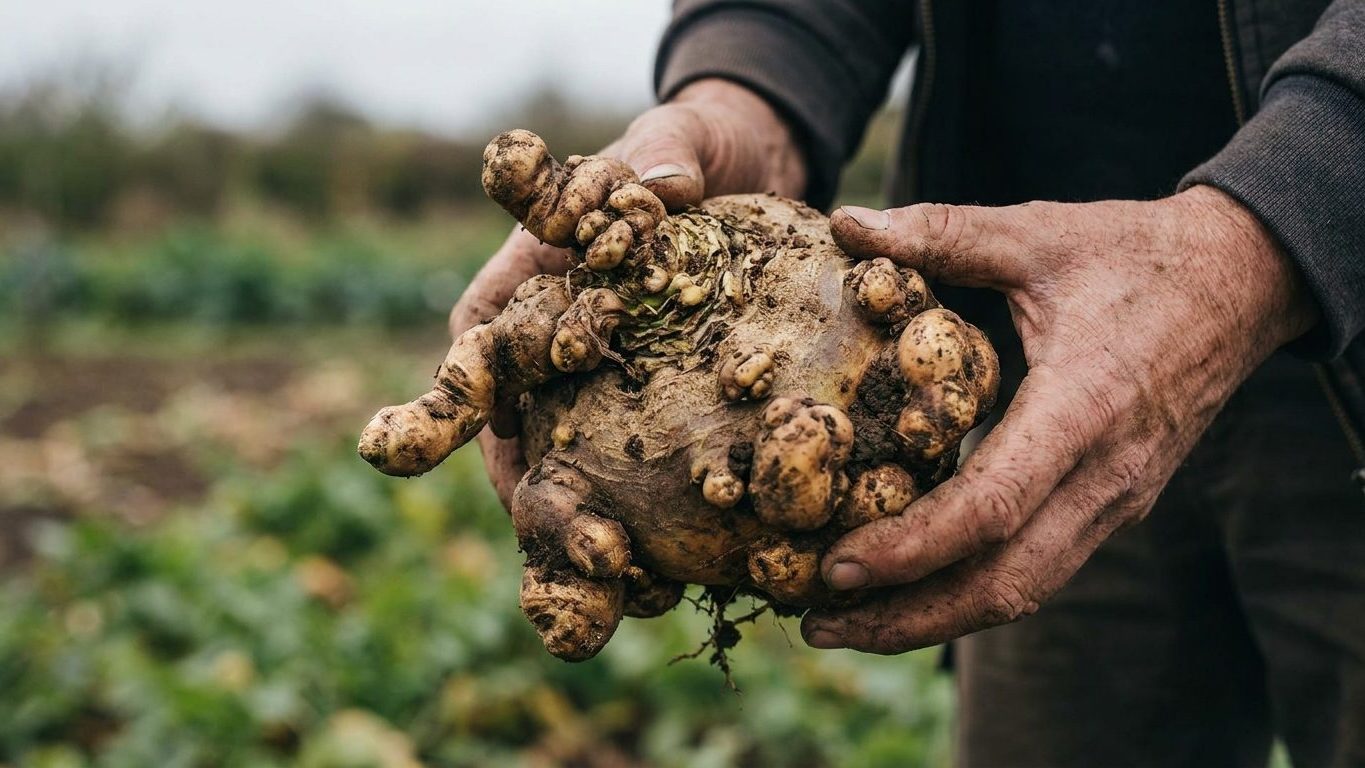

Clubroot doesn’t just cost a turnip or rutabaga crop. It costs the ground itself. Once Plasmodiophora brassicae gets into a bed, that soil stops being a safe place to grow any brassica for years, sometimes closer to a decade, no matter how good the compost or how careful the watering.
What is actually going on
The thing to understand here is persistence. Clubroot is caused by a soil-dwelling organism, not a fungus in the usual sense but something classified closer to a slime mold, and it produces resting spores that can sit dormant in soil for many years, often well past a decade, waiting for a host root to pass close enough. That single fact changes everything about how a gardener has to think about the disease. This isn’t a leaf spot you spray and move past. It’s a property of the soil now.
Once a turnip or rutabaga root grows into infected soil, the organism enters through root hairs and triggers the plant’s own cells to divide abnormally. The root swells into a distorted, clubbed mass, sometimes one big knot, sometimes a string of smaller galls. Those galls can’t do a root’s real job. Water and nutrient uptake collapse, so the plant wilts on hot afternoons even when the soil underneath is damp. Growth stalls. By harvest, what should have been a smooth root is a twisted, spongy lump that isn’t worth pulling.
Turnips and rutabaga are brassicas, in the same family as cabbage, kale, broccoli, and mustard, and clubroot doesn’t care which of those crops it’s infecting. This is exactly why the crop rotation guide on this site matters as much as any planting calendar. A gardener who pulls diseased turnips and replants the same square with cabbage the next season hasn’t rotated anything. The organism reads brassicas as one big food source, regardless of the common name on the seed packet.
Spread happens mostly through moved soil: on boots, tools, tiller tines, even in the root ball of a purchased transplant that came from infected ground somewhere else. Water runoff through a garden can carry spores from one bed to another. This is why a single clean-looking transplant tray from an unknown source is a bigger risk than most gardeners assume, and why disinfecting tools between beds is worth the extra minute when clubroot has shown up anywhere on the property before.
In the garden
Recognizing clubroot early, or at least understanding the conditions that invite it, saves years of frustration later. The table below walks through the signs and the soil factors gardeners run into, along with what tends to happen when each one gets missed.
| Sign or factor | What it looks like | What happens if it’s ignored |
|---|---|---|
| Daytime wilting | Plants droop in afternoon heat even though the soil feels moist | Gardeners blame drought stress, water more, and the extra moisture actually favors the organism further |
| Roots at harvest | Swollen, knotted, sometimes rot-streaked galls instead of a smooth root | Roots get composted on-site, spreading spores right back into the garden through the finished compost |
| Soil acidity | Below neutral pH, often in the 5.5 to 6.5 range | Acidic soil left uncorrected keeps favoring spore germination season after season |
| Wet, compacted ground | Water sits on the surface after rain, soil feels dense underfoot | Poor drainage stays poor, and the moist conditions the organism needs never let up |
| Tool and boot movement | Same fork, same boots used bed to bed | A single infected patch quietly becomes a garden-wide problem within a season or two |
The rotation this forces is longer than most gardeners expect for a home plot. Extension guidance generally points growers toward keeping any brassica, turnip, rutabaga, cabbage, kale, radish, or mustard, out of confirmed clubroot soil for a stretch measured in years, not one season off. That’s a hard adjustment in a small backyard garden where the brassica bed is often the same convenient corner every year. It means mapping the garden and actually tracking which square grew what, not trusting memory.
Liming to raise soil pH toward neutral or slightly alkaline is a standard cultural practice that makes conditions less favorable for the organism, though it won’t erase an established infestation on its own. Improving drainage, working in organic matter to loosen compacted ground, and avoiding overwatering all chip away at the conditions clubroot needs. None of these are a fix by themselves. Together, over several seasons of strict rotation, they’re what actually turns a bed back into usable brassica ground.
What it depends on where you are
Some of this is universal. The organism itself, the way it survives in soil, the way it swells roots into galls, doesn’t change from one state to the next. What does change is how favorable a particular garden’s conditions are to it, and that’s genuinely regional.
Soil pH varies naturally by region, and so does rainfall pattern. Areas with consistently wet springs and heavier, poorly drained soils tend to see clubroot pressure build faster than places with lighter, faster-draining ground. Season length matters too: a longer growing season gives more windows for the organism to complete its cycle and build up spore loads, while a shorter one compresses the risk into a narrower stretch. None of that is something this page can answer for a specific yard, because it depends on the exact soil, the exact drainage, and the exact rainfall a garden gets in a given year.
This is where the state-level pages in this turnips and rutabaga guide become useful, since they cover the practical growing conditions, timing, and regional pressures for specific parts of the country. Pairing that with a call to the local cooperative extension service is the more reliable path than guessing from a national average. Extension offices track clubroot confirmations county by county in many states, test soil pH for a modest fee, and usually know which turnip and rutabaga types have performed better against local clubroot pressure in university trials, information that changes by region and by year, and that a general guide like this one simply can’t source responsibly.
A gardener in a humid, high-rainfall region with heavy clay soil is dealing with a fundamentally different risk level than one in a dry climate with sandy, fast-draining ground, even if both are growing the exact same rutabaga seed. Treating the two situations identically is where a lot of generic advice falls apart.
The mistake that costs the most
The single costliest mistake is treating a one-year or two-year break from brassicas as if it solves the problem. It doesn’t, and this is where the disappointment hits hardest, because a gardener does everything right for a season, comes back the next year, and finds galled roots again.
The organism’s resting spores don’t care about a short pause. They’re built to outlast it. A rotation that feels generous by home-garden standards, say skipping brassicas for a year while planting tomatoes or beans in that bed, barely dents a spore population that can persist for a decade or more. The instinct to rush back to a favorite growing spot is understandable. It’s also exactly what keeps the problem alive.
The better approach is to treat a confirmed clubroot bed as brassica-free territory for the long haul, tracked deliberately rather than remembered casually, while working the soil chemistry and drainage in the meantime. That means raising pH toward neutral, improving drainage where the ground stays soggy, and using that space for unrelated crops, root vegetables outside the brassica family, legumes, alliums, for the full stretch of years extension guidance recommends for that specific region and soil type. It also means not moving soil, tools, or transplants from that bed into other parts of the garden without cleaning them first.
If roots come up swollen or clubbed at harvest, the temptation to compost them at home is worth resisting. A backyard compost pile rarely reaches the sustained heat needed to kill resting spores, so infected roots going into that pile just relocates the problem to wherever the finished compost ends up. Bagging and discarding them, following local guidance on disposal, is the more cautious route. Patience with the calendar, not a clever workaround, is what actually gets a bed back to growing turnips and rutabaga again.