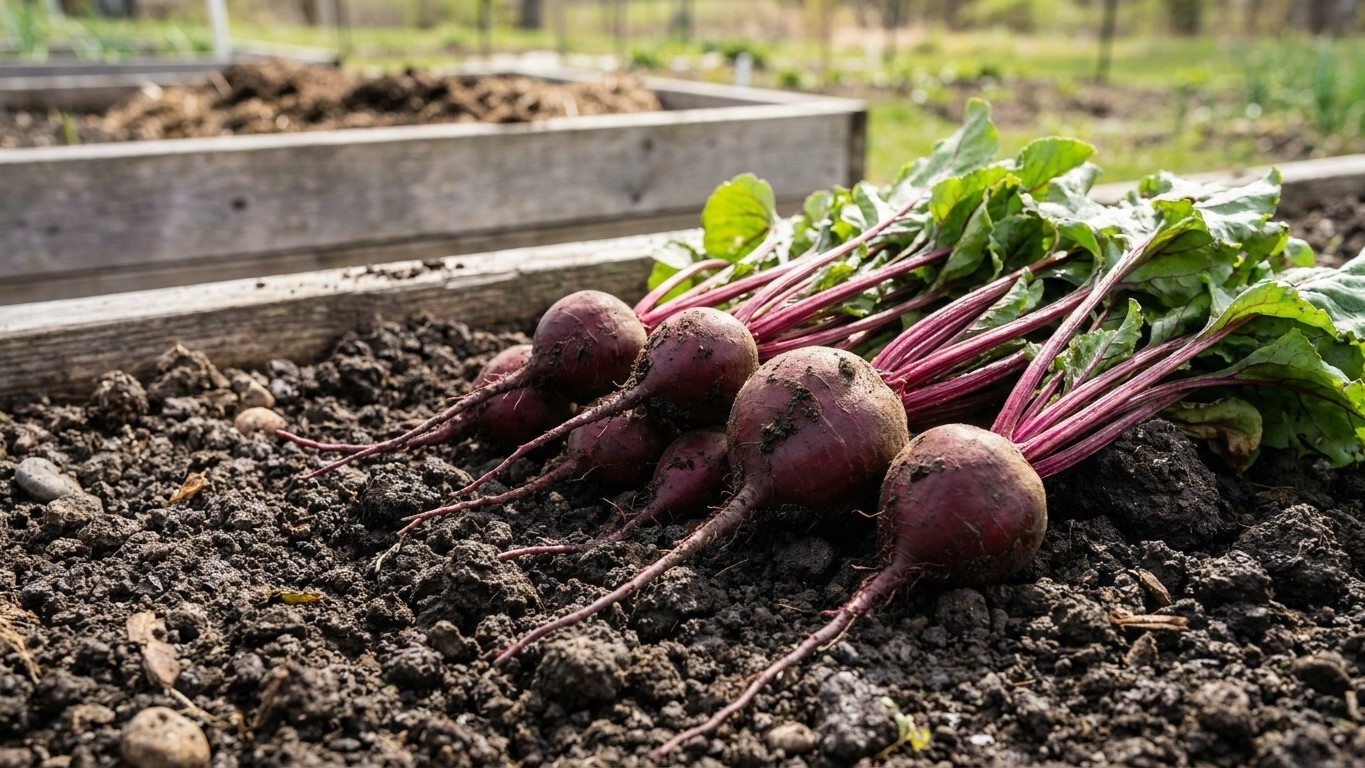

Pull beets roughly 60 to 80 days after seeding, and do it before heat above 85 F and dry soil turn the root woody. Then store them at 33 to 36 F, not colder. Colder is not better: topped roots held at 32 to 34 F develop more black spot and rot than roots kept a little warmer. In western Washington the frost window runs February 27 to March 18, which sounds early but doesn’t mean beets should go in early.
The short answer
Washington’s state soil is the Tokul series, an Andisol, which is a volcanic-ash soil: light, porous and unusually good at holding both water and phosphorus. USDA’s representative values for the surface layer read 45 percent sand, 10 percent clay and 45 percent silt (a loam to silt), with a pH of about 4.5, which is strongly acid. Drainage is moderately well drained. The organic matter figure, about 75.0 percent, tells you the mapped surface is a natural organic layer like forest litter. A cultivated bed won’t look like that. This is the soil that represents the state, not the one under your garden. Washington spans hundreds of soil series, and river bottoms, hill country and any lot a builder has scraped or filled will differ completely. Treat it as a starting point.
What that ground does to a beet
Utah State University Extension describes the beet’s ideal as deep, sandy, well-drained soil rich in organic matter. Tokul-type ground meets that halfway. The 45 percent sand and the porous ash structure give roots room to swell. The water-holding strength means a seedbed rarely dries out as fast as pure sand would. The trade-off is “moderately well drained,” which in a wet spring means a bed that stays soggy longer than a beet would like. The same extension source caps compost at no more than 1 inch of composted organic matter per 100 sq ft, so piling on amendments to chase richness works against you. For what the root will meet below the surface, see Beet Soil in Washington: What the Root Will Meet. For your own pH and texture, a soil test is the only real answer.
Heat and the 90 F question
You’d expect a count here of how many days a year the reference city passes 90 F. That number isn’t published in the figures behind this page, so I won’t guess at one. The more useful threshold comes from the extension source anyway, and it’s lower: heat above 85 F combined with water stress makes the root woody. Woodiness is a late failure, tied to the weeks when the root is sizing up. It has nothing to do with the early thirst that makes a plant bolt, and the two shouldn’t be lumped together as “keep it watered.”
Beets are sown in place, so the 60 to 80 days run from seeding, never from a transplant. A seeding on February 27 puts harvest between about April 28 and May 18. A seeding on March 18 pushes it to between May 17 and June 6. A spring crop mostly gets pulled ahead of the warmest stretch of the year. A late sowing, or a row left standing past its prime, drifts into the weeks when 85 F becomes possible. The “pull on time” part of the answer is mostly about not letting that drift happen.
One more boundary. These dates describe western Washington, mild and maritime. Eastern Washington, beyond the Cascades, is high desert with a far shorter season, and the Seattle window doesn’t carry across the state. For the wider picture, see Growing Beets in Washington.
The six weeks that decide it here
Sowing 2 to 3 weeks before the last frost is the standard rule for beets, and the arithmetic is simple. With a last-frost window of February 27 to March 18, that points to roughly February 6 to 13 at the early end and February 25 to March 4 at the late end. Early February through early March, then, is the calendar window on paper.
On the ground it’s rarely that tidy. A mild frost date doesn’t mean an early planting date in western Washington, because cold, wet soil and low light hold spring crops back well past the last freeze. Seed sitting in a cold, saturated bed can stall or rot. Many gardeners find that a sowing at the late end of the window, or a little after it, catches up with an earlier one. The frost date marks when a freeze stops being likely, not when the soil is ready.
The first six weeks after seeding are the ones that matter most. According to the extension source, water stress in that stretch causes premature flowering, which is bolting. Western Washington’s spring is usually wet and cool, so thirst isn’t the typical problem in a February or early March sowing. But springs here swing. A dry, bright week in April or May can arrive in the middle of those six weeks, and the later you sow, the more likely those weeks slide into it.
That is where the bolting risk sits: in a seedbed that dried out during a dry spell early in the crop’s life, not in the cold and not in the rain. Soil like the Tokul series buffers some of this, since it holds water well. A thin raised bed, a sandy fill or a gravelly lot buffers much less, and a bed that drains fast needs checking every few days when the rain stops. If you’re sowing beyond the Cascades, the dryness moves from occasional to expected, and the Seattle sowing dates don’t apply at all.
What goes wrong here
- Bolting after an early dry spell. Water stress in the first 6 weeks after seeding triggers premature flowering. Remedy: check the seedbed every few days once the rain pauses, and water deeply enough to reach the root zone, especially in raised beds and any sandy or fast-draining spot.
- Woody roots in the heat. Temperatures above 85 F with water stress make the root woody. This is a different failure from bolting. Remedy: sow so the 60 to 80 days finish before the hottest weeks, pull on schedule rather than leaving roots in the ground, and keep water even in later growth.
- Sowing too early because the frost date is mild. The February 27 to March 18 window doesn’t mean the soil is ready. Cold, wet ground and low light stall seed. Remedy: wait for a bed that isn’t saturated, and don’t treat the early end of the window as a deadline. Scars and chewing on the root are a separate matter, covered in What Eats Beet in Washington, and When.
- Over-amending the bed. More than 1 inch of composted organic matter per 100 sq ft goes past what the extension source recommends. Remedy: stay under that figure, and test your soil before adding anything to ground that may already be rich or acid.
- Storing too cold. At 32 to 34 F, black spot and rot increase compared with slightly warmer storage. Topped roots belong at 33 to 36 F and 98 percent humidity. Remedy: set the storage spot to the warmer side of the range. For a cellar or pit, keep it from dropping below 31 F or rising above 41 F.
- Storing with the tops on. Bunched beets with leaves keep only 10 to 14 days at 32 F and above 98 percent humidity. Remedy: cut the tops off first if you want them to last longer.
- Saving the wrong roots. Large roots keep much better than small ones, which lose water and shrivel faster. Remedy: eat the small ones first and put the big ones away.
Common questions
How many days until beets are ready to pull?
Plan on 60 to 80 days counted from seeding. Beets are sown in place, so there’s no transplant date to count from. Mark the sowing day and count forward from there.
Should I store beets with the leaves on?
Only for a short stretch. Bunched beets with their leaves last about 10 to 14 days at 32 F and above 98 percent humidity, and no longer. For anything beyond that, top them first.
What temperature is best for storing beets?
For topped roots, 33 to 36 F at about 98 percent humidity. The source is explicit that storage at 32 to 34 F brings more black spot and rot than somewhat higher temperatures. If you use a pit or cellar, keep it above 31 F and below 41 F.
Does the Seattle frost window work across Washington?
No. February 27 to March 18 is a western Washington range from a station in the mild maritime zone. East of the Cascades is high desert with a much shorter season, and sowing dates there need their own local frost information, which isn’t covered in the figures here.
One storage detail trips people up. The 98 percent humidity figure matters as much as the temperature: roots in dry air lose water and shrivel, and small ones lose it fastest.