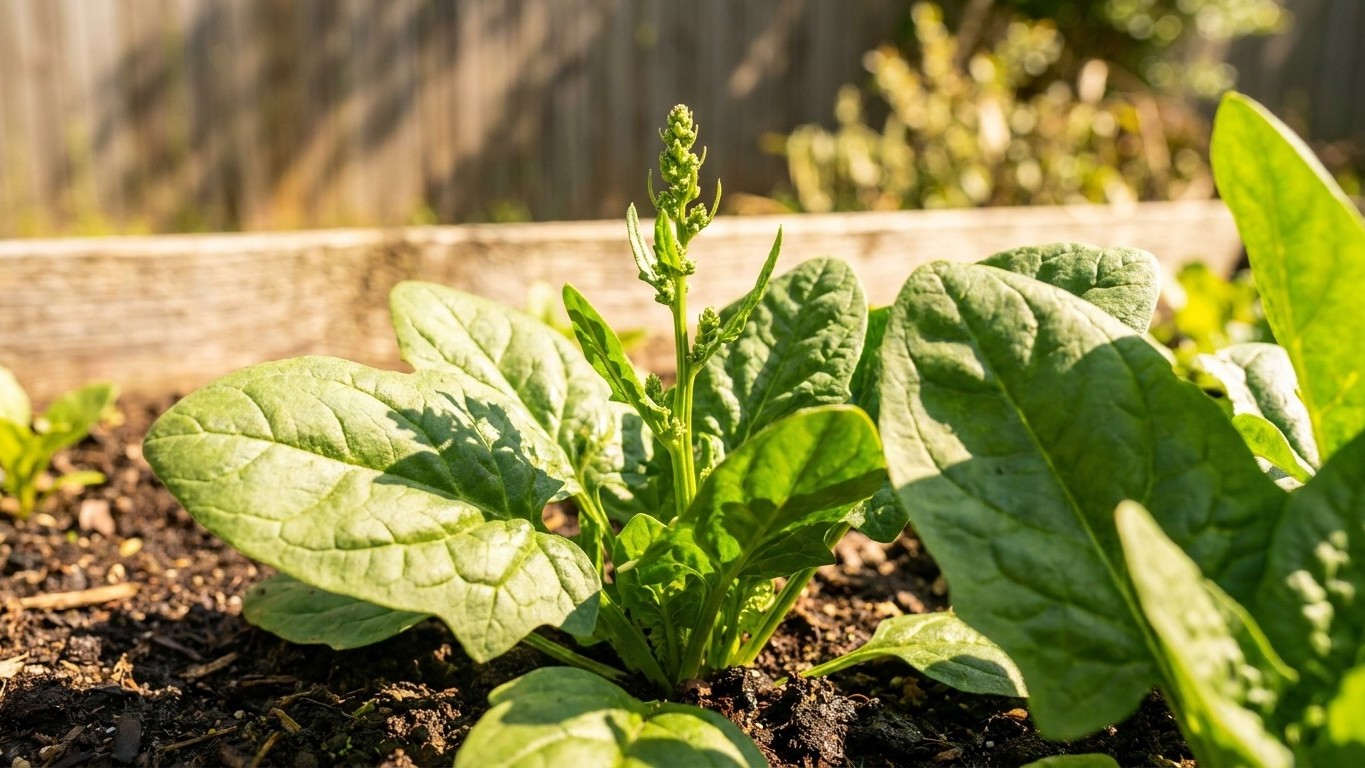

In Washington, what eats spinach isn’t a bug. It’s the calendar. Spinach gets two workable windows, one from late winter into spring and one from late summer into autumn, and the long bright days between them close the gap. Western Washington gets the generous version of both windows. Eastern Washington, beyond the Cascades, gets far shorter ones. Every date below comes from Seattle’s climate normals, so read them as west-side numbers. For the full crop plan, start with Growing Spinach in Washington.
The short answer
On the longest day of the year, Seattle gets 15 h 45 of daylight. That number matters more than any thermometer reading. According to Utah State University Extension, spinach bolts during long days and warm temperatures, and long days alone are enough to start the flowering. A cool summer does not buy extra weeks. A gray, 65 F June afternoon still sits under the same 15 h 45 of daylight, and the plant counts hours of light, not degrees. If you want the full picture of how early flowering plays out here, Will Spinach Bolt Early in Washington? goes deeper.
So is the limit day length or heat? Both, though not equally. Day length is the one nobody can negotiate with. You can’t shade, mulch or water your way out of a 15 h 45 day. Heat is the milder partner on the west side: the reference station averages only 3.0 days a year at 90 F or higher. That sounds harmless, but 90 F isn’t spinach’s number. The number that counts is 75 F. Spinach grows best where temperatures do not exceed 75 F, and that same line is where leaves turn bitter. One figure, two consequences: growth stalls and flavor sours together. This page can’t tell you how many days a year Seattle crosses 75 F, because the data behind it doesn’t publish that count.
Notice what 75 F is not. It’s not a date on the calendar. It’s a ceiling you watch for, and it arrives earlier in a warm spring and later in a cool one. Day length, by contrast, runs on a fixed schedule every year. That’s the useful way to hold the two ideas: heat is the variable, daylight is the constant.
The mild frost dates can fool you into planting too early. Seattle’s last spring frost falls between February 27 and March 18 (the 30 to 70 percent probability band of the NOAA NCEI 1991-2020 Climate Normals). That sounds like an invitation to sow in February. But a mild frost date doesn’t mean an early planting date here. Cold, wet soil and low winter light hold spring crops back well past the last freeze.
One scope note. The sources behind this page publish nothing on insects, slugs or deer, so none are discussed. What follows is about the two forces that reliably shorten the crop: light and heat.
How long the spring window really is
The rule of thumb is to sow spinach two to three weeks before the last frost. Pair that with the 75 F growth ceiling and you can work out the spring window in plain arithmetic. Here’s how it plays out on the west side.
- Start with the frost range. The last spring frost lands between February 27 and March 18, depending on how cautious you want to be.
- Subtract two to three weeks. From February 27, three weeks back is about February 6. From March 18, two weeks back is about March 4. That puts the sowing window at roughly early February to early March, about four weeks wide.
- Trim it for real conditions. Soil that is cold and soggy in early February won’t germinate well, and winter light is thin. In practice the usable part of that window sits toward its later end, and a wet year can shave off another week or two.
- Let the long days set the end. Daylight stretches fast through spring toward that 15 h 45 peak, and long days alone can trigger flowering. The source doesn’t publish a day-length cutoff, so there is no trustworthy date to name. What you can say is that the crop is racing the light.
- Let heat set the other end. Once temperatures climb past 75 F, growth stops being good and leaves turn bitter. In a mild maritime spring that may come late, but it comes.
Add it up and the spring window is about four weeks to sow in, then a harvest period that stays open only until the light and the warmth catch up. The source publishes no days-to-maturity figure for spinach, so I won’t invent one. What the arithmetic does show is that the western Washington spring is generous at the front end and unforgiving at the back end. Gardeners who sow in the middle of the window, harvest steadily, and replant small batches every couple of weeks tend to get more usable leaves than those who plant a whole bed once.
East of the Cascades, none of this transfers. The region is high desert, with a far shorter season. The frost dates above belong to the Seattle station and shouldn’t be borrowed for Yakima, Spokane or the Tri-Cities. Check a local frost date before you count back.
The autumn crop, and when the soil lets you sow
Autumn is where western Washington gardeners get the best spinach, because the light is shrinking instead of growing. The day length that works against the spring crop works for the fall one. The timing still has two obstacles, and they pull from opposite ends of the season.
Warm soil blocks the early sowing
The surprise is that autumn sowing isn’t held back by cold. It’s held back by warmth. Utah State University Extension reports that seed germination is reduced above 80 F soil. A bed that has baked all July can still sit above that line in late August, even after the air feels like fall. Seeds pushed into hot soil may sprout poorly or not at all, which is why a gardener sowing on the first cool-feeling day sometimes sees a patchy row.
In a hot region the window opens when the soil temperature falls, and that is a thermometer question, not a calendar one. A cheap soil thermometer pushed 2 inches into the bed settles it. Watering the bed ahead of time and covering it with a board or burlap until the seeds go in can help cool the surface. Sowing details for this season are laid out in When to Sow Autumn Spinach in Washington.
The first frost ends the season
The other limit is the end of the road. Seattle’s first fall frost falls between November 13 and November 30 (NOAA NCEI 1991-2020 Climate Normals, the 30 to 70 percent band). The source’s guidance for a fall crop is to plant 50 to 75 days before the date you want to harvest. It publishes no days-to-maturity for spinach, so that range is the whole rule.
Count back from a realistic harvest date. If you want to be picking by November 13, the earliest frost date, then 75 days back is about August 30 and 50 days back is about September 24. If you can count on the later date of November 30, the range slides to about September 16 through October 11. Put the two together and the whole autumn sowing span runs from late August to mid October, with the safest middle sitting in mid-to-late September.
Hold the earliest edge of that range loosely. A late August sowing is exactly when warm soil can still bite, so the soil thermometer outranks the arithmetic. And remember that shorter days are doing you a favor now: the same light that pushes spinach to flower in June is draining away by October.
Common questions
Does a cool Washington summer keep spinach from bolting?
No. Long days alone trigger flowering, and Seattle’s longest day holds 15 h 45 of daylight no matter how mild the weather is. Cool temperatures help growth, since spinach does best at or below 75 F, but they don’t cancel the light signal.
Can I use these dates in eastern Washington?
No. The frost dates here belong to the Seattle station on the mild, maritime west side. Eastern Washington is high desert with a far shorter season, and the numbers in this article don’t include a figure for it. Use a local last and first frost date, then apply the same counting method.
Which spinach variety should I plant?
The source names four: Bloomsdale, Melody, Teton and Olympia. It gives no data about any of them, such as bolting resistance or days to harvest, so there’s nothing reliable to say about how they differ. Treat the seed packet as your guide and try a small row of more than one.
How long does harvested spinach keep?
UC Davis Postharvest says spinach is highly perishable and will not maintain good quality for more than 2 weeks, and that is a ceiling, not a plan. That holds only at 32°F with 95 to 98 percent relative humidity. At the 41 to 50°F a typical fridge door holds, yellowing and decay come faster. Keep it in a bag at the back of the bottom shelf, where it is coldest, and plan to eat it within days.