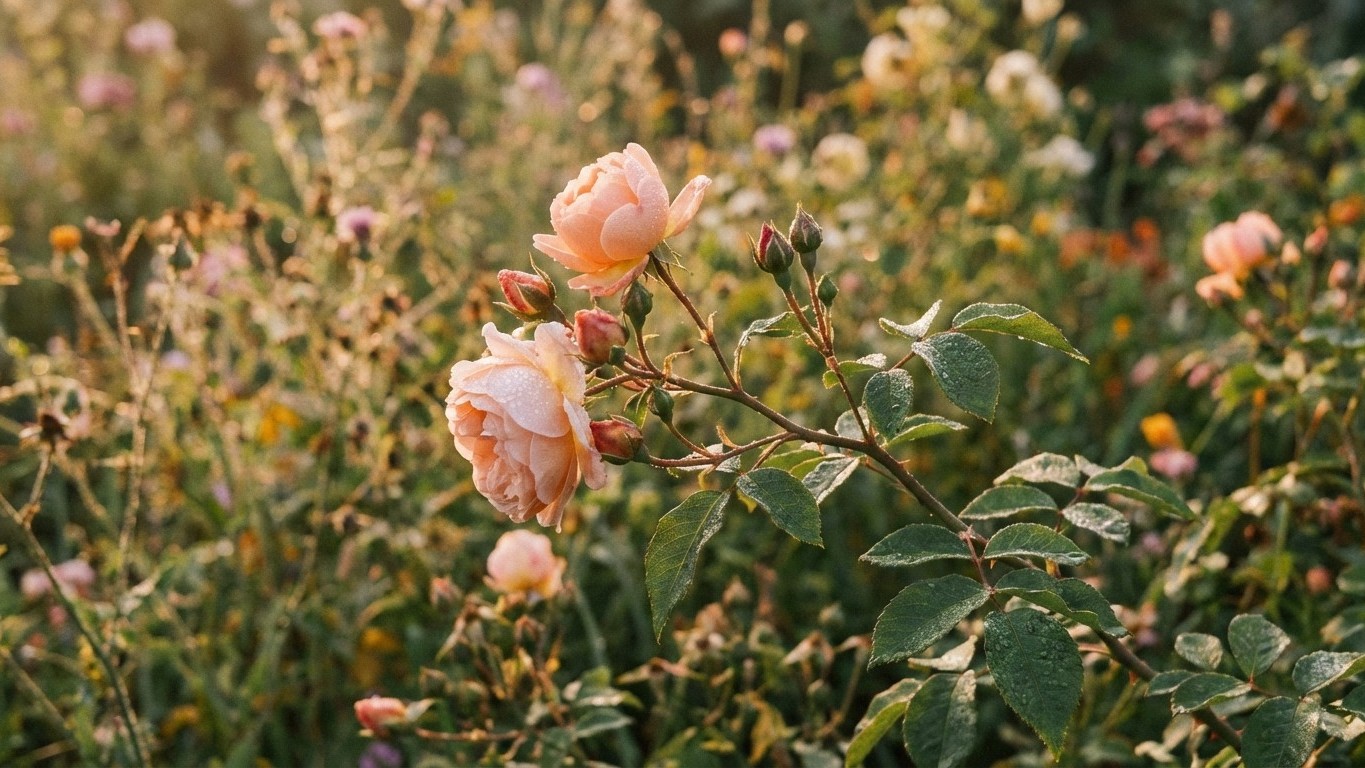

Set bare-root roses in the ground as soon as the soil is workable in spring, and put potted ones out around the average last frost of May 16 at Charlottetown. That date is a midpoint, not a guarantee. Cold-hardy, disease-tolerant types such as rugosas and Canadian-bred Explorer roses give the best odds. Give them six hours of sun and stop feeding by early August. All the frost figures below come from one weather station, so districts away from it may run weeks later.
When to plant Roses in Prince Edward Island

In Environment and Climate Change Canada’s Canadian Climate Normals, it shows an average last spring frost of May 16, an average first fall frost of October 17, and 153 frost-free days in between. “Average” is the word to underline. In one year out of two, the last frost arrives after May 16, so treat the date as the middle of a window that stretches into late May and sometimes beyond.
Two caveats come with those numbers. The Canadian normals cover 1981-2010, while the US figures on this site (see the Growing Roses in Indiana: Planting Dates, Varieties and Local Pests guide for an example) cover 1991-2020, so don’t compare them to the day. And Charlottetown is one location. Northern shore districts, higher ground and low-lying frost pockets run later, and a garden fully exposed to the Gulf of St. Lawrence wind warms more slowly in spring than a sheltered backyard.
Bare-root and potted roses
Bare-root roses arrive dormant, with no leaves to damage, so they can go in as soon as the ground has thawed and stopped being a bog. On the island that usually means late April to early May. If a hard frost follows after buds have started to swell, drape a blanket or row cover over the plant overnight.
Potted roses are already leafed out and tender. Wait until the May 16 midpoint has passed, then add a buffer of about a week, which puts your target around May 23. Keep a sheet of fleece handy anyway, because that coin-flip frost can still show up.
Seed starting, hardening off and transplanting
Nearly everyone buys roses as plants. Seed makes sense only for species roses such as rugosas, and it is slow: the seed typically needs 8 to 12 weeks of cold, moist stratification (a sealed bag of damp sand or peat in the refrigerator) before it will germinate.
- Transplant target: May 23, a week past the average last frost.
- Hardening off: about 10 days, so start May 13. Begin with an hour or two in shade, add a little more sun and wind each day, and bring trays in on cold nights.
- Indoor growing: roughly 8 weeks under lights, so sow around March 18.
- Stratification: 8 to 12 weeks before sowing, which means the refrigerator step starts between late December and late January.
Soil and site preparation
Roses want six or more hours of direct sun, and morning sun matters most because it dries dew off the leaves before fungus can use it. On an open island site, wind is the second variable. A fence, hedge or building to the northwest breaks the worst of it, but leave a gap of a few feet so air still moves around the canes. Stagnant, shaded corners are where black spot and powdery mildew settle in.
Drainage decides more than soil type. Dig a hole about a foot deep, fill it with water, let it drain, and fill it again. If water is still standing the next morning, build a raised bed or pick another spot. Sandy ground drains fast but loses nutrients, so it needs more compost and more frequent feeding. Heavier ground holds water and needs organic matter to open it up. A soil test tells you far more about your own yard, including pH, and roses do best at a pH of roughly 6.0 to 6.5.
Amendment timing is where most gardeners lose weeks. Lime works slowly, so if the test says the soil is too acidic, apply it in fall or at least a month before planting. Compost can go on closer to planting day. Here is a working timeline:
- Six weeks before: send off a soil sample and strip any sod from the bed.
- Four weeks before: spread 2 to 3 inches of compost and fork it into the top 8 to 12 inches, adding lime if the test calls for it.
- Planting week: soak bare roots in a bucket for a few hours, and water potted roses in their pots.
- Planting day: dig a hole wider than the root spread, and set grafted roses with the bud union (the knob where the canes meet the rootstock) 1 to 2 inches below soil level for winter protection.
Spacing depends on the type. Hybrid teas and floribundas need 2 to 3 feet, most shrub roses 3 to 4 feet, rugosas 4 to 5 feet because they spread, and climbers a good 8 feet from their neighbors. Avoid planting a new rose in the exact spot where an old one died, since the soil can carry problems that make new plants sulk (rose replant disease). Dig the hole in a fresh spot or swap out a large bucket of soil.
Varieties that suit Prince Edward Island
Roses are perennials, so “days to maturity” is the wrong yardstick. The traits that count here are winter hardiness, disease resistance, whether the plant blooms on new wood, and tolerance of wind and salt spray. A rose that blooms on new growth recovers from winter dieback and still flowers by midsummer. One that blooms only on old wood loses its whole season if the canes freeze back.
| Group | Widely sold examples | Winter hardiness | Disease resistance | Good for |
|---|---|---|---|---|
| Rugosa and hybrid rugosa | ‘Hansa’, ‘Therese Bugnet’, ‘Blanc Double de Coubert’ | Very good | Strong, tough foliage | Windy or coastal sites, hedges, hips |
| Explorer and Parkland series | ‘William Baffin’, ‘John Cabot’, ‘Morden Blush’, ‘Winnipeg Parks’ | Bred in Canada for cold winters | Good, varies by cultivar | Repeat bloom, trellises, mixed borders |
| Landscape shrub roses | Knock Out types, ‘Carefree Beauty’ | Good, may die back to the snow line in cold spots | Reputation for good resistance | Low-maintenance beds, long bloom |
| Hybrid teas and floribundas | ‘Peace’, ‘Mister Lincoln’ | Needs winter protection | Moderate, spraying or vigilance often needed | Cut flowers, sheltered garden beds |
Rugosas are the safest starting point. They are familiar along Atlantic Canada’s shorelines for a reason: the wrinkled leaves resist disease, the plants tolerate salt and wind, and the hips are good for jelly or tea. The trade-off is size and suckering. Give them room, or accept a thicket.
The Explorer and Parkland series were bred in Canada with cold winters in mind, and the names above are widely available from nurseries across the country. For a first-time buyer, own-root plants (grown on their own roots rather than grafted) are worth seeking out. If a hard winter kills the canes to the ground, an own-root rose regrows as the variety you bought, while a grafted one can regrow as the rootstock.
Hybrid teas can work, but treat them as a project. Plant them near a house wall or fence on the south side, mound them well in fall, and expect to prune out dieback every spring. Choose them for the flowers, not for ease.
What to plant alongside
The best companions earn their place through plain physical effects. Catmint (Nepeta) is a good example. It draws pollinators, fills bare ground around the rose base, and shades the soil. Hardy geraniums and lady’s mantle do much the same job at a lower height. Large-flowered clematis can climb through a sturdy shrub rose, and its roots appreciate the rose’s shade, though it competes for moisture, so water the pair generously.
Alliums, including ornamental onions and chives, get credit for confusing aphids with their smell. The evidence is modest. Mixed plantings can make it harder for pests to find their target, and the flowers feed beneficial insects, but there is little proof that planting garlic by a rose stops aphids or black spot. Plant them because they look good and cost little.
Watch for competition. Lavender is a lovely companion in photos, but it wants dry, lean soil, while a rose wants steady moisture and rich ground. One of them will be unhappy. Turf grass is a worse neighbor than any flower, since lawn roots take water and nitrogen right up to the rose crown, so keep a mulched circle about 2 feet wide.
Watering, feeding and support
Water deeply and less often. About 1 inch a week, counting rainfall, is a good baseline for established roses. A slow soak at the base once or twice a week pushes roots down, while a light daily sprinkle keeps them shallow and soaks the leaves. Wet foliage is how black spot spreads, so use a soaker hose or hand-water at the soil line in the morning. New plants need more attention for the first season: check them when the top inch of soil is dry.
Mulch holds moisture and blocks weeds. Spread 2 to 3 inches of shredded bark or compost after the soil has warmed, and keep it a couple of inches away from the canes so the crown does not stay wet. Top it up each spring.
For feeding, a three-step rhythm suits the local season. Give a balanced or rose-formulated fertilizer, or a compost top-dressing, at leaf-out in mid to late May. Feed again after the first flush of bloom in early July. Make the last application around early August, about ten weeks before the October 17 average frost. Late nitrogen pushes soft new growth that has no time to harden, and the first hard frost then kills it back into good wood.
Support depends on the type. Rugosas and compact shrub roses stand on their own. Explorer climbers and similar long-caned varieties need a trellis or wires, and tying canes closer to horizontal than vertical produces more flowering shoots along their length. Use soft ties, not wire against the bark.
Prune in spring, once buds swell and you can see which canes survived the winter. Cut dead or black wood back to healthy tissue with a white center, working just above an outward-facing bud. Roses that bloom once a year on old wood should be pruned right after flowering instead. Remove suckers on grafted roses by pulling them away from the root, not just snipping at ground level. They come from below the bud union and often have seven or more leaflets, unlike the five on the grafted variety. On own-root rugosas, the shoots you see are part of the plant and can be kept or thinned for shape.
Common problems

The pest list comes from University of Maine Cooperative Extension, the service of a neighboring US state. The biology crosses the border but the calendar does not always. It documents Browntail moth, Cabbage maggot, Colorado potato beetle, Emerald ash borer, Lily leaf beetle, Seedcorn maggot, Spotted wing drosophila, Squash vine borer, Striped cucumber beetle and Winter moth. Most of those target vegetables, fruit, lilies or ash trees, not roses. Take unfamiliar insects or damage to your provincial agriculture office for identification.
Diseases and growth problems
Black spot shows up as dark, fringed-edge spots on the leaves, followed by yellowing and leaf drop. Wet foliage is the cause. Water at the base, rake up fallen leaves, remove infected ones, and pick resistant varieties. Powdery mildew is a white coating on young shoots and buds, common when nights are humid and days are dry. Better air circulation and thinning crowded canes are the first fix.
Black or brown canes in spring are winter dieback. Prune back to white-centered wood. If a healthy rose will not bloom, the usual causes are too much shade, too much nitrogen, or pruning off the old wood on a once-blooming type. Yellowing leaves with green veins suggest a nutrient or pH problem, which a soil test can confirm.
Insects
Browntail moth caterpillars have orange-brown tufts and shed fine hairs that cause an itchy rash on skin, so never handle them or their winter webs with bare hands. Winter moth caterpillars are green inchworms that chew buds and young leaves of many woody plants in spring. Both are on the Maine list, so ask the provincial office what is active in your area.
Timing the Season: From Planting to Hardening Off for Winter
Roses are perennials, so there is no days-to-maturity label, but the clock is real: the plant needs time to establish, bloom, and harden its wood before winter. The frost-free figure at Charlottetown is 153 days. Planting a potted rose on May 23 uses up 7 of them, leaving about 146.
A container-grown rose typically flowers within 6 to 8 weeks of planting, which means first blooms in early to mid July. That leaves roughly 13 to 15 weeks of flowering before the October 17 average frost, and repeat bloomers will use all of it. Once-bloomers flower in June or July regardless. Rugosa hips usually color up by early fall, well ahead of the first frost.
The deadline that matters is hardening. Growth should slow by late August, which is about 8 weeks before the average first frost. A rose planted in late summer gets only a few weeks of root growth before the ground freezes, so fall planting works best by early September, around six weeks before the frost midpoint.
To redo the arithmetic for your own district, use three steps:
- Take your local frost-free days and subtract days between the last frost and planting.
- Subtract 42 to 56 days from planting to first bloom.
- Check that growth can slow about 8 weeks before the first fall frost.
Cutting Flowers, Hips and End-of-Season Care
Cut flowers in the morning, when buds are showing color but have not fully opened. Use sharp pruners and make the cut just above a leaf with five leaflets, which encourages a new flowering shoot. Strip the lower leaves and put the stems straight into water. Hybrid teas keep well indoors, while rugosa blooms drop their petals quickly.
Hips are the late-season harvest. Pick rugosa hips when they are fully red or orange and slightly soft. Many gardeners wait for a light frost, believing it improves the flavor. Slice them open, scrape out the seeds and fine hairs, and dry them for tea or cook them into jelly. Use only roses you have not sprayed.
Plan your fall around October 17, with the reminder that in half of years the first frost comes later. By September, stop deadheading repeat bloomers so the plant starts forming hips and slows down. Clean up fallen leaves to reduce black spot spores. Water deeply until the ground freezes, since dry roots lose more canes in winter than cold alone.
Protect grafted roses and borderline-hardy types after a few hard frosts have gone through, not before. Mound soil or compost 10 to 12 inches up the base of the plant, and wrap exposed canes in burlap on windy sites. Tie climbers loosely so winter gales do not whip them. Rugosas need almost none of this. In April, pull the mounding away gradually as the weather settles, then prune.
Local help
For district-level frost dates, soil testing and help identifying a pest, start with the Prince Edward Island agriculture office. Their staff can point you to the right provincial resources for your area. For more island-specific gardening, see the Prince Edward Island guides, and for the full plant background, read How to Grow Roses: The Complete Guide.
Common questions
When can I plant roses outdoors on the island?
Bare-root roses can go in as soon as the soil is workable, usually late April to early May. Potted roses wait until after the May 16 average last frost at Charlottetown, ideally a week later, with fleece nearby. Colder districts need extra time.
Will roses survive an island winter?
Hardy types such as rugosas, Explorer roses and Parkland roses are bred for cold. Hybrid teas need mounded protection, and exposed, windy sites cause more losses than the temperature alone. A steady snow cover helps because it insulates the crown.
Can I grow roses from seed?
Species roses like rugosas can be grown from seed, but the seed needs 8 to 12 weeks of cold stratification and germinates unevenly. For most gardeners, a bare-root or potted plant saves a year or more.
Are the Charlottetown frost dates the same across the island?
No. They come from a single station, and northern or upland districts run weeks behind. Treat May 16 and October 17 as midpoints, not safe dates, and track your own yard’s last frost for a season or two.
Which pests should I watch for?
The documented list comes from Maine, not the island, and includes Browntail moth and Winter moth. Both affect woody plants, and Browntail moth hairs can cause a rash, so avoid handling the caterpillars. Report anything unfamiliar to the provincial agriculture office rather than assuming it is absent from the island.