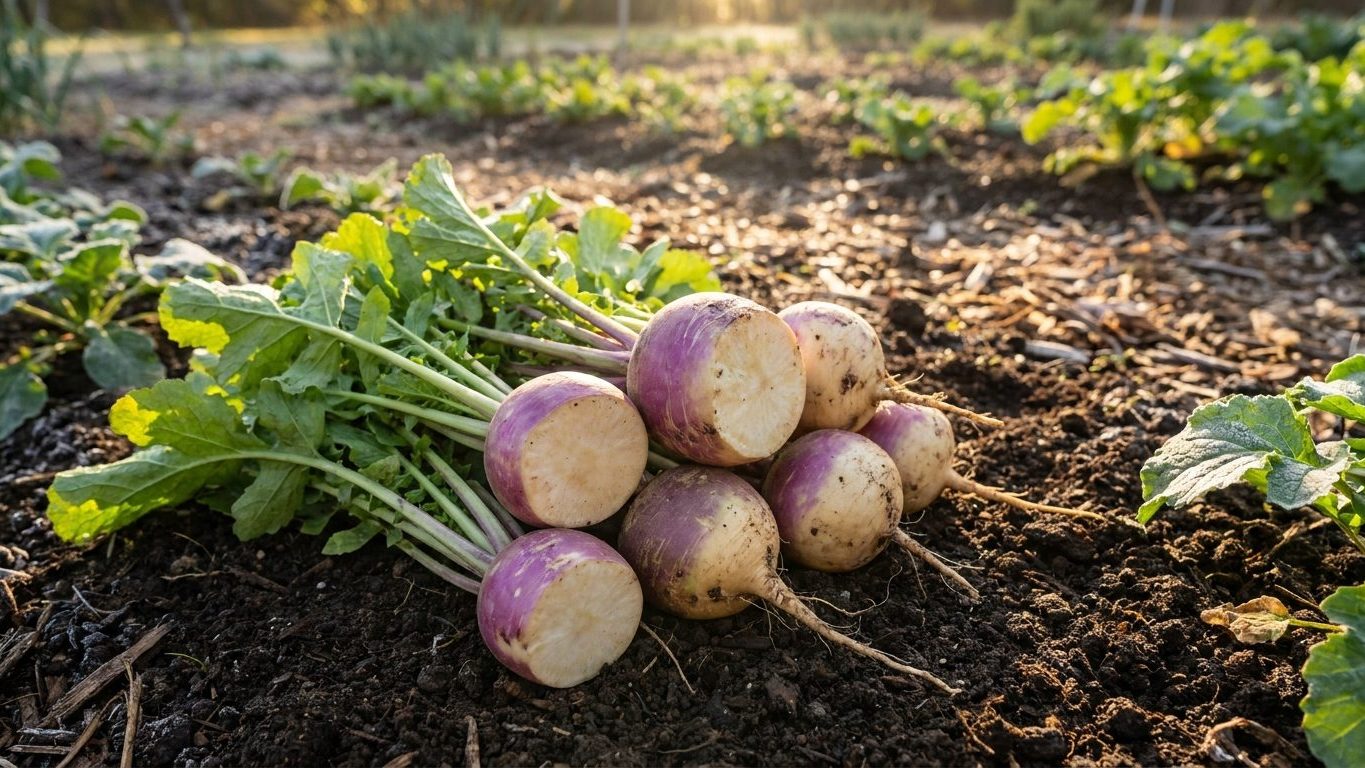

In Delaware, turnips and rutabaga are mostly a fall crop. Sow them after the worst of summer heat has passed, and let late-October and November frosts sweeten the roots. A spring sowing can work, but it competes with warming weather. The numbers below come from NOAA’s Wilmington reference station, so treat them as a starting point and adjust for your county.
When the soil is warm enough in Delaware
The date most gardeners ask about is the last spring frost. At the Wilmington reference station (NOAA NCEI 1991-2020 Climate Normals, station USW00013781), the 32°F freeze probability band runs from April 3 to April 14. Those are the dates when the odds of another freeze fall from 70 percent to 30 percent. A frost date is a probability, not a promise, and a late freeze after April 14 is always possible.
That date is also a proxy. Turnips and rutabaga are not waiting for the calendar to clear. They respond to soil, and soil warms after the frost risk ends, not alongside it. A bed can be frost-free on April 15 and still be cold, wet and sticky three inches down. Press a soil thermometer into the planting zone in the morning. It tells you more than the almanac does, and your University of Delaware Cooperative Extension office can give you the soil-temperature thresholds it recommends for each crop.
The Wilmington figures come from an airport weather station, and gardens a few miles away often disagree with it. Suburban and rural plots typically see the last spring frost one to two weeks later than the airport, and the first fall frost one to two weeks earlier. Low spots where cold air pools run behind the station numbers by even more. Check your own county before you pencil in a date, and keep a note of the last frost you actually see this year.
Soil temperature also changes the answer by season. In spring, a root crop that is sown into cold soil and then overtaken by warm weather tends to bolt or turn woody. The autumn sowing runs the other way. You sow into warm summer soil and the crop matures as the weather cools, which is why the fall planting usually gives the better roots. If you want the general logic behind that pattern, our overview, Growing Turnips and Rutabaga: An Autumn Crop, Sweetened by Frost, lays it out before the territory-specific details.
Rutabaga is the slower of the two. It generally needs a longer stretch to size up than a turnip, so in a fall plan it goes in first and turnips follow. I won’t give you a count of days here, because maturity time depends on the type you choose and the seed packet and your extension office are the right sources for it.
How long the season lasts here
Both frost dates for the Wilmington reference station are in hand, so the window can be worked out. The last spring freeze falls between April 3 and April 14, and the first fall freeze falls between October 26 and November 7, using the same 30-70% probability band and the same NOAA station.
| Case | Last spring frost | First fall frost | Frost-free window |
|---|---|---|---|
| Shortest | April 14 | October 26 | 195 days |
| Longest | April 3 | November 7 | 218 days |
That is a window of roughly 195 to 218 days at the reference station. It is a long one by northern standards. Now subtract. If your garden’s frost comes one to two weeks later in spring and one to two weeks earlier in fall, you can lose two to four weeks, and the window tightens accordingly.
What does a window this long allow? A second sowing. Delaware’s window is long enough that you can plan two sowings and treat a failed first one as recoverable. A hot spell that bolts the spring planting, or a flush of flea beetles that shreds the seedlings, does not end the year for you.
Transplanting still deserves caution. Turnips and rutabaga form a taproot, and handling it can leave forked or stunted roots. In a window this generous you do not need to transplant to save time. Direct sowing is the better default, and thinning does the work that transplanting would only complicate. If you use trays at all, disturb the roots as little as you can.
The succession sowing guide on this site explains how to space those sowings and how to stagger them so the harvest does not arrive all at once. For Delaware, the practical shape is a modest early sowing, a pause through the hottest weeks, and then the main sowings for fall, counting back from your own first-frost date rather than the airport’s. Gardeners in colder places have a harder version of this puzzle. Growing Turnips and Rutabaga in Indiana shows how a shorter season changes the arithmetic, and Growing Turnips and Rutabaga in Nova Scotia shows it at the far end.
Heat and water in Delaware
This page does not carry a verified count of days above 90°F or a summer rainfall total for Delaware, and I won’t substitute a number from memory. For the specifics, your extension office or NOAA’s station data for your nearest weather station will give you the real figures. What can be said honestly is how heat and water act on this crop, and why the two facts that govern it are cold ones.
Why summer matters less than winter
Turnips and rutabaga are an autumn crop. Summer is the problem to get through, since heat and humidity push seedlings toward bolting, toughen the roots and invite fungal trouble. Once the roots are growing in cooler fall weather, what matters is the cold. The coldest month at Wilmington has a mean daily minimum of 25.6°F (NOAA NCEI Climate Normals 1991-2020). That is an average of the lowest temperature each night, not a record low, so individual nights will run colder.
That number decides whether roots can stay in the ground under mulch or must be lifted and stored. A mean minimum in the mid-20s means most nights are below freezing but the ground does not lock up for months. A thick mulch of straw or leaves over the row makes in-ground holding plausible for part of the winter. A hard cold snap can still damage roots, especially turnips, which are less tolerant than rutabaga. Lift what you cannot protect.
The USDA Plant Hardiness Zone Map (2023) puts Delaware at 7a to 8a. That system is built on a single variable, the average annual extreme minimum temperature, so it says little about summer. Treat it as a range across the state, and use the Wilmington figures only as the reference city.
Frost sweetening, and what damp summers bring
The winter low also sets how much frost sweetening the crop gets. Cold nights push the roots to convert starch to sugar, which is why a turnip pulled after several frosts tastes milder than one pulled in September. At Wilmington the first fall freeze arrives between October 26 and November 7, so the sweetening starts late and builds through November and December. A crop that is sown on time has weeks of cold nights ahead of it. One sown late may be lifted before it has had any.
Summer in Delaware is humid, and humidity is the more reliable enemy of brassicas than drought. Wet foliage and still air bring mildew, leaf spots and rot. The answer is practice, not product. Space plants so air moves between them, water at the soil line in the morning, and mulch to keep soil from splashing up onto leaves. Water steadily rather than in surges, since a dry spell followed by a soaking tends to split roots. Check the soil with a finger rather than a calendar.
For storage, inspect every root before it goes anywhere. A soft patch, a weeping spot or a moldy crown ends the question, and that root goes to the compost, not the cellar. I won’t give you a keeping time, because it depends on the condition of each root and your storage.
Which turnips and rutabaga suit Delaware
This page does not name a cultivar, and that is deliberate. The varieties that matter are the ones trialled where you live, and this page does not have those trial results. Your state’s University of Delaware Cooperative Extension service is the place to ask for tested types, and its county offices can tell you what has done well in local soil.
Types are another matter, and Delaware’s facts point somewhere. With a window of roughly 195 to 218 days at the reference station, and less in colder or later gardens, you do not need to chase the very earliest types. A long window favors choosing for quality and disease resistance over speed. Still, a quick-maturing turnip is handy for the early sowing, because it gets harvested before summer heat arrives.
Heat favors types that tolerate warm weather in the early stage and keep their shoulders covered. Give them airflow and some mulch at the root.
Humidity makes disease resistance the first criterion. Read seed descriptions for resistance to mildew and leaf spot, and ask your extension office about clubroot, a soil-borne brassica disease that can persist in a bed for years once it arrives. Both crops are brassicas and share pests and diseases with cabbage, kale, broccoli and mustard, so the rotation rule applies in full: keep them off ground that has recently carried cabbage, kale, broccoli, collards or mustard, and keep a written map of what went where.
Between turnip and rutabaga, the choice follows what you want from the bed. Turnips give you greens and quick roots and fit around other crops. Rutabaga asks for more time and more room but rewards you at the other end of the season, since it is generally the better candidate for mulched in-ground holding. Where you are unsure, plant a short row of each and keep notes.
Common questions
When can I plant turnips in Delaware?
Spring planting follows the last frost, which at the Wilmington reference station falls between April 3 and April 14, and then waits for workable soil. The main sowings go in late summer for a fall harvest. Because frost dates are probabilities, and because gardens outside Wilmington often run one to two weeks later in spring, check your own county.
Can I leave rutabaga in the ground over winter in Delaware?
Often, with mulch, for part of the winter. The coldest month at Wilmington has a mean daily minimum of 25.6°F, which is cold but not a deep freeze. A hard cold snap can still damage roots, so lift what you cannot cover. Inspect everything you lift, and discard any root with a soft patch, a weeping spot or a moldy crown.
Which variety should I grow?
Ask University of Delaware Cooperative Extension, which knows which types have been trialled in the state. Choose by type: disease resistance first in a humid climate, heat tolerance for early sowings, and a slower-maturing type if you want a rutabaga for fall.
Can I plant turnips where cabbage grew?
No. Turnips and rutabaga are brassicas, and they share pests and diseases with cabbage, kale, broccoli and mustard. Planting them in a former cabbage bed carries those problems forward. Rotate them into ground that has had a different plant family, and give the bed a few seasons before brassicas return.