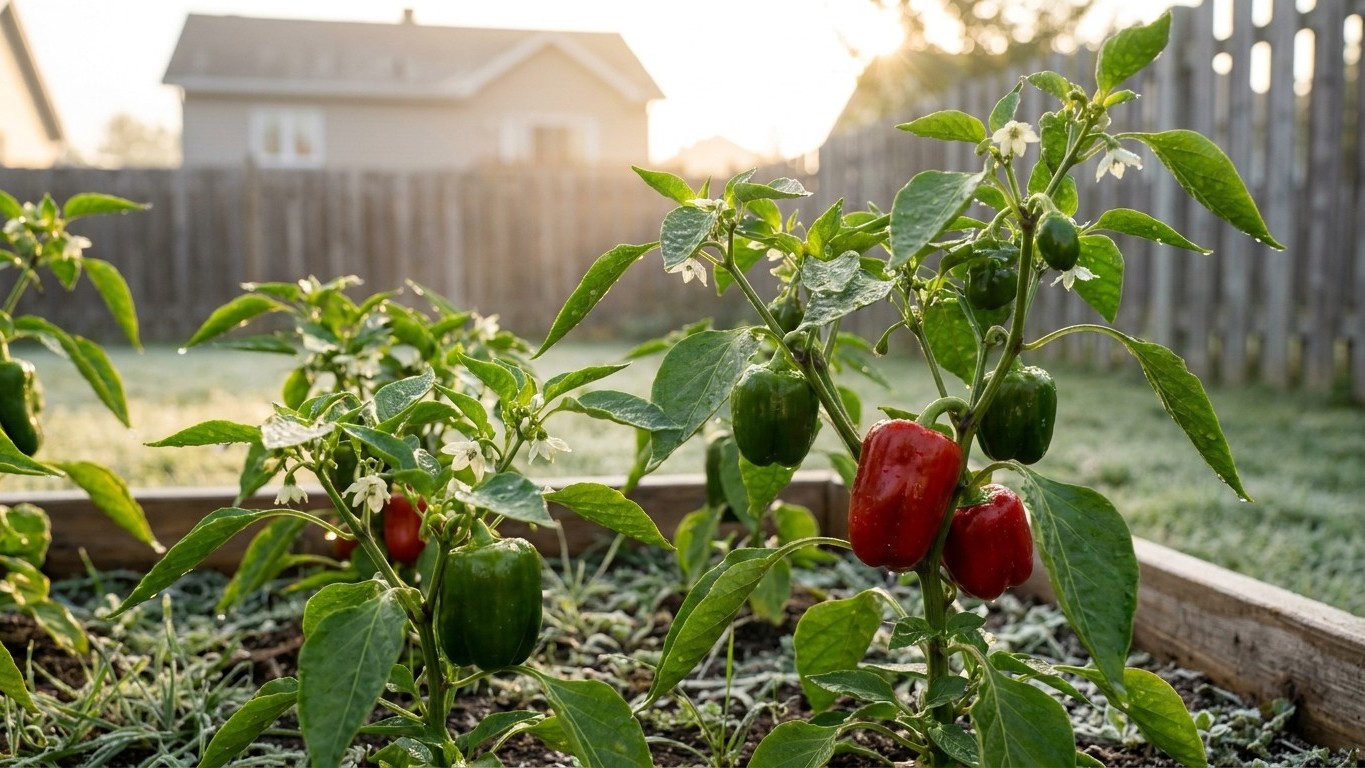

Pick peppers about 70 to 85 days after transplanting, when the fruit is firm, glossy and full-sized for its type. Then keep them out of the refrigerator. A home fridge runs colder than the 45 to 50 °F that peppers like, and below about 45 °F the skin pits and the flesh softens. That is chilling injury, and it is the mistake nearly everyone makes. Hawaii has no frost season to plan around, so your timing hangs on heat, nights and exposure.
The short answer
Honolulu, the reference station in NOAA’s most recent 30-year climate normals, reaches 90 F or more on 18.7 days a year. That is roughly one day in twenty. It is the hot-end risk in a single number, because Utah State University Extension says pepper fruit set fails when days climb above 90 F. A flower that opens during one of those afternoons is a flower likely to drop. The figure is an annual mean at one station, so it says nothing about which weeks those days fall in or how your own yard behaves. It does suggest that, at the reference station, the hot end is a matter of a few weeks’ worth of days rather than a whole season. A thermometer in the shade near your plants will catch the spells that matter.
The cool end deserves equal attention. The same Utah State guidance says fruit set also fails when nights fall below 55 F. This site does not carry summer night minima, so there is no local number to lean on here. Guessing from latitude, or from how mild your winters feel, would only be a guess. Elevation, rainfall, and whether your slope faces the trade winds or sits in their shadow all shift the answer from one garden to the next. A min/max thermometer at plant height, read each morning while flowers are opening, will tell you more than any regional average. If you are new to the crop here, Growing Peppers in Hawaii covers the wider picture.
Once fruit is set, the calendar gets gentler. Clemson Cooperative Extension says peppers “should be ready for harvest in about 70 to 85 days after transplanting.” Individual fruit keep a different clock: the 35 to 45 days run from flowering, not from sowing or transplanting. A flower that opens late in a bad stretch pushes that fruit later, whatever the seed packet implies. Pick when the fruit is firm, glossy and the size the tag promises. Utah State’s guide names six varieties but gives no heat rating, days or size for any of them, so this page attributes no figure to a variety name. Your tag is the better guide.
Then comes the step where good harvests get ruined. Clemson’s optimal storage is “temperatures of 45 to 50 °F and 80- to 90-percent relative humidity for two to three weeks.” That span is a ceiling under ideal conditions, not a promise. A domestic refrigerator sits below that band. Under about 45 °F, peppers pit and soften, and a crisper drawer that feels like the right place is exactly where it happens. The full guidance is on the Clemson factsheet. A cool, humid spot you have checked with a thermometer beats the fridge; otherwise, eat them soon.
When to start seed here
The usual advice is to transplant after the last frost and when soil reaches 60 F, counting back 8 to 10 weeks for indoor seedlings. In Hawaii the first half of that rule resolves itself. The arithmetic below is easy to redo for your own county.
- Drop the frost date. NOAA’s normals for the Honolulu station (USW00022521) show zero days a year at or below 32 F, and no freeze occurs in inhabited areas. Frost reaches only the high volcanic summits of Mauna Kea, Mauna Loa and Haleakala, never the places people garden. The “after frost” condition is met everywhere you are likely to plant, which is why no frost-based calendar appears on this page. The NOAA data is public.
- Let the soil pick the transplant date. Push a soil thermometer a few inches down in the morning. If the bed reads under 60 F, wait; at 60 F or above, you are clear to transplant. Rainfall, elevation and windward versus leeward exposure decide how quickly that happens, so a neighbor across the island may hit it on a different week.
- Count back 8 to 10 weeks. That is 56 to 70 days of seedling time indoors. Take a made-up transplant date of May 1, used only to show the arithmetic. Eight weeks back lands on about March 6, and ten weeks back on about February 20. Sow somewhere in that window, and swap in your own date to get yours.
- Count forward to check the harvest. Clemson’s 70 to 85 days after transplanting puts the first pickable fruit, from a May 1 transplant, between about July 10 and July 25. Flowers open well before that, so the weeks leading up to those dates are your fruit-set window.
- Test that window against both ends. If your thermometer shows days above 90 F or nights under 55 F stacking up across those weeks, move sowing a few weeks earlier or later and recount. The goal is flowers opening between spells, not through them.
One caution on step 3: if your seedlings stall indoors, the extra weeks are not wasted. Utah State’s range is a guide to how long transplants need, not a deadline they must meet to the day.
What goes wrong here
Hawaii’s peppers rarely die from the weather. They sulk, drop flowers, or scar. Four failures account for most of the lost fruit, and each has a fix you can do in an afternoon.
- Blossom drop in a hot spell. Days above 90 F, which Honolulu logs 18.7 times a year, make flowers fall without setting fruit. Cover plants with light shade cloth during the afternoon, keep watering steady, and hold back heavy nitrogen, which feeds leaves instead of fruit. New flowers usually follow once the spell passes. The longer diagnosis is in Why Peppers Fail to Set Fruit in Hawaii.
- Blossom drop on a cool night. Nights under 55 F cause the same flower loss from the other direction. This site does not carry summer night minima, so you have to watch your own. Read that min/max thermometer each morning, and on a night that looks marginal, cover plants or move containers against a warm wall.
- Sunscald. The sun here is strong, and fruit exposed to it develops pale, papery, sunken patches on the side facing the sky. Leave the leaf canopy alone instead of stripping leaves for airflow, stake heavy branches so they do not flop open, and use shade cloth over the hottest hours.
- Blossom-end rot. A dark, leathery, sunken patch appears at the bottom of the fruit, opposite the stem. It usually traces to uneven watering that keeps calcium from reaching the fruit, rather than a calcium-poor soil. Water deeply and consistently, mulch the bed, and run a soil test before adding any calcium. Dry leeward spells and sudden windward downpours both swing soil moisture hard, so mulch matters on either side.
Holes, gnawed shoulders and scarred skin belong to another list. What Eats Pepper in Hawaii, and When sorts those out.
Common questions
How do I know a pepper is ready to pick?
Use two checks together. Clemson’s guide puts harvest at about 70 to 85 days after transplanting, so count from the day you set the plant out. Then judge the fruit itself: firm, glossy and full-sized for the type on your tag. Any 35 to 45 day count for individual fruit starts at flowering, not at sowing or transplanting.
Can peppers go in the refrigerator?
Not as whole fruit if you want them to keep their texture. Clemson’s optimal storage is 45 to 50 °F at 80- to 90-percent relative humidity, for up to two to three weeks, which is a maximum under ideal conditions. A home fridge is colder than that, and below about 45 °F peppers pit and soften. Sliced or cooked peppers are a different case, since they will not be stored whole anyway.
Is there a frost date I should plan around?
No. NOAA’s normals for the Honolulu station show zero days a year at or below 32 F, and no freeze occurs in inhabited areas. Frost happens only on the high summits of Mauna Kea, Mauna Loa and Haleakala. Plan around rainfall, elevation and windward versus leeward exposure, and use the 60 F soil reading as your transplant signal.
Do cool nights matter in Hawaii?
They can. Utah State University Extension says fruit set fails when nights fall below 55 F, just as it does when days top 90 F. This site carries the count of days at or above 90 F but not summer night minima, so you have to measure your own. A cheap min/max thermometer left at plant height for a couple of weeks while flowers open will show you whether the cool end is a real risk in your yard or a non-issue.