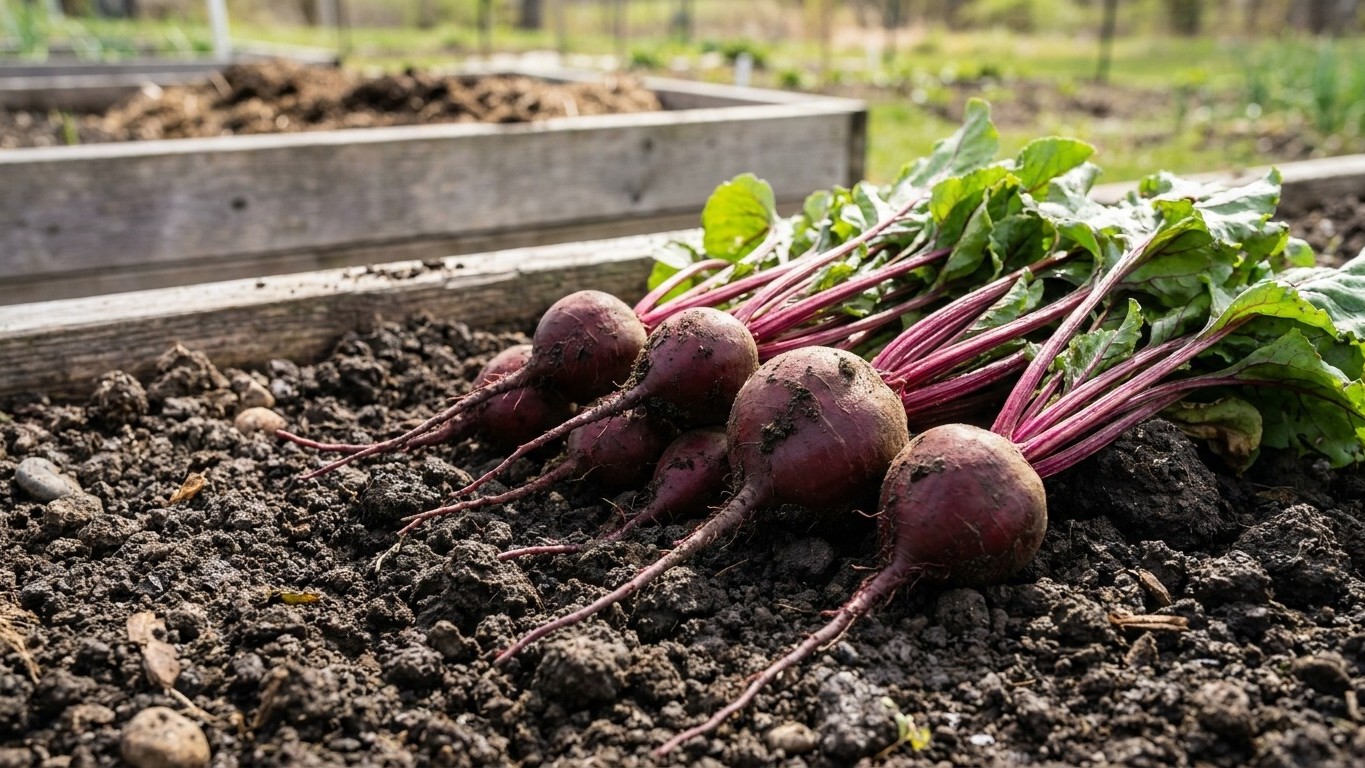

Count 60 to 80 days from the day the seed goes into the ground, then pull. Beets are sown in place, so a transplant date never enters the math. After harvest, the cold rule runs backward from what most gardeners expect. Topped roots keep best at 33 to 36 F, while the 32 to 34 F range people reach for first produces more black spot and rot. Top them right away, store the big roots, and eat the small ones first.
The short answer
Hawaii’s state soil is the Hilo series, an Andisol, which is volcanic-ash ground: light, porous, and unusually good at holding both water and phosphorus. USDA NRCS Soil Data Access lists the representative surface values as 10 percent sand, 35 percent clay and 55 percent silt, with about 9.0 percent organic matter, a surface pH around 5.8 (slightly acid), and a well-drained rating. Those numbers come from the surface horizon of four mapped components of the series. They are not a reading of anyone’s worked bed. Hawaii spans hundreds of soil series, so treat this as a starting point.
Utah State University Extension, the authority behind this page’s growing rules, describes the beet’s ideal as deep, sandy, well-drained soil rich in organic matter. Hilo clears two of those three bars. Drainage and organic matter are both strong. Sand is the miss, at only 10 percent, so on paper the texture reads heavy and fine-grained. The ash chemistry softens that, since this ground behaves lighter than its percentages suggest. Its water-holding talent also matters for beets, as the next section explains. For a closer look at what the root meets underground, see Beet Soil in Hawaii: What the Root Will Meet.
Heat, and the 90 F question
The page brief called for a count of days a year the reference city passes 90 F. That figure is not published in the data behind this page, so there is no number to give you, and a guess would be worse than a gap. The threshold that matters in the Extension guidance is lower anyway: heat above 85 F combined with water stress makes the root woody. Put a thermometer in the shade near the bed and trust it over any regional average.
Two separate failures hide in that guidance, and they should not be folded into a vague “keep it watered.” Water stress in the first 6 weeks causes premature flowering, which is bolting. Heat above 85 F with water stress later on makes the root woody. One ruins the crop early, the other spoils it late, and they call for different timing. The harvest window follows from the same count: 60 to 80 days from seeding gives you a 20-day span in which to pull, and the sooner end of it is safer when the bed is running hot.
The six weeks that decide it here
The usual advice to sow two to three weeks before the last frost has nothing to attach to in Hawaii. NOAA NCEI’s most recent 30-year climate normals for station USW00022521 show zero days a year at or below 32 F, and the freeze percentiles at 32 F and 36 F come back flagged as not computable. Frost does occur on the high volcanic summits (Mauna Kea, Mauna Loa and Haleakala), but nobody gardens there. In lowland Hawaii there is no frost season, so a frost-based calendar would be fiction.
Rainfall, elevation and exposure do the work a frost date does elsewhere. Windward slopes catch trade-wind showers and tend to stay damp. Leeward coasts sit in a rain shadow and run dry. Broadly, the winter months are the wetter half of the year and summer the drier half, though a windward bed and a leeward bed a few miles apart can behave like different states.
That is where the bolting risk sits. The first six weeks after seeding are the ones that matter, and any dry stretch that lands inside them without irrigation is the threat. Leeward and sheltered sites face it most often, and a summer sowing faces it more than a winter one. A bed that dries out on day 20 can send up flower stalks that no later watering will undo.
Here the Hilo-type ground has a real advantage. Ash soil holds water well, so a bed that behaves like the series gives you a buffer through a missed day or two. Do not lean on it for a week without rain. Keep the seedbed evenly moist from sowing through week six, and treat that stretch as the part of the season you do not skip. Pests are another early stress, and What Eats Beet in Hawaii, and When covers who shows up and which weeks to watch.
Once week six passes, the worry changes from bolting to heat. Keep counting toward day 60. Brush the soil from a shoulder or two to judge size, and pull when the roots are ready rather than waiting for a cue the climate will never send. There is no frost to force the decision.
What goes wrong here
- Bolting after an early dry spell. Water stress in the first 6 weeks triggers premature flowering. The remedy is prevention: keep the seedbed evenly moist from sowing through week six, and check leeward or windy beds daily. A bolted plant will not recover.
- Woody roots in hot, dry weeks. Heat above 85 F with water stress makes the root tough. This is a later failure than bolting and a different one. Water consistently once the roots are sizing up, and pull at the early end of the 60 to 80 day window when the bed is running hot. That timing is a practical call, not a figure from the source.
- Trusting the state soil as your soil. Hilo is what represents Hawaii, not what is in your yard. Scraped, filled or river-bottom ground will differ completely. Get a soil test before you amend, and keep any compost to no more than 1 inch of composted organic matter per 100 sq ft.
- Storing at the coldest setting. During storage at 32 to 34 F, more black spot and rot occur than at slightly warmer temperatures. Aim for 33 to 36 F for topped roots at 98 percent humidity, and put a thermometer where the beets sit.
- Leaving the tops on. Bunched beets last about 10 to 14 days at 32 F and above 98 percent humidity, and no longer. Cut the leaves off first, and eat the greens fresh.
- Saving the small roots. Large roots keep much better because they lose water and shrivel more slowly. Eat the small ones first and keep the big ones for storage.
Common questions
How many days from sowing to pulling?
Plan on 60 to 80 days, counted from seeding. Beets are sown in place, so there is no transplant clock to restart. The full growing picture is in Growing Beets in Hawaii.
Should I keep beets at the coldest setting in the fridge?
No. USDA Agricultural Handbook 66 puts topped beets at 1 to 2 C (33 to 36 F) and 98 percent humidity, and says that at 32 to 34 F more black spot and rot occur than at higher temperatures. For pits and cellars it sets limits: stay above 31 F and below 41 F. The full chapter is in USDA Agricultural Handbook 66.
Which beets should I store, and which should I eat now?
Top all of them first. Bunched beets with leaves last 10 to 14 days at best. Then keep the big roots for storage and eat the small ones, because small roots lose water and shrivel faster.
Can I rely on the Hilo soil numbers for my own garden?
Treat them as a starting point only. The figures are USDA’s representative values for the surface horizon of the series as mapped, from four components, and Hawaii has hundreds of soil series. A lab report on your own bed will tell you more than any state average, and it costs less than a failed crop.