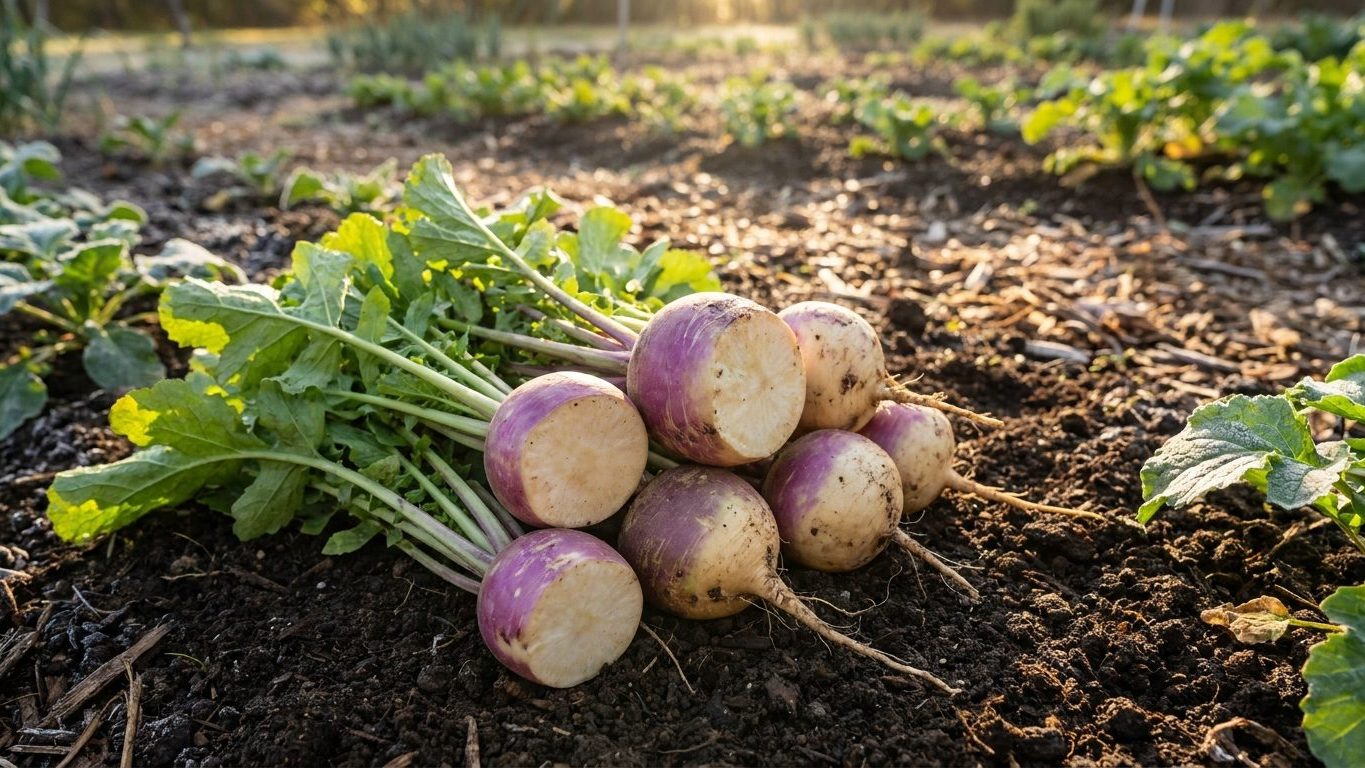

Growing turnips in Georgia works best as a fall crop, with a shorter spring planting as a bonus. At the Atlanta reference station, the normal last freeze falls between March 11 and March 29, and the first fall freeze between November 13 and December 1. That is a long runway. The trouble is summer heat, which shortens the spring crop and makes late-summer sowing a timing game. Rutabaga follows the same logic, only slower.
When the soil is warm enough in Georgia
What the frost dates say, and what they don’t
The date most gardeners search for comes from the NOAA NCEI 1991-2020 Climate Normals for station USW00013874 in Atlanta. Using the 32°F freeze probabilities (the 30-70% band), the last spring freeze lands between March 11 and March 29. Treat that as a probability, not a promise: a cold snap after the band has passed is part of the odds.
Frost is only a proxy, though. Turnips and rutabaga don’t care about the calendar. They care about the soil, and soil warms after the frost risk ends, not with it. A bed can be frost-free on paper and still be cold, soggy Georgia clay where seed sits for weeks and rots before it sprouts. The practical test is physical. Push a soil thermometer into the top inch or two in the morning, and check that a handful of soil crumbles instead of smearing into a ribbon. If it smears, wait.
The Georgia twist: the soil question flips in fall
Here the crop behaves differently than it does up north. A spring sowing in Georgia is a race against rising heat, because roots that mature in warm weather tend toward a woody, sharp-tasting result. Get seed in as soon as the bed is workable and dry enough, then harvest while the weather is still mild.
The main crop runs on the opposite problem. Late-summer soil is hot and can dry out within a day, so the question is not whether the ground is warm enough but whether it has cooled and moistened enough for seed to germinate and seedlings to survive. Sowing too early means scorched seedlings and a bed full of flea beetle damage. Sowing too late means small roots when the cold arrives. For the dates that fit your county, ask University of Georgia Extension, which publishes planting calendars by region.
One caution about the numbers above. Atlanta is an urban airport heat island, so its dates run kinder than the surrounding countryside. North Georgia and the mountains freeze several weeks earlier in fall, and the coastal plain runs milder. Shift your own expectations accordingly. A garden in the northern counties has less fall room than the Atlanta figures suggest, and one near the coast has more.
How long the season lasts here
Doing the subtraction
Both ends of the Atlanta window come from the same NOAA station, so the arithmetic is fair. Pair the latest spring date (March 29) with the earliest fall date (November 13) and you get 229 days between freezes. Pair the earliest spring date (March 11) with the latest fall date (December 1) and you get 265 days. The honest answer is somewhere between those two numbers, and the actual year will land wherever the weather puts it.
For comparison, our guide to growing turnips and rutabaga in Ohio deals with a much shorter frost-free stretch, where the first sowing is often the only one. Georgia does not force that choice.
What a long window allows
A window this long permits things a short one forbids. You can sow a spring crop early, pull it before the heat, and still have the whole summer to prepare a fall bed. You can also stagger fall sowings a couple of weeks apart instead of betting everything on one date. If one planting is hit by a hot spell, a dry stretch or a flush of beetles, the next one covers the gap. The main guide to growing turnips and rutabaga covers the basics, and the succession sowing guide on this site explains how to space those plantings.
Transplanting is the other decision a long season changes. These are root crops, and the root is the part you eat, so disturbing it risks forked or stunted roots. In a short season you might accept that risk to gain weeks. In Georgia there is rarely a reason to. Direct sowing costs you nothing in time, and it skips the root check that transplants require. The one exception is a late-summer bed where seed won’t hold moisture, and even there, thinning and shading are usually better answers than moving seedlings.
Rutabaga deserves a note of its own. It matures more slowly than turnip and wants cool weather to finish, so it is the crop that most benefits from the length of the Georgia fall. Give it the earliest fall slot your heat allows, not the last.
Heat and water in Georgia
The numbers this page does not have
Georgia summers are hot and humid, and anyone who has weeded a garden in July knows it. But this page has no verified count of days above 90°F and no verified summer rainfall figure, so it will not make one up. What matters for the crop is the direction. Heat and humidity are what you plan around from June through September, and the key cold-side figures are the ones that decide what happens from October on. Compare this with growing turnips and rutabaga in Arizona, where heat dominates in a very different way, and Georgia’s problem looks more like moisture and disease than raw temperature.
Humid heat is hard on brassicas. Wet foliage and warm nights favor leaf diseases, and turnips and rutabaga are brassicas, which means they share their troubles with cabbage, kale and mustard. Flea beetles, aphids and fungal leaf spots that hit one hit all of them. That is why rotation matters here: a gardener who follows turnips with collards has rotated nothing. Keep these crops out of any bed where another brassica grew recently, and use the rotation guide on this site to map your beds.
What the cold side decides
The coldest month at the Atlanta reference station has a mean daily minimum of 35.6°F, per the NOAA 1991-2020 normals. That is an average of nightly lows, not a record, so individual nights will be colder. Still, it suggests roots in Atlanta’s range can generally stay in the ground under mulch through winter instead of being lifted and stored. A thick layer of straw or shredded leaves keeps the soil from freezing hard and lets you harvest as needed.
The same figure limits how much frost sweetening you get. Cold nights push roots to convert starch to sugar, and a winter that rarely dips well below freezing offers less of that than one in the northern states. Expect a milder sweetening in the Atlanta area, more of it in north Georgia where the first freeze arrives weeks earlier. The USDA Plant Hardiness Zone Map (2023, built on average annual extreme minimum temperature) puts Georgia in zones 6a through 9b, a spread that tells you how different the mountains and the coast are. Look up your own location and don’t rely on a statewide number.
If you do lift roots, inspect each one before it goes anywhere. A soft patch, a weeping spot or a moldy crown ends the question: discard that root. Do not trust one because it looks sound on the outside, and don’t assume a stored root is safe because the one next to it is fine. This page offers no keeping duration, because none can be promised.
Which turnips and rutabaga suit Georgia
Choosing by type, not by name
This page names no cultivar, and that is deliberate. The only recommendation that means anything is one from trials run in your own part of the state, and this page does not have those results. A variety that thrives in Atlanta’s clay may struggle in the mountains or sandy coastal soil. Naming one without trial data would be a guess dressed up as advice.
What can be reasoned from the facts is the type of plant to look for. In Georgia, three considerations stand out:
- Humidity makes disease resistance the first criterion. Read seed descriptions for resistance to leaf diseases before anything else.
- Heat favors types that size up quickly, so the root is ready before summer or after it. Spring sowings in particular should be fast types.
- Airflow and shade at the root help in hot weather. Space plants generously, keep soil mulched, and consider light shade cloth on late-summer sowings.
Georgia’s long window means the very earliest types are not a necessity as they would be farther north. You can afford a slower, more flavorful type for fall, and rutabaga fits there too, provided you give it the early end of the fall window.
Where to find the local answer
Your county extension office is the right next stop. University of Georgia Extension maintains vegetable planting guides and county agents who know which varieties have performed in trials near you. Ask specifically about disease resistance and about the best sowing dates for your region, since north Georgia, the Atlanta area and the coastal plain differ by weeks. A county agent can also test your soil, which is worth doing before you plant any brassica.
Common questions
Can I grow turnips in Georgia in spring?
Yes, with a short window. Sow once the bed is workable and the soil has dried enough to crumble, and harvest before summer heat makes the roots woody. The Atlanta last-freeze band (March 11 to March 29) is a guide, not a trigger.
Do turnips survive Georgia winters?
Generally, yes, in much of the state. The Atlanta reference station has a coldest-month mean daily minimum of 35.6°F, so roots can usually stay in the ground under mulch. Colder nights occur, especially in north Georgia, so watch the forecast and mulch ahead of a hard freeze.
Is rutabaga harder to grow in Georgia than turnip?
Rutabaga is slower and more dependent on cool weather to finish, so it has less room for error in hot, humid places. Give it the early part of the fall window and keep soil evenly moist, then check with your extension office about local trials.
Can I plant turnips where I grew collards or cabbage?
Avoid it. Turnips, rutabaga, collards, cabbage, kale and mustard are all brassicas and share the same pests and diseases, so rotating between them does not break the cycle. Choose a bed that held something outside the family, such as beans, tomatoes or squash.