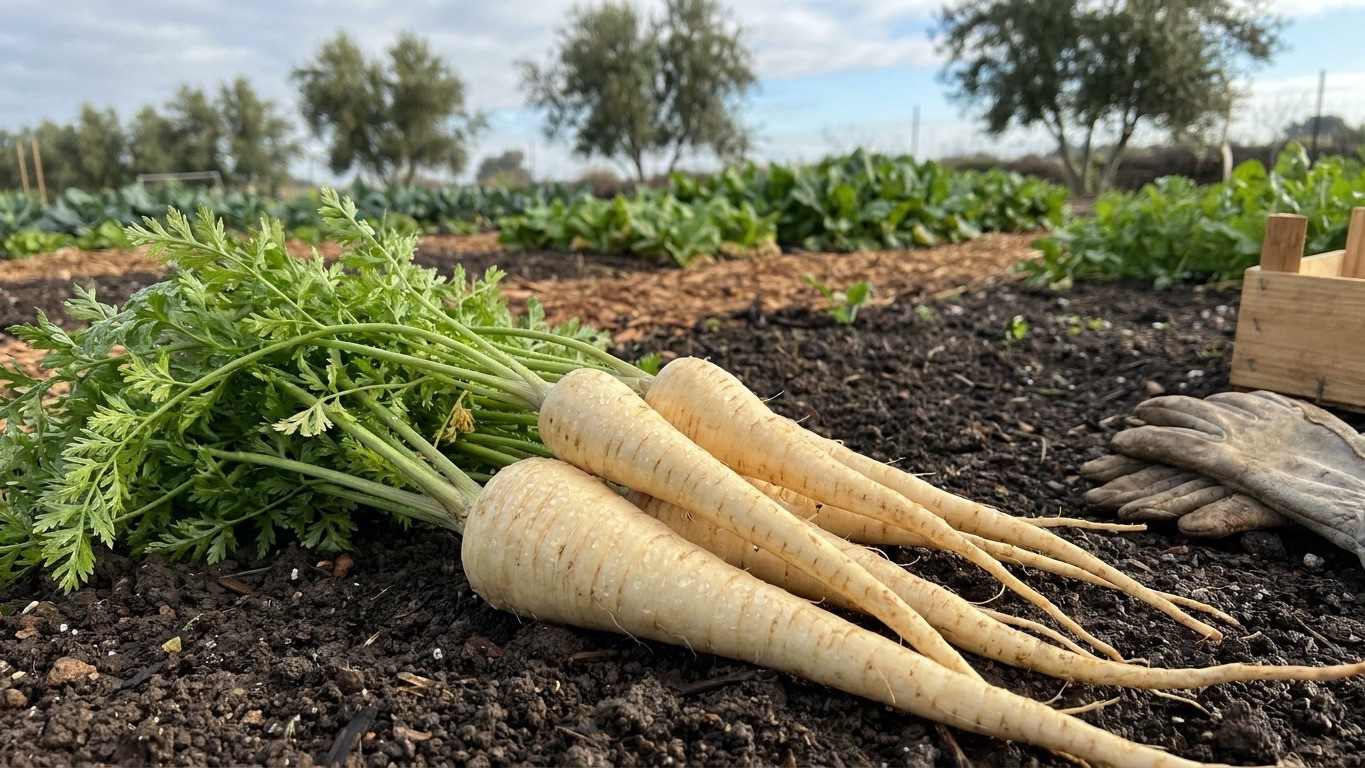

Lift parsnips in Illinois after several frosty weeks. In the Chicago reference record that means mid-November at the earliest, and you can keep digging through winter whenever the ground is workable. Once out of the ground, they keep four to six months, but only at 32 to 34°F and 98% humidity, and never near apples. The roots are sown in spring and wait on the cold, so the dig date is less a deadline than a flavor decision.
The short answer
Does Illinois deliver several frosty weeks? At the Chicago reference station, the mean daily minimum of the coldest month is 18.8°F, per NOAA NCEI Climate Normals. That is the average night, so plenty of nights run colder and a few run warmer, but the typical low sits more than 13 degrees under freezing. A parsnip grown here will not merely grow. It will sweeten, because the cold has the time and the intensity to do the work.
The mechanism is simple. Utah State University Extension notes that parsnips taste best after several weeks of cool, frosty weather, which converts stored starch to sugar. A root pulled in September is edible, but it tastes starchy and plain. The same root pulled after a month of hard nights tastes like a different vegetable. The sweetening is a response to exposure, and exposure is counted in weeks of actual frost, not in a number on a map.
That distinction matters because it is tempting to read a hardiness zone and call it settled. Don’t. A zone describes how cold the worst winter nights get, which tells you whether a plant survives. It says nothing about how many frosty weeks stack up in a row, and that count is what sweetens a parsnip. A place can have a comfortable zone and a winter that never stays cold long enough to do the job. Chicago’s record shows the reverse, a long run of nights well below freezing. For a fuller look at the sweetening itself, see Will Parsnips Sweeten in Illinois?
Timing the dig follows from the frost dates. The first fall frost at the reference station falls between October 24 and November 3. Those are airport figures, and suburban and rural gardens usually see frost one to two weeks earlier, which starts your sweetening clock sooner. Count several weeks from your own first frost, not from the calendar. In practice that puts the first worthwhile dig somewhere from mid-November onward, with the sweetest roots arriving later still.
Southern Illinois runs milder than Chicago. This page holds no coldest-month figure for that end of the state, so check your county’s normals before assuming the northern result applies. If your winters turn out gentle, you will grow a good parsnip that never gets properly sweet.
On dig day, loosen the soil beside the row with a fork and lift each root rather than yanking the tops. Parsnips are topped after harvest, but the USDA’s storage handbook advises against trimming into the crown. Cut the leaves off just above it and leave the shoulder intact. Pull one root first and taste it raw. If it still seems bland, give the row another week or two.
Does the season fit?
The math works in Illinois, and it works with room to spare. Parsnips are sown in place, never transplanted, and the 100 to 120 days run from seeding. Here is the count, using the reference-city dates:
- Start with the last spring frost. At the Chicago reference station, NOAA NCEI puts it between April 11 and April 22. A suburban or rural garden is often one to two weeks later, so treat these dates as a starting point and look up your own county.
- Back up two to three weeks to find the sowing date. Parsnips are sown 2 to 3 weeks before the last frost. That gives a seeding window of about March 21 to April 8 at the reference station. Later spring frost in your garden pushes the window later by the same amount.
- Wait out germination. Seeds take 14 to 21 days to come up, and parsnips are slow enough that a row can look empty for three weeks. Mark the row and do not dig it up or re-sow. Bare soil at day 10 is normal.
- Add 100 to 120 days to the sowing date. Seeding on March 21 and counting 100 days lands on June 29. Seeding on April 8 and counting 120 days lands on August 6. The roots reach full size between early summer and early August.
- Compare against the first fall frost. At the reference station, that frost arrives between October 24 and November 3. From the latest maturity date, August 6, to October 24 is about 79 days. The crop finishes about eleven weeks before the cold arrives.
- Stress-test the late case. Say you sow as late as April 22 and count the full 120 days. That is August 20, still more than two months ahead of the earliest fall frost. Even if frost arrives a couple of weeks early in a rural garden, the margin holds.
The verdict is a comfortable fit. Illinois offers roughly 185 to 206 frost-free days between the reference dates, against a crop that needs 100 to 120. The surplus is not wasted. It is the period when the roots sit mature and wait, and it is why the real limit on a parsnip here is not the length of the growing season but whether you sow early enough to avoid summer heat stress on slow seedlings. Sowing in the first half of April, as soon as the soil can be worked, keeps you near the low end of the window.
What goes wrong here
- Forked roots from heavy or stony ground. Much of Illinois sits on clay-rich soil, and a taproot that meets compaction or a stone splits and forks. Utah State University Extension recommends deep sandy soil and says heavy soil must be double dug. Dig two spades deep, remove stones, and break up clods before sowing. Your own soil is the deciding factor, so test a spadeful before assuming the worst.
- Forked roots from overwatering. This is a separate cause with a separate fix. Soaking the bed constantly can also encourage a branching, hairy root even in loose soil. Water deeply but less often, and let the top inch dry between sessions. Check the drainage before you check the soil texture.
- An empty row mistaken for failure. Germination takes 14 to 21 days. Gardeners who dig up bare soil at day ten and re-sow end up with a patchy row of mixed ages. Wait the full three weeks before deciding anything.
- A season that runs out. Sowing in May or June, after the March and April window has passed, squeezes 100 to 120 days against the first fall frost. A June 15 seeding reaching 120 days lands in mid-October, right at the reference first-frost window. Sow early, and note that pests that chew seedlings, covered in What Eats Parsnip in Illinois, and When, are easier to outgrow with an early start.
- A winter too mild to sweeten. Where nights rarely stay cold for weeks, the roots grow fine and never turn sweet. Lifting earlier will not fix that. If your county’s winters are mild, check local normals before committing garden space, and accept a milder flavor.
- Bitterness from ethylene in storage. A parsnip is not chilling sensitive, so cold is not the risk. Ethylene is. The USDA handbook says even low levels in cold storage cause bitterness. Keep stored roots away from apples, pears, and any ripening fruit.
- Cutting into the crown. Top the roots after lifting, but do not trim into the crown. A cut shoulder invites rot and shortens storage life.
Common questions
Can I lift parsnips before the first frost?
You can, and they will be edible once they reach full size. They will taste starchy, though, because the starch-to-sugar conversion needs several weeks of cool, frosty weather. Leave them in the ground and dig as you need them.
How long do lifted parsnips really keep?
The USDA handbook gives four to six months at 32 to 34°F with 98% relative humidity. That figure assumes both held steady, which almost no house manages. A refrigerator crisper is the closest most households come, and the roots will likely last a shorter time there. A cold, damp cellar or garage that stays just above freezing comes nearer to the target.
Is it safe to store parsnips next to apples?
No. Parsnips produce very little ethylene themselves, but exposure to low levels from nearby fruit turns them bitter in cold storage, even at the right temperature. Keep them in a separate drawer, bag, or room from apples, pears, and anything ripening.
How do I dig them without snapping the roots?
Start with the bed. Utah State University Extension calls for deep sandy soil, and heavy soil must be double dug before sowing, which also sets up an easy lift later. At harvest, push a fork into the ground a few inches beside the row, rock it back to loosen the soil, and ease each root up whole. Top the leaves after lifting, leaving the crown uncut. The USDA handbook with the storage figures is available at its Agricultural Research Service posting. For the full crop plan, start at Growing Parsnips in Illinois.