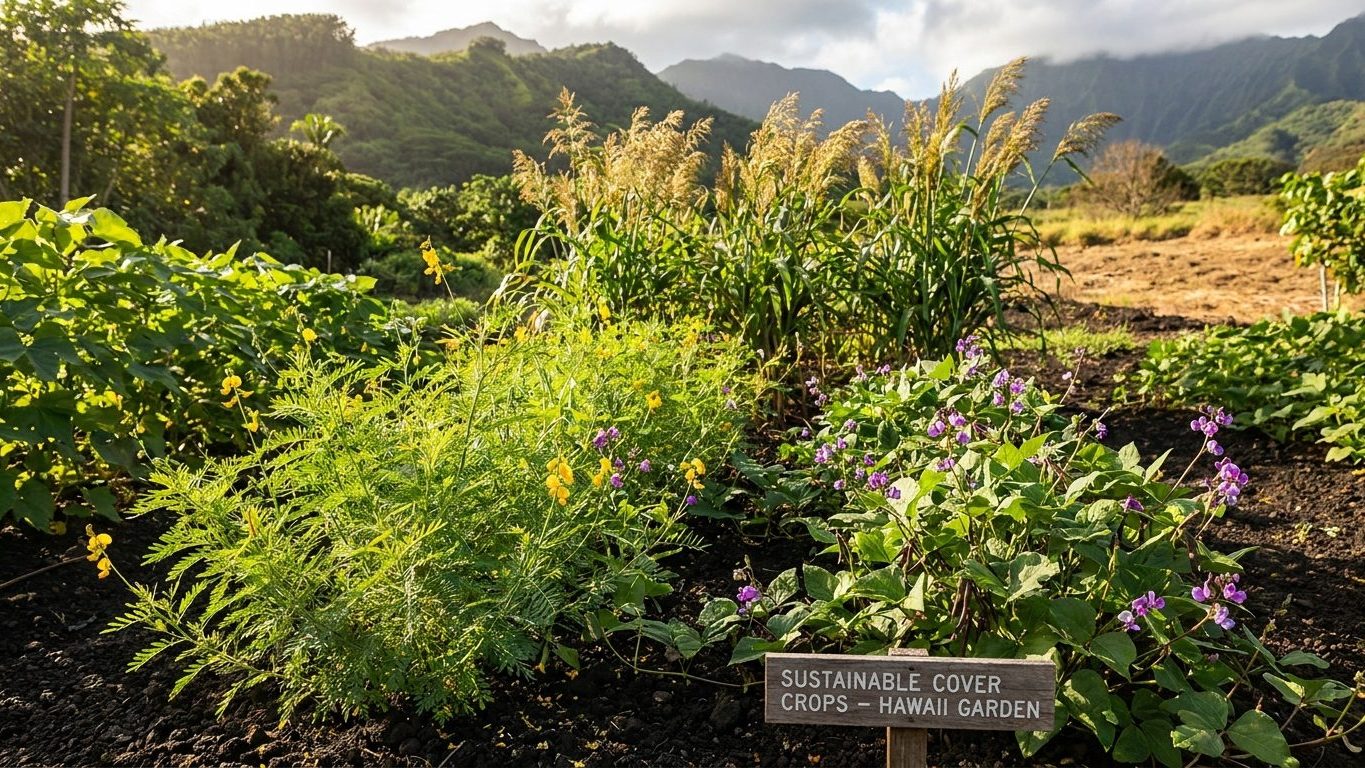

Alberta’s cover crop options come down to two clear paths: fast-maturing spring annuals sown after the frost risk drops in late May, and one exceptionally hardy fall cereal that carries a field through the winter. Everything else on the seed catalog list either won’t finish or won’t survive.
The short answer for Alberta
Pick by season length and winter cold, not by what a neighboring province grows. The average frost-free window here runs from May 21 to September 16, which works out to roughly 118 days, and the coldest month averages a daily minimum of just 8.2°F. Those two numbers, taken from the Calgary Int’l A station, decide almost everything about what survives.
For a spring-sown cover that needs to grow, bloom or at least build biomass before the fall frost mean, the safe types are the fast ones: oats, spring barley, field peas, oilseed radish, mustard, phacelia and buckwheat. All of them can establish, do their job (nitrogen scavenging, weed suppression, soil structure) and winterkill cleanly within that 118-day window, which is exactly what you want in a rotation that needs the ground back for a cash crop.
For anyone who wants a cover crop standing through the winter and greening up again in spring, fall rye (cereal rye) is the standout. It’s routinely seeded in Alberta in late summer or early fall specifically because it tolerates winter cold that would kill most other options, and it resumes growth as soon as soil temperatures allow the next spring.
| Goal | Best type | Why it fits |
|---|---|---|
| Fast summer-fallow cover | Oats, field peas, oilseed radish, phacelia, buckwheat | Mature or build biomass inside a ~118-day window |
| Overwinter cover | Fall rye | Tolerates a coldest-month mean minimum near 8°F |
Everything in between, slower legumes, tender winter annuals, warm-season specialists, needs a hard second look before it goes in the ground here.
What will not work here
Warm-season cover crops are the first casualty. Cowpea, sunn hemp and sorghum-sudangrass are bred for regions with long, hot growing seasons; they need sustained warmth to germinate well and weeks more to build the biomass that makes them worth planting. With an average frost-free stretch of about 118 days, and Alberta summers running cool relative to the U.S. Corn Belt, these crops routinely fail to reach a useful size before the September 16 mean frost date shuts things down. In a year where frost arrives on the earlier side of that average, and it often does since this is a mean, not a guarantee, the loss is even worse.
The second failure point is winter survival. Crimson clover, subterranean clover and hairy vetch sown as standalone overwintering covers are popular in milder zones, but they’re rated for winters considerably gentler than an average coldest-month minimum of 8.2°F. Without a reliable, deep snow cover acting as insulation, and snow depth varies year to year and field to field, these legumes are a gamble as a sole winter cover crop. Some growers blend a little vetch into a rye stand for the nitrogen benefit, but leaning on it alone in zone 4a is asking for a bare, dead stand come April.
Timing failures matter as much as species choice
Even a fast, appropriate crop can fail on timing. Oilseed radish or mustard seeded in late August is racing a September 16 mean frost with almost no margin, since the mean itself is only a midpoint, in half the years frost comes earlier. A cover crop that needs six to eight weeks to be useful, sown with four weeks left on the calendar, simply won’t deliver the biomass or root structure it’s planted for.
What changes across Alberta
The 4a hardiness zone figure in this page comes from one reference point, the Calgary area, using the Canadian system built on seven climate variables rather than the single-variable USDA scale. That matters because Alberta is not one climate. A province running from the Montana border north past the Peace Country, and from prairie flatland up into foothill elevation, does not share one frost date, one snow pattern or one winter minimum. Whatever the zone reads at a given town, it will not read the same two hundred miles north or a thousand feet higher.
That means the frost dates and the 8.2°F winter minimum used throughout this page describe conditions around Calgary specifically, not a province-wide average. A grower near the northern grain belt or at higher elevation in the foothills should expect a shorter frost-free window and a colder winter minimum than what’s listed here, which pushes the calculus further toward the fastest spring covers and further away from anything marginal on winter hardiness, fall rye included, since even it has limits.
Rather than guess where an individual property falls, the right move is checking the actual zone for that location on Natural Resources Canada’s mapping tool. It uses the same seven-variable system behind the number quoted on this page, and it’s built to be checked address by address rather than assumed from a provincial average: https://planthardiness.gc.ca/?m=22.
Where to check this for your own county
This page describes Alberta at the provincial level, built from one reference station’s climate normals. A municipal district or county-level recommendation will always beat that, because it accounts for local soil, local snow cover and local microclimate in a way a province-wide page can’t.
The place to look is Alberta’s Ministry of Agriculture and Irrigation: https://www.alberta.ca/agriculture-and-irrigation. Two things are worth hunting for once there. First, a local or regional planting calendar, since sowing windows for cover crops shift meaningfully between the southern prairie and the Peace region, and a provincial ministry resource is more likely to break that out than a general seed catalog. Second, look for variety trial results for the specific municipal district or region in question. Alberta’s agricultural extension work regularly tests cover crop varieties, including fall rye lines and brassica mixes, under local conditions, and those trial results reflect actual survival and biomass numbers from nearby fields rather than a station-based estimate.
Treat anything found there as the tie-breaker over this page. A provincial average frost date is useful for a first pass at planning, but a county-level trial or calendar reflects what has actually grown, and actually survived, closer to home. If the two disagree, especially on winter hardiness near the province’s colder or higher-elevation districts, the local source should win.
Checking this against your own garden
None of the dates on this page beat what’s happening in the actual dirt. A mean frost date is a fifty-year average boiled down to one day; a particular spring or fall rarely matches it exactly, and a grower’s own observations catch that faster than any calendar.
Three signals are worth tracking by hand, literally. First, soil warmth: crumble a handful of topsoil in early spring before sowing anything. Cold, tight and slow to break apart means germination will lag no matter what the frost date implies. Second, watch the first true leaves on a fast test crop like oats or field peas. If they show up noticeably earlier or later than expected from the May 21 mean, that’s a direct read on how this particular spring, and this particular field’s exposure and drainage, compares to the station average. Third, note the date the season’s first hard frost actually nips a tender crop like buckwheat in the fall. That’s the real end of the growing season for that plot, and tracked over a few years, it builds a far more useful personal planting calendar than any single mean date ever will.