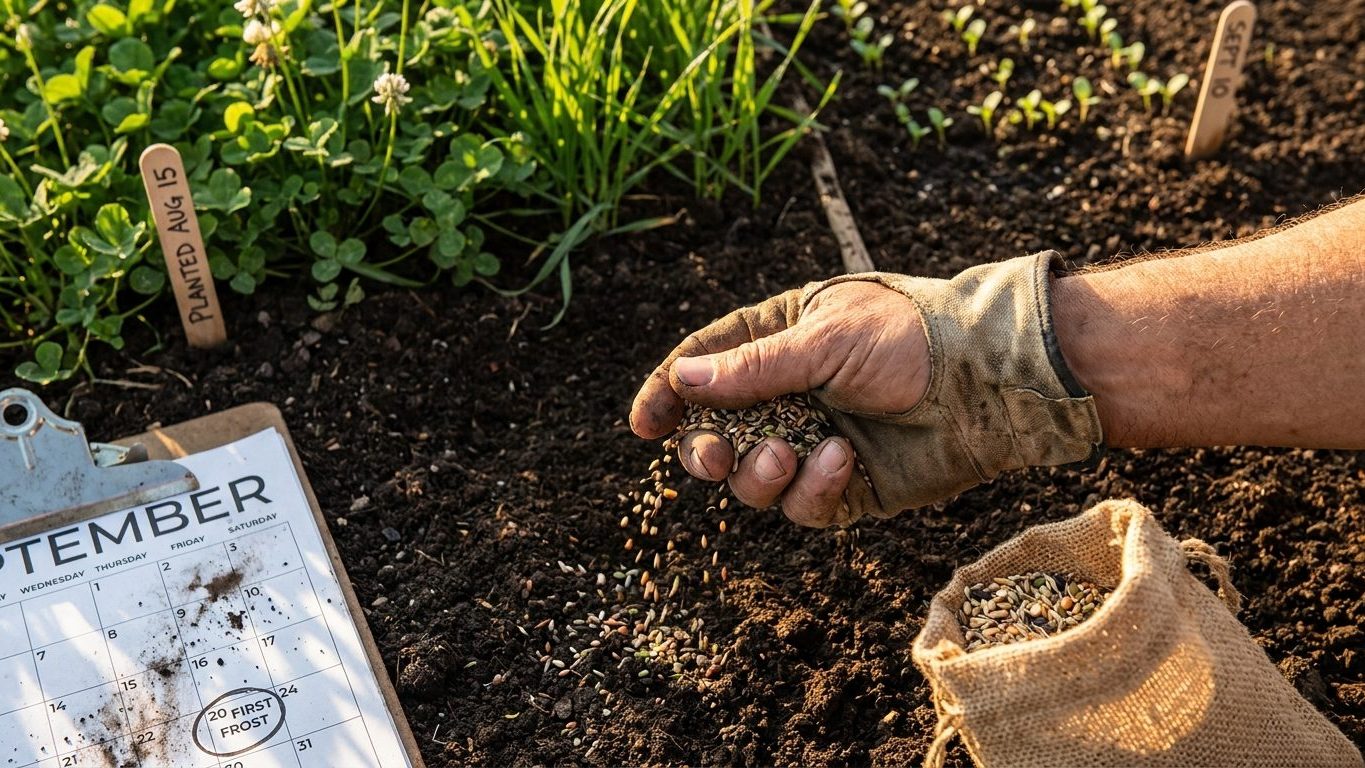

The right sowing date is your average first fall frost date, counted backward by the number of weeks a given species needs to establish. Legumes and brassicas typically need 6 to 10 weeks of growth before a hard freeze; cereal grains like rye and oats can go in as late as 2 to 4 weeks before frost and still do their job. The exact week depends on species and your local climate, not a fixed calendar date.
What is actually going on
The thing to understand here is establishment. A cover crop doesn’t need to flower, set seed, or reach any kind of “maturity” in the way a vegetable does. It needs enough leaf area and root mass to hold soil, shade out weeds, and, for legumes, run through the early stages of the nitrogen-fixing partnership between the plant and soil bacteria. Miss that window and the seed still germinates most of the time. It just never becomes anything worth having.
What makes counting backward from frost tricky is that growth isn’t linear as the season closes in. A cover crop sown in early September in a cool-summer region grows fast: warm soil, long days, plenty of sunlight hitting the leaves. Sow that same species three weeks later and growth slows dramatically, even though the calendar gap looks small. Day length is shrinking, sun angle is lower, and soil temperature is dropping toward the point where germination itself stalls. Two weeks lost in early September might cost a plant almost nothing. Two weeks lost in late October can be the difference between a cover crop that survives winter and one that never gets past the seedling stage.
Cold tolerance is the second half of the mechanism, and it splits species into two camps. Winter-killed covers, oats being the classic example, are bred and selected to grow fast, then die outright at the first hard freeze, leaving a mat of residue on the surface. Winter-hardy covers, cereal rye and hairy vetch among them, are built to survive freezing temperatures as small plants and resume growth in spring. Both strategies work. But they only work if the plant reaches the right stage of growth before winter shuts things down, which is exactly why the sowing window differs by species rather than being one universal date for the whole garden.
This is also why a seeding rate you saw somewhere else, or a rate meant for a drilled field, isn’t something to copy directly into a backyard bed. Rate depends on the species, whether you’re broadcasting by hand or using equipment, and how much competition from existing weeds or crop residue the seed is up against. A rate that’s too light leaves gaps that weeds fill; too heavy wastes seed and thins itself out through competition. Your state’s Cooperative Extension office, part of the USDA’s land-grant extension network, publishes rate charts calibrated to your region and is the better source than a generic number pulled from a different climate.
In the garden
Counting backward means picking your average first frost date first, then working out how many weeks a species needs before that date arrives. The table below lays out the general lead time by species, along with what actually happens if you sow later than that window allows.
| Species | Weeks before first frost to sow | Winter behavior | What happens if sown too late |
|---|---|---|---|
| Forage radish and other brassicas | 8 to 10 weeks | Winter-kills in most regions | Taproot stays thin and short, so it never breaks up compaction, which is the entire reason to grow it |
| Hairy vetch | 6 to 8 weeks | Overwinters where hardy | Seedlings enter winter too small and are prone to heaving out of the soil without snow cover, killing the stand |
| Austrian winter peas and other field peas | 6 to 8 weeks | Winter-kills in cold regions, overwinters in mild ones | Root nodules never fully develop before a hard freeze, so the nitrogen-fixing partnership barely gets started |
| Crimson clover | 6 to 10 weeks | Marginally winter-hardy depending on region | Plants stay at one or two leaves and thin out or die outright over winter instead of forming a dense stand |
| Oats | 6 to 8 weeks | Reliably winter-kills | A shorter, thinner stand still winter-kills, but leaves too little residue to suppress spring weeds |
| Cereal rye (winter rye) | 2 to 6 weeks | Overwinters, resumes growth in spring | Germination and growth slow but rarely stop; this is the most forgiving choice when you’ve sown late |
| Winter wheat | 3 to 6 weeks | Overwinters | Similar to rye but slightly less cold-tolerant as a seedling, so very late sowings are riskier |
Notice the pattern: brassicas need the longest lead time because a taproot takes weeks to bulk up, while cereal rye needs the least because it keeps germinating in soil that’s already gone cold. That makes rye the default answer when a gardener realizes in late October that nothing has gone into the ground yet. It won’t fix nitrogen and it won’t bust compaction, but a thin stand of rye still holds soil through winter, which is more than a bare bed does.
If you’ve missed even that window, a thick layer of shredded leaves or straw laid over the bed does the same basic job, minus any of the biological benefits a living cover provides. It’s not a substitute in a real sense. It’s a placeholder until spring sowing is possible again.
What it depends on where you are
Everything above is a species-by-species logic, not a set of dates, because the dates themselves are entirely local. Your average first frost date depends on latitude, elevation, and proximity to large bodies of water, and it can vary by six weeks or more between two spots in the same state. A garden in a river valley often frosts later than one on a nearby ridge for reasons that have nothing to do with the calendar and everything to do with cold air pooling.
Summer heat and rainfall change the picture too, though in a different way. In hot, humid regions, summer soil can stay too warm and dry for good seed-to-soil contact right through early fall, which pushes the practical sowing window later even though the frost date itself might be later as well. In short-season regions, the gap between “cool enough to sow” and “cold enough to stop growth” can be narrow enough that only the fastest-establishing species, rye and oats among them, are realistic choices at all. Arid regions add a third variable: without irrigation or a rain event, seed can sit ungerminated for weeks regardless of temperature, quietly burning through the establishment window this whole page is built around.
None of that is something a national page can resolve, and it shouldn’t pretend to. The species logic and the mechanism don’t change from Vermont to Texas. The actual date does, sometimes by two months. This site’s state-level pages work through frost timing and regional adjustments in more detail, and your local Cooperative Extension office, reachable through the same USDA land-grant network mentioned above, has frost-date tables and rate charts built specifically for your county’s soil and climate.
The mistake that costs the most
The single costliest error is borrowing someone else’s sowing date instead of counting backward from your own. A rule of thumb like “sow six weeks before frost” gets repeated across gardening forums and neighbor-to-neighbor conversations without the two things that make it useful: the listener’s actual frost date, and the fact that growth decelerates sharply as fall progresses. Someone in a mild coastal climate passes along a date that works fine for them, a gardener two states north follows it literally, and the seed goes into ground that’s already sliding toward its first freeze with three weeks of growth left instead of six.
The fix isn’t a better rule of thumb. It’s reversing the order of operations. Find your own average first frost date before deciding anything else, then match the species to however many weeks of real growing time remain between now and that date, not the other way around. If a brassica needs eight weeks and you’re standing seven weeks out from frost, that species is off the table this year regardless of how good it looked in a catalog or on a neighbor’s plot. Cereal rye, sown right up to a couple of weeks before frost, is almost always still an option, which is exactly why it functions as the fallback species across the whole table above.
Waiting for harvest to finish before even thinking about a cover crop makes the same mistake in a different form. Harvest timing is its own variable, driven by what you planted and how the season went, and it has nothing to do with when frost will arrive. Counting backward from frost first, then figuring out whether a given bed will be clear in time, keeps the two calculations separate instead of letting a late tomato harvest quietly eat into a window that was already tight.