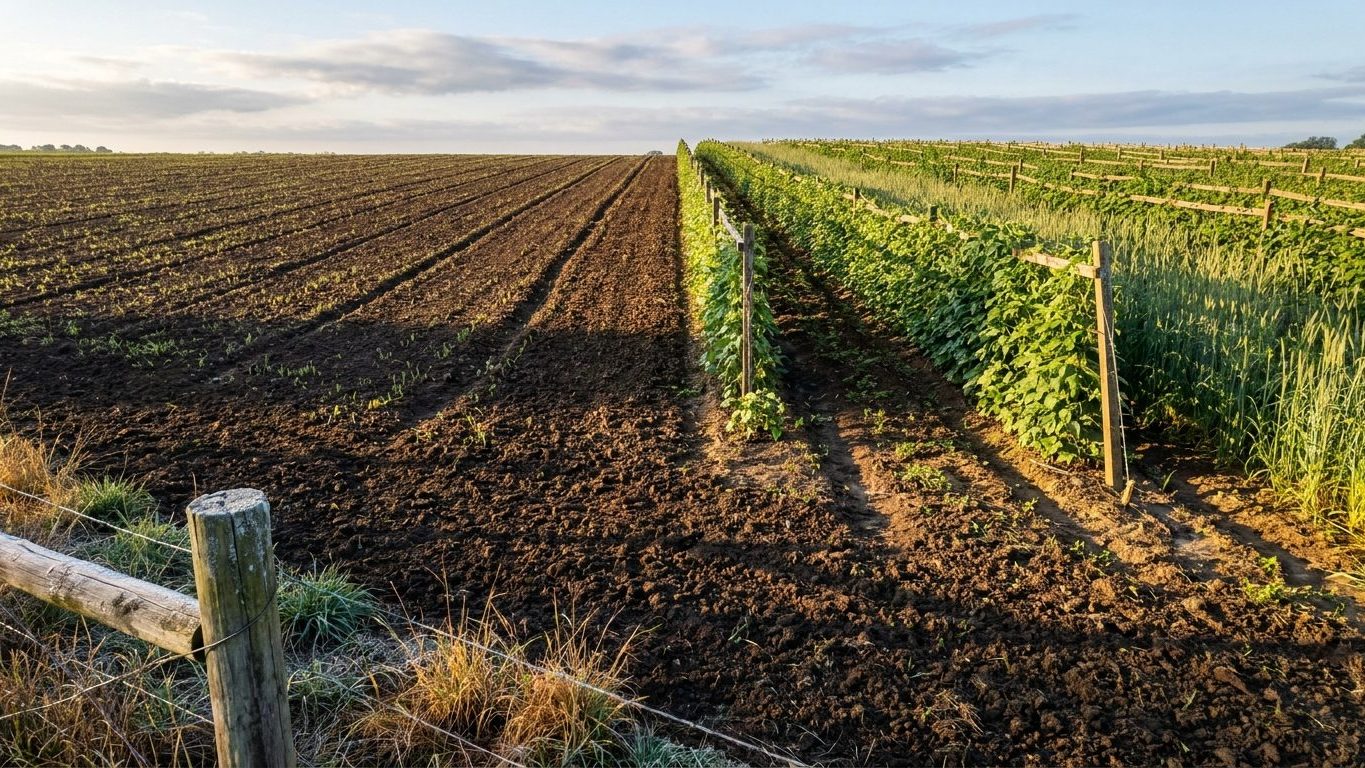

Georgia has two sowing seasons for cover crops. Winter covers go in during fall, ahead of the first hard freeze. Summer covers go in during spring and early summer, once the last freeze has passed and the soil has warmed. The dates below come from Atlanta weather records, so they are a reference point rather than a promise for your yard. Anywhere in the state, frost and soil warmth set the calendar, not the date on the wall.
The short answer for Georgia
Sow winter cover crops in fall, before the first freeze arrives between November 13 and December 1, and sow summer cover crops after the last spring freeze, which falls between March 11 and March 29. Both ranges come from NOAA’s 1991-2020 Climate Normals for the Atlanta station, and both are the band where the chance of a 32°F freeze sits between 30 and 70 percent. They are probabilities of a freeze, not dates on which one is scheduled to show up.
That distinction changes how you use them. Inside the band, a freeze is close to a coin flip on any given day. Before the band, you are likely safe. After it, a freeze becomes more likely than not. For a winter cover, the practical goal is seedlings that are up and rooting before the band opens, so the November 13 end is the one to aim for. A planting made at the December 1 end is a gamble with seeds that have no time to establish.
For summer covers the logic reverses. Sowing right at March 11 means a freeze is still a real possibility, and a tender seedling does not survive one. Waiting until after March 29 removes most of that risk, though it costs you a few weeks of growth.
The coldest-month figure adds one more piece. The mean daily minimum of the coldest month at Atlanta is 35.6°F, above freezing on average. Winter in the reference city is mild enough that a fall-sown cover keeps growing, slowly, through much of the cold season. Individual nights still dip below 32°F, which is why the freeze dates exist at all.
Boiled down to a working calendar for the Atlanta area:
- Winter covers: finish sowing by mid-November where you can, earlier if the garden sits north of the city.
- Summer covers: sow after March 29 for safety, with March 11 as the earliest gamble.
- Spring termination: the same March window opens vegetable planting, so plan to knock a winter cover down before then.
Which species belong in which slot is a separate question, covered in The Best Cover Crops for Georgia. For the bigger picture of why the practice pays off in Georgia soil, start with Cover Crops for Georgia Gardens.
What will not work here
Sowing a winter cover in December fails more often than people admit. The Atlanta freeze band closes on December 1, so a seed that goes into the ground after that has to germinate and root in cooling soil with no head start. In north Georgia the problem arrives sooner, because fall freezes there come several weeks earlier than at the Atlanta airport. A calendar copied from an Atlanta source and applied to a mountain garden will have you sowing into the cold.
The opposite mistake is just as common. Georgia’s early spring tempts gardeners into sowing frost-tender summer covers in the first warm week of March. With the last-freeze band running March 11 to March 29, a freeze is still 30 to 70 percent likely across that stretch, and one night at 32°F can wipe out a whole planting. Warm afternoons say nothing about the lowest temperature of the night.
Northern advice also travels badly. Many cover crop guides lean on a hard winter to kill off certain crops so they will not need mowing or tilling. With a coldest-month mean minimum of 35.6°F at the reference city, a cover that dies reliably in a colder state may simply keep growing here. If a source promises winterkill, check where its author gardens. Plan on terminating the crop yourself, by mowing, rolling or cutting at the right stage.
Timing matters because the season is long. The last freeze can pass as early as March 11, so spring planting starts early, and a winter cover left standing becomes a problem. It gets tall, tough and slow to break down, and it can shade or crowd the vegetables that follow. Georgia’s mild winter also hands a cover crop more weeks of growth than a northern gardener would expect, which means more biomass to deal with.
Humidity works against close spacing. Georgia summers are warm and damp, and a thick stand of summer cover holds moisture in the canopy and under the residue, which tends to favor fungal trouble and sheltering pests. Sowing a little thinner and giving stands room to dry out between rains is safer than the seeding rates printed on a bag meant for drier regions.
One honest limit: this page has no rainfall or summer heat figures for Georgia, so it cannot give you a watering schedule. Rely on species chosen for the season and let them work with natural rain rather than planning around weekly irrigation.
What changes across Georgia
Georgia is not one garden. The USDA Plant Hardiness Zone Map (2023 edition, built on 1991-2020 normals) places the state in zones 6a through 9b, which is a very wide spread. There is no single answer for the whole state, and the dates above describe Atlanta, not Georgia.
The zone system rests on one variable, the average annual extreme minimum temperature. It tells you how cold the coldest night of a typical year gets, which matters for whether a plant survives winter at all. It does not tell you when the first freeze arrives or how long your growing season runs, and those are the two things a sowing calendar depends on. Two gardens can share a zone number and still have freeze dates weeks apart.
If you garden in the north or at altitude
North Georgia and the mountains freeze several weeks earlier in fall than Atlanta does, so the November 13 to December 1 band is too late for you. Treat November 13 as the far edge, not the target, and move your winter sowing earlier by those several weeks. Spring runs the other way. Your last freeze likely falls later than March 29, so summer covers should wait beyond the end of the Atlanta range. Higher elevation pushes both adjustments further.
If you garden on the coastal plain
The coastal plain runs milder. Fall freezes come later and spring freezes end sooner, so winter covers have more time to establish and summer covers can go in earlier. The Atlanta dates are conservative for you, though a mild climate can tempt you to sow too late and lose the root-building weeks that make a cover crop worth the seed.
Do not guess your own zone from a neighbor or from the state average. Look up your location on the USDA Plant Hardiness Zone Map and read your own result. Then treat the Atlanta dates as a baseline to shift, not a rule.
Where to check this for your own county
University of Georgia Extension is the place to confirm anything on this page. Georgia’s county extension offices answer the question that a state page cannot: what works in your soil, at your elevation, with your freeze history.
A county recommendation beats a state one. This page is the state one, and it leans on a single Atlanta station. The sources behind it do not include a county-level sowing calendar or a Georgia extension cover crop calendar, so those details are not covered here and should not be filled in from another state.
When you reach the extension site or call your county office, look for three things:
- A planting calendar for your county or region, with fall and spring sowing dates for cover crops.
- Cover crop varieties that have been trialed in your county, not just recommended in general.
- Termination guidance matched to your spring planting dates, since the end of the cover matters as much as the start.
Ask the county agent about the last and first freeze dates they use locally. These may differ from the Atlanta figures here by weeks, and they are the dates your calendar should hang on. Extension staff also know local quirks, such as frost pockets in valleys or soils that warm slowly, that no statewide table captures.
Checking this against your own garden
Your own observation outranks every date on this page. Three things are worth watching, and none needs equipment.
The first is soil warmth by feel. In spring, push your hand a few inches into bare soil on a sunny morning. If it feels distinctly cold, the ground is not ready for summer covers, whatever the calendar says. Compare a sunny bed with a shaded corner. The gap between them shows how much your microclimate varies, and a south-facing slope will warm earlier than a low, shaded patch.
The second is the first flush of male flowers on early squash or cucumbers. Those plants show male blooms before female ones, and their timing tells you how fast your garden has warmed this year compared with last. If the blooms appear earlier than you expected, your site runs warm. If they lag, plan later sowings.
The third is the first true leaves on your cover crop seedlings. The first pair of leaves is the seed’s own stored food. The second set, the true leaves, means the plant is feeding itself. If fall seedlings reach that stage before the freeze band begins, your timing was right. If they are still tiny when cold arrives, sow earlier next year. Keep a note of the date, and after two or three seasons you will have a calendar that is more accurate than any state table.
Some gardeners also time this by the Moon: when to plant cover crops by the moon, as almanac tradition rather than fact.
Common questions
Can I sow winter cover crops after the first frost in Georgia?
You can, but results are poorer. The Atlanta freeze band closes on December 1, and seedlings that start later have little time to root. North of Atlanta, freezes come several weeks earlier, so “after the first frost” arrives sooner than the Atlanta dates suggest.
When is it safe to sow summer cover crops?
After the last spring freeze range at Atlanta, which runs March 11 to March 29, with the end of that range being the safer choice. Sowing inside the range means a freeze is still 30 to 70 percent likely. Gardens farther north should wait longer.
Do the Atlanta dates apply to my garden?
Only as a starting point. Atlanta’s airport station is an urban heat island, so the surrounding countryside can be colder. North Georgia and the mountains freeze several weeks earlier in fall, and the coastal plain runs milder.
Does my hardiness zone tell me when to sow?
No. The USDA zone is built on one variable, the average annual extreme minimum temperature, and says nothing about freeze dates or season length. Georgia spans zones 6a to 9b, so your county’s frost dates from the extension service are a better guide.