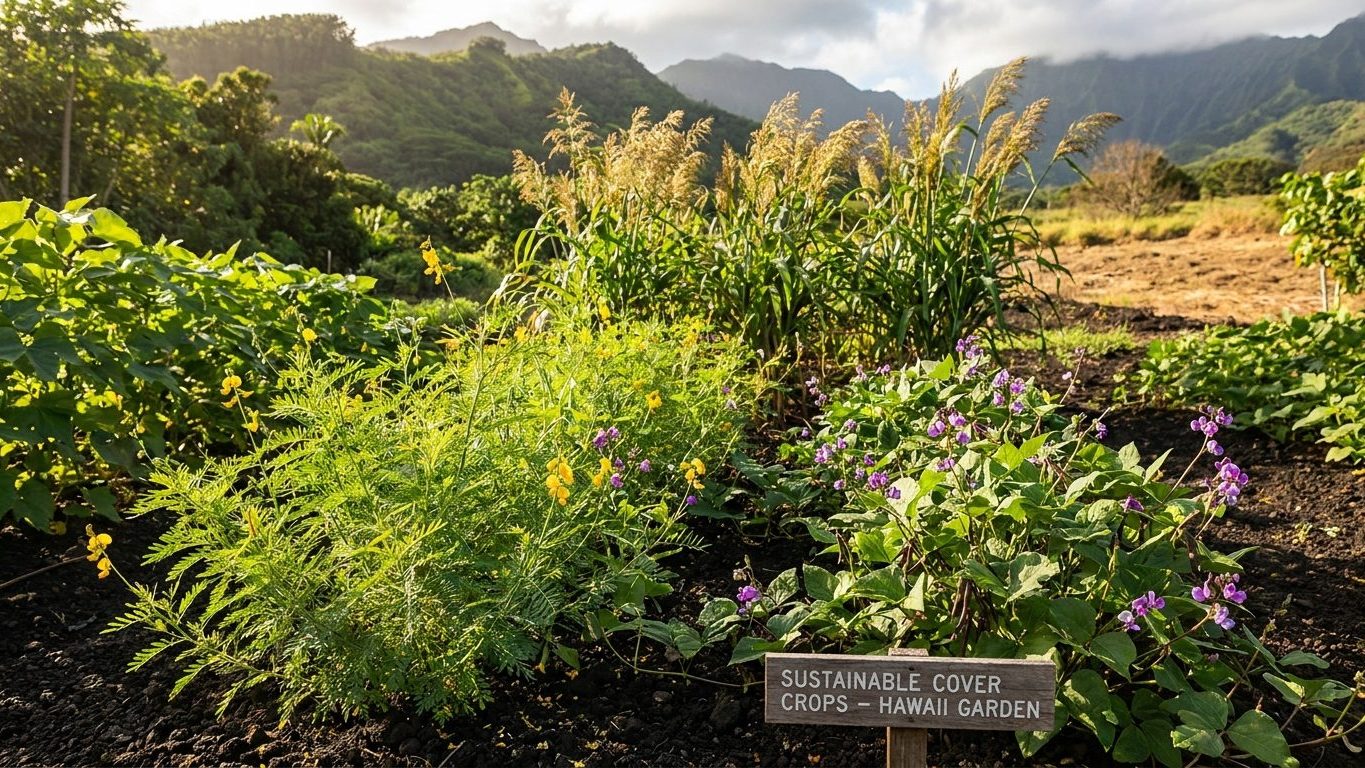

Short answer: on the wet, mild coast represented by Vancouver’s climate data, fall-sown winter rye, crimson clover, field peas, and hairy vetch outperform almost everything else, because the frost-free window runs roughly from March 18 to November 10 and winters rarely drop much below freezing. Move inland or uphill, and that answer changes fast.
The short answer for British Columbia
Cover crop choice in this province comes down to two numbers from the reference station data: a mean last spring frost of March 18, a mean first fall frost of November 10, and a coldest-month average minimum of 33.5°F. That’s a frost-free window of roughly 237 days and a winter that barely touches freezing on an average night. Those two facts alone rule certain categories in and others out.
Legume covers like crimson clover, hairy vetch, and field peas are the strongest performers here. They germinate in cool fall soil, tolerate wet ground through winter, and use that long shoulder season to fix nitrogen before a spring vegetable planting. Sown in September, they have two full months before the mean fall frost to root in, then keep growing through a winter that almost never gets truly cold.
Grass covers, mainly winter rye and annual ryegrass, are the second strong option. They establish faster than legumes in cold, damp soil, hold slopes against winter rain, and choke out weeds better than almost anything else on this list. Rye in particular tolerates the low light and short days of a Pacific coast winter better than most broadleaf covers.
Brassica covers such as forage radish and mustard work, but with a catch worth flagging now and returning to below: they’re usually sold on the promise that a hard freeze kills them over winter, saving the gardener a termination step in spring. A coldest-month average minimum of 33.5°F means that promise often doesn’t hold on the coast.
Warm-season covers like buckwheat and cowpea belong to interior valleys with real summer heat, not the cool, cloud-covered coastal strip this station represents. They’re not a coastal answer at all.
| Cover crop type | Sow relative to frost dates | Behavior in a 33.5°F winter |
|---|---|---|
| Legumes (clover, vetch, peas) | 4-8 weeks before Nov 10 | Overwinters, keeps growing slowly |
| Grasses (rye, ryegrass) | Anytime before Nov 10 | Overwinters, vigorous regrowth in spring |
| Brassicas (radish, mustard) | 6-10 weeks before Nov 10 | Often survives instead of winter-killing |
| Warm-season (buckwheat, cowpea) | After Mar 18, well into summer heat | Not viable in a cool coastal season |
What will not work here
The failure mode on this coast isn’t a season too short. With 237 days between mean frost dates, length isn’t the constraint that trips people up here the way it does on the Prairies or in the BC interior’s higher valleys. The constraint is temperature behavior at the edges of the season, and it catches gardeners who bought a cover crop for the wrong reason.
Forage radish and other brassicas are marketed almost entirely on one selling point: sow in fall, let winter kill it, till in a soft, decomposed mat in spring with zero labor. That mechanism depends on a hard freeze. At a coldest-month average minimum of 33.5°F, the reference station’s winter rarely delivers one. Plant forage radish on the wet coast expecting a tidy winter-kill and you may instead get a live, woody, bolting plant in March that needs to be cut and turned by hand, exactly the labor the crop was supposed to save.
Warm-season legumes and grasses, cowpea and sorghum-sudangrass among them, fail for a different reason: they need sustained heat to put on the biomass they’re known for, and a cool, cloud-heavy Pacific coast growing season, even one this long, doesn’t deliver the heat units. These are interior-valley or hot-summer choices, not coastal ones, and the frost-free window length can mislead a gardener into thinking the season is “long enough” when the missing variable is warmth, not time.
Anything demanding dry, well-drained soil for spring termination runs into the opposite problem: a coastal winter that stays close to freezing rather than dropping below it also tends to stay wet, and equipment or even a hand fork can struggle to work saturated ground in February and March. A cover crop that needs to be turned under early, before it sets seed, can outrun a gardener who’s waiting for the soil to dry out.
None of this applies uniformly across the province, which is the point of the next section: a fact drawn from one coastal station describes one climate, not the whole map.
What changes across British Columbia
British Columbia is not one growing region wearing a single label. The hardiness zone figure available for this page, 9a in the Canadian system, applies specifically to the reference city behind these climate normals, not to the province as a whole. Natural Resources Canada’s own hardiness mapping is explicit about this: it’s built from seven climate variables, not one, and it produces a patchwork across British Columbia that runs from the mildest coastal valleys to sub-arctic interior plateaus and alpine terrain within a few hours’ drive.
That spread matters for every cover crop decision above. The mild-winter logic that undermines forage radish’s winter-kill on the coast reverses completely once you’re in a colder interior zone: there, a hard freeze arrives reliably, and radish behaves exactly as advertised. The long, cool growing season that favors legumes and rye on the coast shortens dramatically at elevation, where a grower may need to move sowing dates weeks earlier just to get roots established before the ground locks up.
It’s also worth remembering that the Canadian zone system does not convert to the USDA scale used elsewhere on this site. Canada’s system measures across seven variables; the US system leans on one, minimum winter temperature. NRCan’s own comparison notes that a single Canadian zone can overlap nine different USDA zones. Don’t try to line up a Canadian 9a with a US zone number on a seed packet; they’re not built the same way.
None of this tells an individual reader which zone covers their own backyard, and this page shouldn’t try to. Natural Resources Canada’s Plant Hardiness Site lets you look up a municipality directly, and that lookup, not a provincial average, is the number to plant by if you’re inland, upland, or simply unsure which side of the coastal mildness line you’re on.
Where to check this for your own county
This page describes British Columbia at the provincial level, using climate normals from a single coastal reference station. That’s useful for orientation, but it’s not a substitute for a local recommendation, and it was never meant to be one.
The BC Ministry of Agriculture and Food publishes provincial agriculture resources at https://www2.gov.bc.ca/gov/content/industry/agriculture-seafood. That’s the right starting point for anyone growing cover crops in this province, and it’s where a regional or local recommendation, closer to your actual soil and microclimate than anything on this page, is more likely to be found.
Two things are worth hunting for once you’re there:
- A regional or seasonal planting calendar specific to your part of the province, since a Fraser Valley schedule and a Kootenay schedule won’t match.
- Any cover crop varieties that have actually been trialled or recommended for your growing region, rather than a generic provincial list.
A regional recommendation beats a provincial one every time, for the same reason a neighborhood forecast beats a national one: it’s built from data closer to your own conditions. This page works at the scale of a single reference station’s climate normals. Your own regional district, valley, or municipality is a finer scale than that, and finer is what decides whether a cover crop actually performs the way this article describes.
Checking this against your own garden
Every date and temperature figure on this page is a provincial average built from one weather station’s climate normals. Your own garden will disagree with it in small ways, and those disagreements are worth trusting over the numbers.
Three things tell you more about your own microclimate than any calendar date:
- Soil warmth by feel. Push a finger a few inches into bare soil before sowing a legume or grass cover in fall, or before terminating one in spring. Cold, sticky ground that clings to your hand is telling you germination or breakdown will lag behind the calendar, whatever the mean frost date says.
- First flush of flowers on a clover or vetch stand. Once a legume cover starts flowering, it’s shifting energy toward seed rather than nitrogen fixation and biomass. That flush, not a date on this page, is the real signal to terminate before the crop sets seed and turns into next year’s weed problem.
- First true leaves on volunteer seedlings pushing through the cover. If weed seedlings are getting past your cover crop’s canopy easily and early, the stand isn’t thick enough for your soil and light conditions, whatever the seeding rate on the bag suggested.
A provincial mean frost date sets the general shape of the season. What’s happening in the actual bed in front of you sets the schedule you should actually follow.