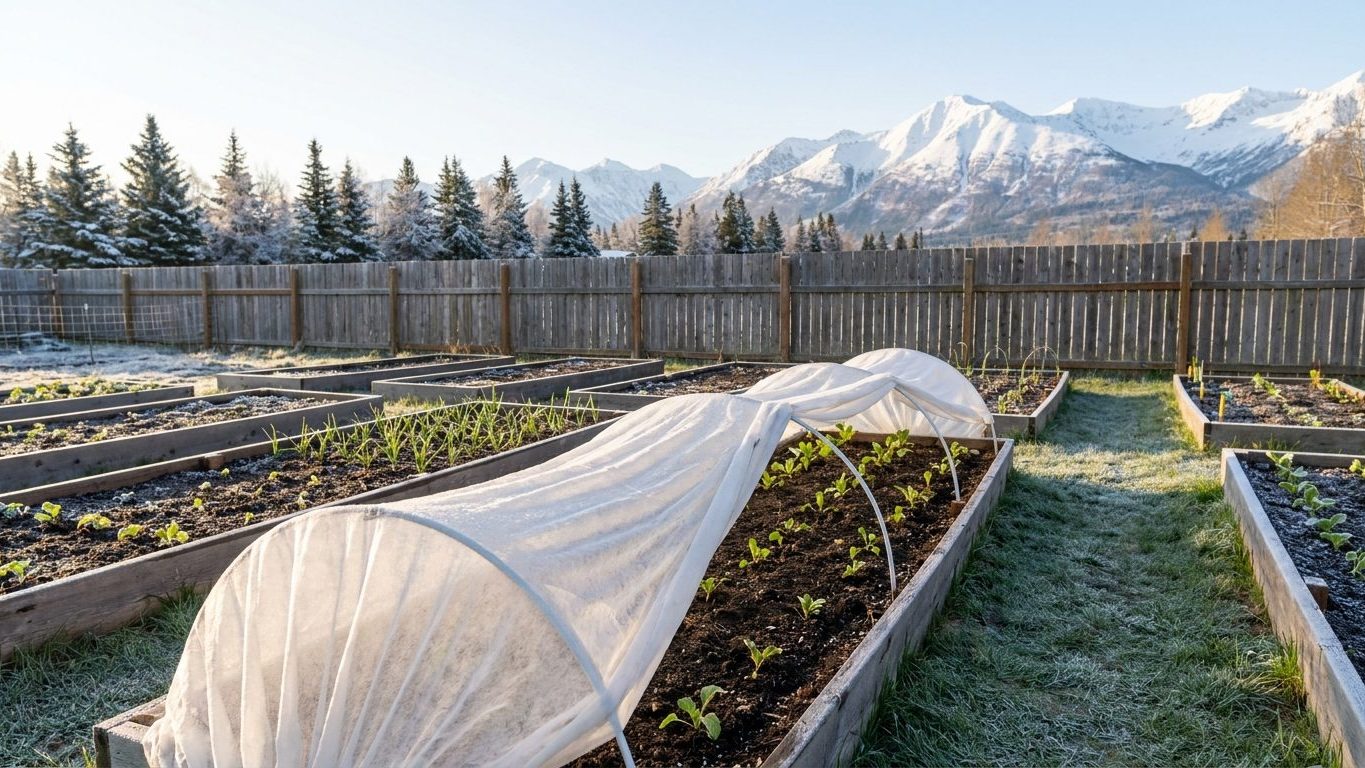

Cover your garden when the overnight forecast reaches about 32°F, and expect that to happen twice a year. In Connecticut the spring freeze band runs April 2 to April 12 and the fall band runs October 28 to November 10, both measured at coastal Bridgeport. Inland gardens freeze earlier in fall and later in spring, so the calendar below is a starting point, not a deadline.
The short answer for Connecticut
Cover tender plants on any night when the forecast low is at or near 32°F, from early April through mid-May in spring and from late October on in fall. Hardy crops can wait for a deeper cold snap. The dates are a window of risk, not a switch that flips on a given day.
Here is what those dates actually measure. NOAA’s 1991-2020 Climate Normals for the Bridgeport station give the days on which the chance of a 32°F freeze falls in a 30 to 70 percent band. So “April 2 to April 12” does not mean frost is over by April 12. It means that around those days, a freeze is still somewhere between a likely and an unlikely event. The fall dates work the same way.
| Measure (Bridgeport station) | Value |
|---|---|
| Last spring freeze, 30-70% band | April 2 to April 12 |
| First fall freeze, 30-70% band | October 28 to November 10 |
| Mean daily minimum, coldest month | 24.4°F |
Why does a cover work at all? On a clear, calm night the ground gives up its stored heat to the sky, and leaf surfaces get colder than the air around them. A cover holds some of that rising warmth against the plants. That is why the nights to worry about are the still, cloudless ones right after a cold front passes. A windy, overcast night at 34°F is usually less dangerous than a dead-calm one at the same reading.
The practical routine is simple. Check the forecast low each afternoon in the shoulder weeks. If it is near freezing, drape the cover before sunset while the soil is still holding the day’s warmth, anchor the edges, and take it off the next morning once the air warms. Which fabric or structure to use is a separate question, covered in Which Season Extenders Work in Connecticut.
What will not work here
Planting tender crops on April 12 and trusting the date will not work. That date sits inside the 30 to 70 percent band, so a freeze after it is plausible, not freakish. Tomatoes, peppers, basil and squash set out that early need a cover on hand, or they need to wait.
Reacting to the first frost does not work either. The fall band opens October 28 at the mildest station in the state, and the caution on that number is blunt: inland and northwest Connecticut freeze noticeably earlier. A gardener in the hills who waits for a coastal date will lose basil and late beans before the calendar says anything is wrong. Watch your own forecast, not Bridgeport’s.
Another dead end is expecting a light cover to carry plants through winter. The mean daily minimum of the coldest month at Bridgeport is 24.4°F. That is an average, so many nights run colder, and it is the mildest corner of the state. A single layer of row cover adds a few degrees of protection at best. It can rescue a bed of kale or spinach from a hard fall night, but it will not keep tender plants alive through a Connecticut January.
Sealing everything up tight also backfires. Plastic or a low tunnel closed through a sunny day in March or April can turn a bed into an oven, and the sharp swing from hot afternoon to freezing night stresses seedlings more than the cold alone. Venting or pulling covers back on mild, sunny days matters as much as putting them on.
Finally, covering too late fails. Once the sun is down and the soil has begun to cool, you are trapping less heat. Plan to be out there in late afternoon, not at 10 p.m. with a flashlight.
What changes across Connecticut
Connecticut does not have one answer. The USDA Plant Hardiness Zone Map (2023, built on 1991-2020 data) puts the state at 6a to 7b, four half-zones, and that map is built on one thing only: the average annual extreme minimum temperature. It says how cold a plant must tolerate over winter. It does not tell you when the last spring frost will arrive.
Every date on this page belongs to Bridgeport, at 41.16 degrees north on Long Island Sound. Water moderates the coast, which is why the caution is repeated: that station is the mildest part of the state. The northwest hills and the interior valleys run colder, with later springs and earlier falls, and cold air pools in low spots on still nights, so a hollow can freeze when the ridge above it does not.
If you garden inland or on higher ground, shift the cover calendar in both directions. Start watching for fall freezes a couple of weeks before the Bridgeport band opens, and hold off on tender transplants until after it closes, or plant them with a cover ready. I am giving that as a direction, not a number, because this page has no inland frost figures to offer.
Latitude matters for a different reason. Day length, not warmth, tells an onion when to stop making leaves and start making a bulb, and 41.16 degrees is Bridgeport’s figure only. A gardener near the Massachusetts line sits a little farther north and should check their own latitude before leaning on any day-length advice.
To find your own zone, use the USDA map and look up your ZIP code. This page cannot tell you which one you are in. For the broader picture, see Extending the Growing Season in Connecticut.
Where to check this for your own county
The best next stop is UConn Extension, the state’s land-grant extension service. It is the source for what a Connecticut county has actually tested, which beats any statewide summary.
Look for two things. First, a local planting calendar, ideally one tied to your county or nearest town, with frost dates and transplant timing. Second, the varieties that have been trialled in your county, since a tomato that ripens on the shore may sulk in a cold northwest valley. Extension offices often also run a Master Gardener help line or a soil-testing service, which can answer questions this page cannot.
Be clear about what this page is. It is the state-level view, built on one coastal weather station. A county recommendation beats it every time, because it reflects local soil, elevation and frost patterns. If the two disagree, go with the county.
One caution on calendars: extension services in other states publish useful ones, but they are written for different climates and, in some cases, a different crop or grass. Use Connecticut’s own, and for a specific crop, find the guidance written for that crop.
Checking this against your own garden
Your own observations outrank every date here. Three are worth tracking, and none needs an instrument.
- Soil warmth by feel. Push your hand a few inches into the bed in the morning. If it feels cold and damp, warm-season seeds will sit and rot. A bed that feels warm in April is likely a sheltered, sunny spot, and you can start earlier there.
- The first male flowers. Squash and cucumbers usually open male blooms before female ones. When they appear in your garden relative to a neighbor’s, you learn whether yours runs ahead or behind.
- First true leaves. The first pair of leaves on a seedling are seed leaves. The true leaves that follow show real growth. If they stall, the bed is cooler than you think.
Write the dates down for two or three seasons. A south-facing wall, a low frost pocket and a windy corner will each show up in the notes, and those patterns tell you where to cover first.
Common questions
Do I need to cover plants every night in fall?
No. Cover only when the forecast low is near 32°F, particularly on clear, still nights. Many fall nights stay well above freezing even in late October.
Is April 12 a safe date to plant tomatoes?
It is not a guarantee. April 2 to April 12 marks the Bridgeport band where a 32°F freeze has a 30 to 70 percent chance. Inland gardens run later, so tender transplants need a cover ready or a later start.
Will a row cover protect plants all winter?
No. The coldest month at Bridgeport averages a daily minimum of 24.4°F, and a cover adds only a few degrees. It can protect hardy greens from a hard night, but it is not winter protection for tender crops.
Should covers stay on during the day?
Not on warm, sunny days. Vent or remove them once the air warms, then replace them in late afternoon before the temperature drops.