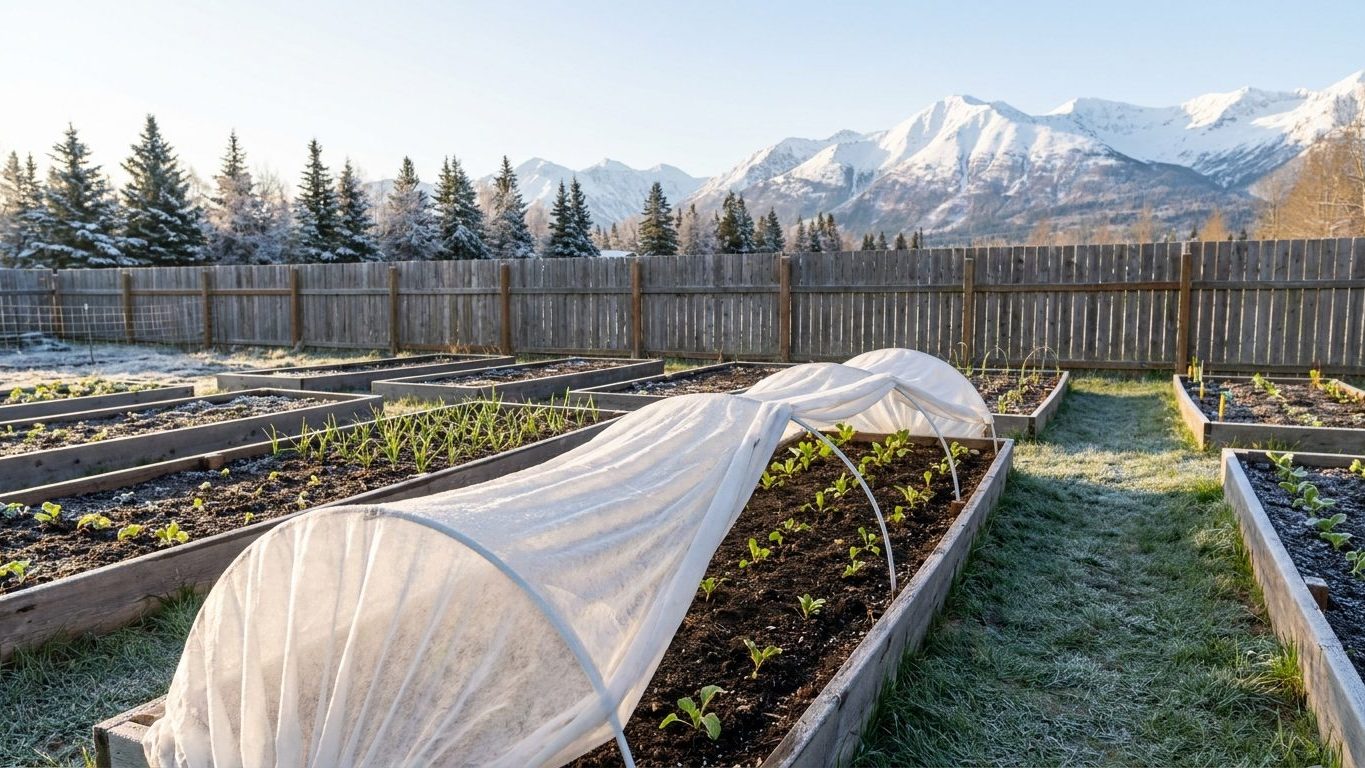

Cover plants in Florida on the night a freeze is forecast, not on a date. In Jacksonville and the rest of north Florida, that means a handful of nights between late November and early March. Farther south, frost cloth is a rare tool, and the cover that earns its keep is shade cloth in summer. Which side of that line you garden on changes everything below.
The short answer for Florida
In north Florida, put covers on when the overnight forecast reaches 32°F, which can happen anywhere from late November to early March. In central and south Florida, which are effectively frost-free, the main reason to cover is not cold at all.
The dates come from the NOAA NCEI 1991-2020 Climate Normals for Jacksonville (station USW00013889). They are a probability of a 32°F freeze, not a deadline. The last spring freeze falls between February 16 and March 7, and the first fall freeze between November 26 and December 13. Both are the 30-70% probability band, a window roughly three weeks wide in spring and about two and a half weeks wide in fall. Inside those windows, a freeze is a real possibility but far from a sure thing.
The same station shows why you cover by forecast rather than by calendar. The mean daily minimum of the coldest month is 42.9°F, so the typical winter night in Jacksonville stays well above freezing. In three of the thirty falls on record, no freeze arrived at all. Freezes here are events, a few clear nights in a row, and the cover is a tool for those nights.
How a cover works on those nights
Soil soaks up heat during the day and releases it after dark. A cover draped to the ground holds some of that heat around the plant. The danger nights are clear and still, because heat escapes straight up. Cloudy or windy nights are usually gentler, though a hard cold front can bring wind and freezing temperatures together.
So the routine is short. Check the forecast low each afternoon from late November onward. If it is near or at 32°F, cover before sunset, while the ground is still warm. Uncover in the morning once temperatures climb, so plants get light and the space does not overheat. For a full picture of how covers fit into the year, see Extending the Growing Season in Florida. For a comparison of materials, read Which Season Extenders Work in Florida.
What will not work here
The Jacksonville window cannot be borrowed. Anyone in Orlando or Miami who sets a planting or covering date from Jacksonville’s February 16 to March 7 spring window is working from the wrong climate. Central and south Florida are effectively frost-free, so the growing calendar inverts. The main season runs through winter, and summer is the hard part. A calendar built around “last frost” does not fit a place where the question is when heat arrives, not when cold leaves.
Leaving covers on all season fails even in the north. With a coldest-month average low of 42.9°F, most winter nights are mild. A tunnel or sheet of plastic left sealed through a sunny day can cook what is underneath it, and trapped humidity invites disease in a state where humidity is a fact of life. Covers belong on the few nights that need them, then off.
Heavy, long-duration season extension also makes little sense. Cold frames, double-layered low tunnels and heated hoop houses are built for short seasons where a gardener is fighting for weeks of warmth. In north Florida the cold is brief, and the structure does not pay for itself. A light frost cloth and a few stakes handle most nights.
Covering badly does damage too. Plastic that touches leaves conducts cold straight into the plant, so it needs stakes or a frame to hold it off the foliage. Fabric that stops short of the soil lets the stored heat escape, so the edges need to reach the ground. And covering at dawn, after the temperature has already fallen, protects nothing.
Finally, waiting for visible frost on the lawn is waiting too long. Frost on grass tells you last night was cold, not what tonight will do. In the south, summer is the real season killer. Covering tomatoes against a cold that does not come wastes effort. Shade cloth against summer sun and heat is the Florida cover for much of the state.
What changes across Florida
There is no single answer, because Florida is not one garden. The USDA Plant Hardiness Zone Map (2023, built on 1991-2020 normals) runs from 8b to 11b across the state. That system rests on one variable, the average annual extreme minimum temperature, and the spread is enormous: from places where a hard freeze is a normal winter feature to places where it is nearly unheard of.
The Jacksonville dates in this article belong to Jacksonville, at 30.48 degrees north, and to an inland airport site. If you garden in the Panhandle or elsewhere in north Florida, they are a decent starting point, but check your own latitude and your own low spots. A garden at the edge of that region may see its own window shift by days or weeks.
If you live in central Florida, expect fewer frost nights and more of a mild cool season. Cold nights still happen, but the work is deciding which tender plants need protecting, not running a seasonal calendar. In south Florida, the calendar flips. Winter is the productive season for many vegetables, and summer heat, rain and pests are what you manage.
Latitude matters in another way. It is day length, not temperature, that tells an onion to stop making leaves and start making a bulb. The farther south you go, the shorter winter days become compared with those up north, so a variety suited to one end of the state may behave differently at the other.
To find your own zone, use the USDA Plant Hardiness Zone Map and enter your ZIP code. Don’t guess from a neighbor or from this page.
Where to check this for your own county
Your county’s University of Florida IFAS Extension office is the right next stop. Look for two things: the local planting calendar and the varieties trialled in your county. The calendar tells you what to plant when, for your part of the state. The variety trials tell you what has actually grown well in your soil, heat and humidity, which no general guide can promise.
If the website does not spell out freeze risk for your area, call or email the county office. Extension agents field questions about cold snaps every winter, and they know which parts of the county run colder, which low-lying neighborhoods collect cold air, and which nights tend to catch gardeners off guard.
A county recommendation beats a state one. This page is the state one. It reads one Jacksonville station and the statewide zone range, and the territory is far bigger than that. A county agent works from local trials and local records, which means more specific answers. Use this page to learn how the cold behaves and what to expect. Use the county office to set your actual dates.
Checking this against your own garden
Your own observation outranks every date above. Three things to watch, none of which needs an instrument:
- Soil warmth by feel. Push a hand into the bed on a mild morning. If the soil still feels cool compared with the air, seeds will sit and sulk. Compare a sunny bed with a shaded one, and you learn where your garden warms first.
- The first male flowers. Squash, cucumbers and melons usually open male flowers before female ones. When they appear, the plant is responding to real warmth and light, and the first flush tells you your spring has arrived.
- The first true leaves. The seed leaves come first, and the true leaves that follow mark when a seedling has committed to growing. Slow true leaves on one bed and quick ones on another point to a cooler spot, shade or poor drainage.
Keep notes on the dates. After a season or two, you will know that the corner by the south wall warms first and the low bed by the fence holds cold longest. That record is your own microclimate, and it will serve you better than any statewide window.
Common questions
Do I need frost covers in Orlando or Miami?
Rarely. Central and south Florida are effectively frost-free, and the Jacksonville freeze dates do not apply there. Cold-tender plants may still need protection on an unusual cold night, so watch the forecast, but your bigger covering job is shade in summer.
When should I take the cover off?
In the morning, once temperatures have climbed above freezing and the sun is on the bed. Leaving it on through a warm, sunny day can overheat the plants and trap humidity.
Is the last frost window a safe planting date?
No. For Jacksonville, February 16 to March 7 is the 30-70% probability band for a 32°F freeze. A freeze can still occur inside that window and, in some years, after it. Plant tender crops with a cover ready, or wait.
Should I water before a freeze?
Moist soil holds and releases heat better than dry soil, so watering earlier in the day is a common practice. Water the soil, not the foliage late in the afternoon, and check with your county extension office for guidance on your plants.