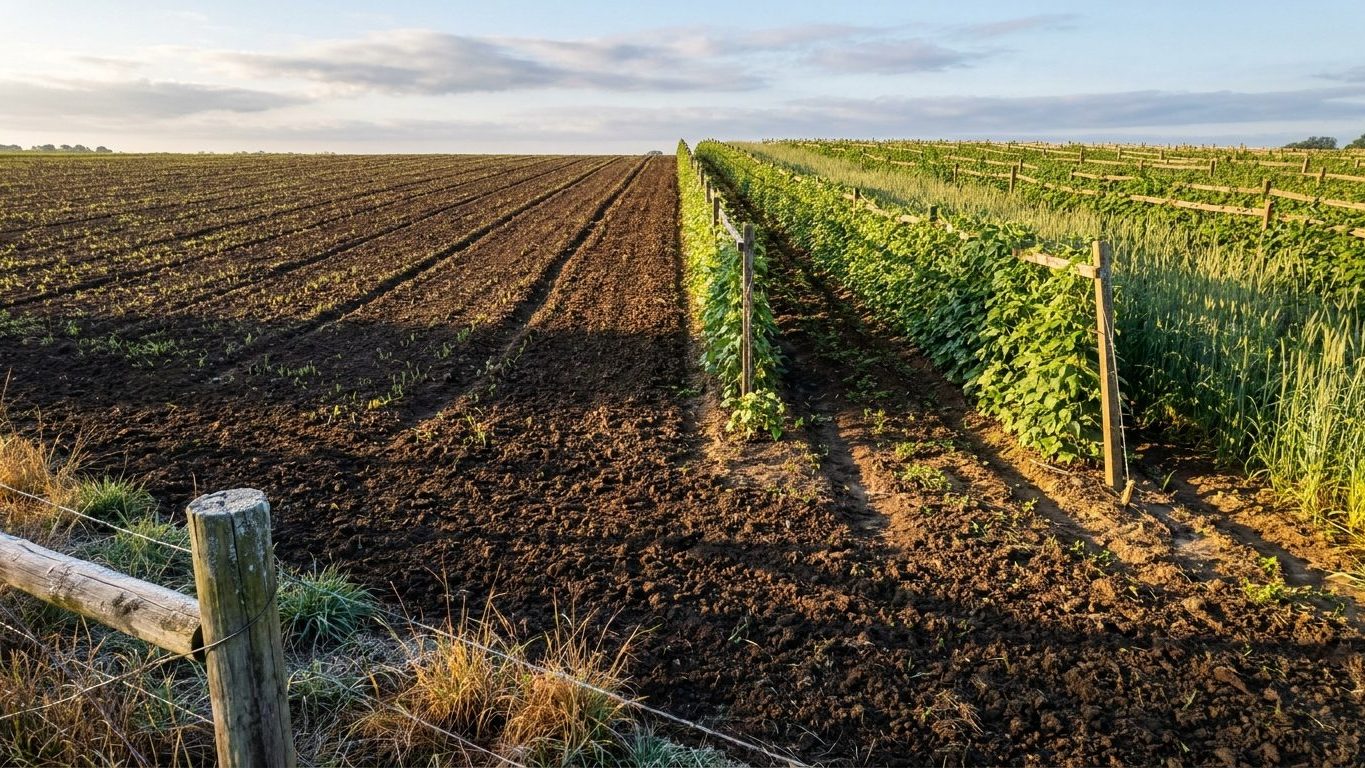

Louisiana has two sowing windows, not one. Winter cover crops go in during fall, once the worst of the heat breaks, and well ahead of a freeze that may never arrive in the south. Warm-season cover crops go in after the last spring freeze window closes, which happens in early February at the New Orleans reference station. Frost is a weak guide here. Heat sets the calendar.
The short answer for Louisiana
Sow winter cover crops in the fall, and sow warm-season ones from spring into summer. Treat the freeze dates as a backstop, not a trigger. In NOAA’s 1991-2020 Climate Normals, the last spring 32F freeze falls in a 30-70 percent probability band from January 18 to February 8, and the first fall freeze falls in that band from December 17 to January 8.
Those dates need careful reading. They are not deadlines. Each one is a probability of a 32F freeze: the stretch when the odds of a freeze sit in the middle of the range, between 30 and 70 percent. Before the spring window the freeze risk is higher, and after it the risk is low. The fall window works the same way in reverse. (The numbers come from the NOAA NCEI normals for the reference station.)
The fall window straddles New Year’s Day, which should tell you this is not a normal planting calendar. At this station a 32F freeze occurs in only 86.8 percent of years. Roughly one year in seven has no freeze at all. The mean daily minimum of the coldest month is 46.1F, so winter here is more of a slowdown than a shutdown.
| Window | What goes in | Anchor from the facts |
|---|---|---|
| Fall | Winter cover crops | Sow once the summer heat breaks, ahead of the December 17 to January 8 freeze band |
| Spring to summer | Warm-season cover crops | Sow after the January 18 to February 8 band has passed |
Species-by-species sowing dates for Louisiana are covered elsewhere. Which crop fits which window is covered in The Best Cover Crops for Louisiana, and the wider picture is in Cover Crops for Louisiana Gardens. Today is mid-October, so the fall window for winter covers is open now.
What will not work here

Counting backward from first frost fails first. That rule was built for places where frost ends the growing season and the calendar hangs on one date. Here the fall freeze band runs from December 17 to January 8, and in about one year in seven the freeze never comes. A rule tied to a date that may not happen is a poor anchor. The limiting factor in Louisiana is summer heat, not cold.
Planting winter covers too early is the second trap. A seed sown while the soil is still baking can sprout weakly, stall, or burn out before the cool weather arrives. The fall window opens when the heat breaks, not when the calendar says “fall.” That is why the dates above describe freeze risk and are not a “sow on” date.
Third, don’t count on a freeze to kill your cover crop. Gardeners in colder states plant oats or similar crops that winterkill, leaving a tidy mat of residue by spring. In south Louisiana a freeze occurs in only 86.8 percent of years, and a light one may not finish the job. Plan to terminate cover crops yourself, by mowing, crimping, or cutting, rather than waiting on the weather. I would not rely on winterkill here at all.
Summer is the other half of the problem. A warm-season cover crop sown in the heat has to carry itself through Louisiana’s humid weather, and a thick, closely spaced stand stays wet longer after rain. That invites fungal trouble and makes lodging (stems flopping over) more likely. Give heat-loving crops room and a seeding rate on the lighter side of the packet range. A bed of tightly packed seedlings that never dries out is not a healthy bed.
Finally, don’t read the coldest-month figure as a cold-hardiness worry. A mean daily minimum of 46.1F in the coldest month means most winter covers keep growing through the cool season. The risk runs the other way. A cover crop that grows too well into spring can turn into a weed problem or a mowing job if you miss the termination window.
What changes across Louisiana
Louisiana is not one garden. The USDA Plant Hardiness Zone Map (2023, built on 1991-2020 normals) places the state in zones 8a to 10a, a spread of three zones. There is no single answer for the whole state, and the frost dates above come from one south Louisiana reference station, so they do not describe the whole territory.
Zone numbers measure only one variable: the average annual extreme minimum temperature. They say how cold the worst nights get, not how hot the summer is. For a cover crop calendar, that is half the picture. Two gardens in the same zone can still sit weeks apart in sowing date because of heat, humidity, or soil type.
South Louisiana barely freezes. North Louisiana freezes far more reliably. In practice that means sowing winter covers earlier in the fall, giving them more time to establish before real cold, and waiting longer in spring before sowing warm-season ones. The page does not have station-level freeze dates for the north, so it won’t give numbers there. A reader along the Gulf Coast can lean the other way: the fall window is generous, and the heat of the shoulder seasons sets the pace.
Do not guess your zone from a neighbor’s garden. Look it up on the USDA Plant Hardiness Zone Map using your ZIP code. Then read the dates here as a starting point and shift them toward the north or the coast as your location suggests.
Where to check this for your own county
The state extension service is the next stop. In Louisiana that is the LSU AgCenter, the land-grant university’s extension arm. It has agents in the parishes (Louisiana’s counties) who see local soil, rainfall, and pest pressure every season. Look there for two things: a local planting calendar for your parish, and a list of cover crop varieties that have been trialed in your area.
A trial result matters more than a general recommendation. A variety that did well in a research plot on your soil type, through your humidity, tells you something a statewide range cannot. A plot trial also shows how a crop behaved after a hot summer or a wet fall, which is the kind of year that wrecks a calendar.
A parish recommendation beats a state one. The statewide range is built from a single reference station’s freeze probabilities, a zone spread of 8a to 10a, and general reasoning about heat and humidity. It is useful for getting oriented and for spotting a bad plan. It cannot tell you whether your own parish’s clay runs wetter in November than the statewide average suggests.
When you get to the extension site, search for your parish name along with “cover crops” or “planting guide.” If the site offers a vegetable or home garden planting calendar, compare its fall dates with the freeze bands here. A match is reassuring. A gap of a few weeks is normal, and the local calendar should win.
Checking this against your own garden
Your own observations outrank every published date. Three are worth watching, and none of them needs an instrument.
- Soil warmth by feel. Push your hand a few inches into the bed in the morning. If the soil still feels warm and almost soupy, the heat has not broken and winter seeds will struggle. If it feels cool and settled, the window is open. Do the same in spring, and a bed that warms early tells you it is a sheltered spot.
- The first flush of male flowers. The yellow-green catkins on oaks, and the first male blooms on squash or cucumber vines, mark warming days. If they show up early in your yard, your microclimate runs warm, and your spring sowing can shift earlier, within the limits of the freeze band for your area.
- The first true leaves. Cover crop seedlings open a pair of seed leaves first, then the true leaves, which look like the adult plant. If a sowing stalls before true leaves appear, the timing was probably off: too hot, too wet, or too cool. If true leaves come quickly, you found a good date and can repeat it next year.
Write the dates down. A few seasons of notes about when the soil felt right, when the blooms came, and when the seedlings pushed through will give you a calendar more accurate than any statewide table.
If you follow the almanac, here is when to plant cover crops by the moon. It is a tradition, not a proven method.
Common questions
Is it too late to sow winter cover crops in mid-October?
No. At the south Louisiana reference station, the fall freeze band does not open until December 17, and the winter-cover window starts when the summer heat breaks. Mid-October is within it. Sow sooner rather than later, so the seedlings can establish before the coolest weather.
Do I need to wait for a frost before sowing?
No. A freeze occurs in only 86.8 percent of years at the reference station, so roughly one year in seven has none. Sowing is tied to the heat breaking, not to a frost date. Frost dates matter more for deciding when warm-season crops are safe in spring.
Will a freeze kill my cover crop for me?
Not reliably in south Louisiana. Because freezes are light or absent in many years, plan to terminate the crop by mowing, crimping, or cutting. North Louisiana freezes more often, but the same plan is safer.
Which hardiness zone is my garden in?
Louisiana spans zones 8a to 10a in the USDA system, which measures only the average annual extreme minimum temperature. Enter your ZIP code on the USDA Plant Hardiness Zone Map to find yours, then check with the LSU AgCenter for local dates.