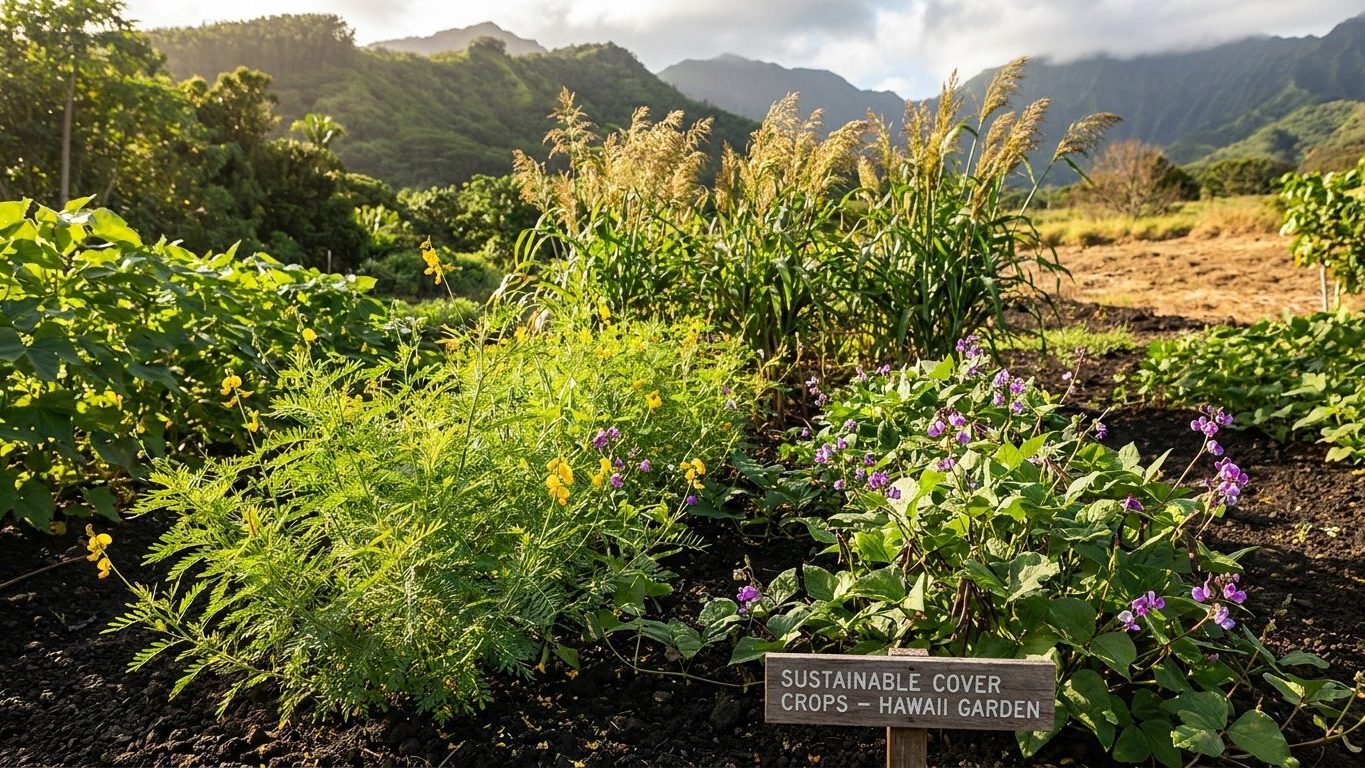

Louisiana’s answer depends on splitting the calendar into two very different jobs: a mild, nearly frost-free cool season and a long, brutally hot summer. Legumes and small grains cover the cool months statewide, while sunn hemp, cowpeas, and buckwheat take over once the heat locks in from May through September.
The short answer for Louisiana
Start with the number that actually runs the calendar here: the coldest month averages a mean daily minimum of just 46.1°F at the New Orleans reference station. That is not a hard freeze, that is barely a chill. It means Louisiana gardeners are not fighting winter kill the way a Midwest or northern-state gardener does. They’re fighting heat, humidity, and a growing season so long that summer cover crops need to survive months of 90°F-plus days, not just a few weeks.
For the cool season, crimson clover, hairy vetch, and winter pea perform well because Louisiana’s mild winters let them establish roots through December and January without freezing back to the ground. Austrian winter pea in particular tolerates the wet clay soils common across the Delta parishes better than many alternatives. Oats and cereal rye also work, though rye needs to be watched: in a state that barely freezes, it can overwinter far more vigorously than a gardener expects, turning into a mowing project instead of a natural die-back.
For the warm season, which stretches from roughly April through October, sunn hemp is the standout for biomass and nitrogen fixation, tolerating both heat and the sandier soils of the Florida parishes. Cowpeas (often sold as southern peas) do double duty as a cover crop and a harvestable crop, and they shrug off humidity better than most bean relatives. Buckwheat is the fast option, ready to till in within six to eight weeks, useful for gardeners who need a quick soil-builder between spring and fall vegetable plantings.
| Cover crop | Season | Best use in Louisiana |
|---|---|---|
| Crimson clover | Cool (fall-winter) | Nitrogen building, erosion control on slopes |
| Austrian winter pea | Cool (fall-winter) | Heavy clay soils, Delta parishes |
| Sunn hemp | Warm (spring-summer) | High biomass, sandy Florida-parish soils |
| Cowpea | Warm (spring-summer) | Dual-purpose forage/food, humid tolerance |
| Buckwheat | Warm (short window) | Fast turnaround between vegetable plantings |
None of this is a fixed calendar so much as a set of defaults. What actually fails in Louisiana, and why, matters just as much as what succeeds.
What will not work here
The first thing to rule out is any cover crop that depends on a hard freeze to terminate itself. That’s a common strategy in northern states: plant oats in fall, let a freeze kill them by January, and till in dead residue come spring. Louisiana’s freeze data makes that risky. A 32°F freeze occurs in only 86.8 percent of years at the reference station, which means roughly one winter in seven brings no freeze at all. Gardeners who count on frost to do their termination work for them can end up with a cover crop that’s still very much alive in February, competing with whatever they meant to plant next.
Second, forget cover crops bred for a short growing season. Anything marketed for a 90-day northern window is wasted here, where the frost-free stretch runs from roughly early February to mid-December depending on the year. Louisiana gardeners have room to let a slower legume like hairy vetch fully mature and fix nitrogen through winter rather than rushing a quick-cycle crop that finishes with months of growing season left unused.
Third, and this is the one that trips up transplants from drier states: anything that needs tight spacing and still air struggles in Louisiana’s humidity. Dense stands of clover or vetch sown too thick invite fungal disease once the spring rains and rising humidity arrive together, usually by April. Wider row spacing and airflow matter more here than in a drier climate, where the same density would be fine.
Finally, don’t plant a warm-season legume expecting it to coast through a Louisiana August the way it might in a milder Southern state. Even heat-tolerant cowpeas and sunn hemp slow down in the deepest summer weeks when nighttime lows stay in the high 70s. That’s a heat-stress response, not a disease, and it’s a different failure mode than the frost problems gardeners further north deal with. The lesson across all of this: Louisiana’s limiting factor is heat and moisture management, not cold, and any planting plan borrowed from a colder state will misfire here.
What changes across Louisiana
Louisiana is not one climate, and the hardiness zone range makes that plain: the state spans USDA zones 8a to 10a. That’s a real spread, not a rounding error. A zone 8a gardener in the northern parishes near Shreveport is working with a meaningfully colder winter than a zone 10a gardener down toward the Gulf coast, even though both are technically “Louisiana.”
The frost dates cited above come from a single reference station in the southern part of the state, where freezes are already rare. North Louisiana freezes far more reliably and for longer stretches each winter. A gardener up there should expect a shorter cool-season window than the dates given here, and should plant cool-season legumes earlier in fall to get full establishment before consistent cold slows growth. They can also lean more heavily on frost to terminate a cover crop, since a hard freeze is a much safer bet in the north than it is near the coast.
Conversely, a gardener in the far south, closer to that 10a zone, is dealing with winters so mild that cool-season cover crops barely pause growth at all. That’s an advantage for biomass but a management headache for termination timing, since there’s no reliable freeze to fall back on. In that part of the state, mowing or crimping becomes the more dependable way to end a cool-season cover crop’s life cycle.
None of this means a reader should guess which zone applies to them from a general description. The safest move is checking the current USDA Plant Hardiness Zone Map directly for a specific address, since parish lines don’t line up neatly with zone boundaries and microclimates near rivers, coastlines, or urban heat islands can shift things further.
Where to check this for your own county
Everything above is a state-level picture, built from a single reference station and a statewide hardiness range. It’s useful for understanding the broad pattern, but it is not a substitute for what your specific parish extension office knows about your specific soil, rainfall, and local variety trials.
The LSU AgCenter is the land-grant extension service covering the whole state, and it’s the right first stop for anyone who wants a recommendation sharper than what a statewide article can offer. Two things are worth hunting down there specifically. First, the local planting calendar for your parish or region, which accounts for the freeze pattern and rainfall specific to that part of the state rather than the single-station average used here. Second, any variety trial results for cover crops tested in your county’s soil type, whether that’s the heavy clay of the Delta, the sandier ground of the Florida parishes, or the alluvial soils along the Mississippi.
A county-level recommendation will always beat a state-level one, because it accounts for local rainfall patterns, soil drainage, and the specific freeze history of that exact area rather than a single weather station’s thirty-year average. This page is deliberately the state-level view: a starting point for understanding why Louisiana behaves differently from, say, Iowa or Minnesota, not a replacement for what your county agent already knows about the field down the road from you.
Checking this against your own garden
Every date and zone number on this page is a probability built from decades of weather records, not a guarantee for this particular year in this particular yard. The most reliable planting cue is still what’s happening in front of you.
Start with soil warmth by feel. Push a bare hand a few inches into the bed in early spring. If the soil still feels cool and damp rather than faintly warm, warm-season cover crops like sunn hemp or cowpeas will sit and sulk rather than germinate quickly, no matter what the calendar says.
Watch for the first flush of male flowers on nearby squash, cucumber, or similar warm-season vegetables if any are already growing close by. That flush is a strong signal that soil and air temperatures have crossed into reliably warm territory, and it tends to show up before most calendar-based planting guides catch up to what’s actually happening in the ground.
Finally, track how fast the first true leaves appear on any test patch of a fast crop like buckwheat. A quick, even emergence of true leaves within a week or so points to good soil warmth and moisture. A slow, patchy emergence, even after the calendar says conditions should be right, is the garden telling you its microclimate runs cooler or wetter than the state average, which is worth trusting over any printed date.