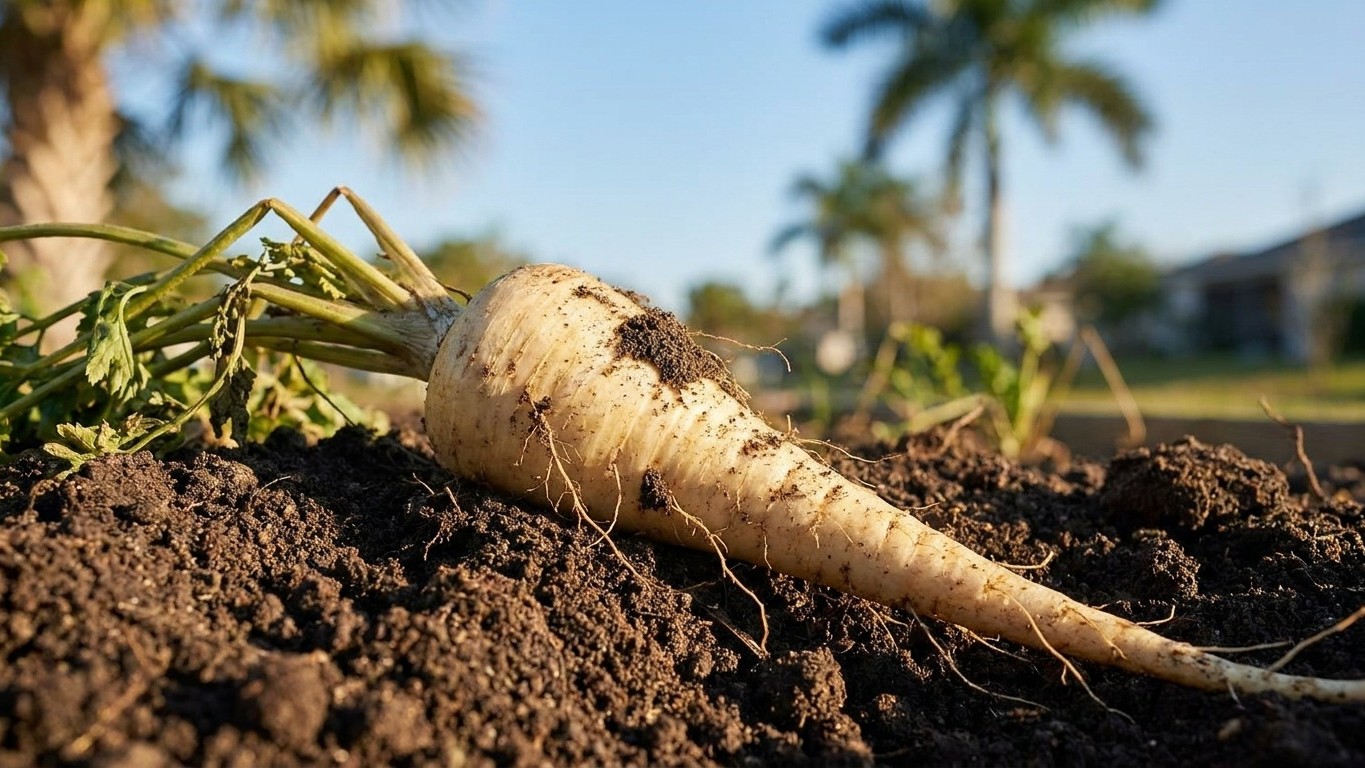

Lift parsnips after several weeks of frost, not before. On Prince Edward Island the average first fall frost is October 17, so counting several weeks from there lands you in November in a typical year. Dug then, a parsnip is sweet and will store for four to six months, if you keep it away from apples and other ripening fruit. Parsnips are sown in place and need 100 to 120 days from seeding.
The short answer
Does the Island deliver several frosty weeks? It does. At the Charlottetown A reference station, the mean daily minimum of the coldest month is -12.1 °C. That is an average of the nightly lows, not a record cold snap, and it describes a winter that sits well below freezing for long stretches. A parsnip grown here will sweeten, not merely grow. The sweetening comes from exposure to cool, frosty weather converting stored starch to sugar, and that exposure is what this climate supplies. A comfortable hardiness zone would not tell you the same thing. If you want the full mechanism, Will Parsnips Sweeten in Prince Edward Island? covers it.
When to dig
October 17 is a mean date from Environment and Climate Change Canada’s normals for Charlottetown A, which means that in one year out of two the first frost arrives later. Treat it as the middle of a window, not a promise. Northern and upland districts of the province run weeks behind the Charlottetown figure, and a farm near the coast can differ from one inland. The practical rule is to let the roots sit through several weeks of cold nights, then lift them when you need them, or all at once before the soil turns too hard to work a fork into.
How long they keep
USDA Agricultural Handbook 66 puts parsnip storage at 4 to 6 months at 0 to 1 °C (32 to 34 °F) with 98% relative humidity. That is a long keeper by any standard. The figure assumes those conditions are held steady, and almost no house does that.
Cold is not the enemy. Parsnips are not chilling sensitive. The hazard is ethylene, the gas that ripening fruit gives off. Parsnips make very little of it themselves, but low levels in cold storage turn them bitter, likely through a compound called xanthotoxin. So the box of apples in the root cellar is the real problem, even when the temperature is perfect. Store roots well away from any ripening fruit. Top them after harvest, but do not trim into the crown.
Does the season fit?
Here is the arithmetic in words, using the Charlottetown A averages. Every date below is a midpoint, so leave yourself margin.
- The average last spring frost is May 16. Parsnip seed goes in 2 to 3 weeks before that, which means roughly April 25 to May 2.
- Germination is slow. Count 14 to 21 days before anything shows. Bare soil in the second week is normal, not a failed sowing, so do not dig it up and re-sow.
- The 100 to 120 days run from seeding, not from the day seedlings appear. Counting from April 25, the roots reach full size between about August 3 and August 23. Counting from May 2, between about August 10 and August 30.
- The average first fall frost is October 17. From the latest of those finish dates, August 30, that leaves about seven weeks. From the earliest, August 3, it leaves about eleven.
- Those weeks are the point. The roots are finished growing before the first frost, and the cold of autumn then does the sweetening. Because the first frost falls later in half of all years, you will usually have more than seven weeks to wait, not fewer.
- A sowing made right at the average last frost, May 16, still finishes between about August 24 and September 13. The season fits comfortably, but the margin shrinks with every week of delay.
The whole frost-free stretch between those two average dates runs about 154 days, which is longer than the 120 days the crop asks for. The fit is comfortable on the Charlottetown figures. In a cold northern or upland district, where the last frost comes later and the first comes earlier, it tightens. Check your own garden’s first and last frost against these numbers before you trust them. Environment and Climate Change Canada’s normals come from a 30-year record, so a recent cold spring or a mild autumn can shift things.
What goes wrong here
- Forked roots from heavy or stony ground. A parsnip that meets a stone or a clay lump splits around it. The remedy comes from Utah State University Extension: deep, sandy soil, and double digging where the ground is heavy. Soil varies from one Island property to the next, so dig a test hole and look before you sow. A regional soil description is a starting point, not a diagnosis.
- Forked roots from overwatering. This is a separate cause and needs a separate fix. Constant wet encourages the root to branch, even in good soil. Water deeply but not constantly, and let the top inch dry between sessions.
- A season that runs out. Sow late, or garden in a district that thaws weeks behind Charlottetown, and the 100 to 120 days may not finish before hard frost. Sow in the window before the average last frost, and do not treat May 16 as safe, since half of years run later.
- Re-sowing too early. Seed that takes 14 to 21 days to come up looks like a failure at day ten. Mark the rows and wait the full three weeks before concluding anything.
- Lifting before the cold has worked. A root pulled in September is edible but starchy. A winter too mild to sweeten is not the usual Island problem, given that -12.1 °C figure, but an early dig-up gives the same result. Wait through several frosty weeks. If the tops are being eaten or damaged before then, What Eats Parsnip in Prince Edward Island, and When lays out the timing.
- Bitter roots from storage. The cause is ethylene, not cold. Keep them away from apples and other ripening fruit, and top without cutting the crown.
Common questions
Can parsnips stay in the ground through winter?
Cold itself is not what harms them, since parsnips are not chilling sensitive. The practical limit is whether you can get a fork into the soil. Lift what you need before the ground locks up, and store the rest properly. The wider growing picture is in Growing Parsnips in Prince Edward Island.
Why did my stored parsnips turn bitter?
Look at what sits beside them. Ripening fruit gives off ethylene, and even low levels in cold storage cause bitterness in parsnips. Apples are the usual culprit. A different shelf or a different room is the fix.
How long before the seedlings show?
Between 14 and 21 days. The 100 to 120 days to harvest count from seeding, so the clock is already running while the row looks empty.
Is the Charlottetown frost date my frost date?
Not exactly. The May 16 and October 17 averages come from the Charlottetown A station, and a province is not one climate. Northern and upland areas run weeks behind, and in any location the frost falls later than the average date in about half of years. Use the figures as the middle of a window, and watch your own garden for a season or two.