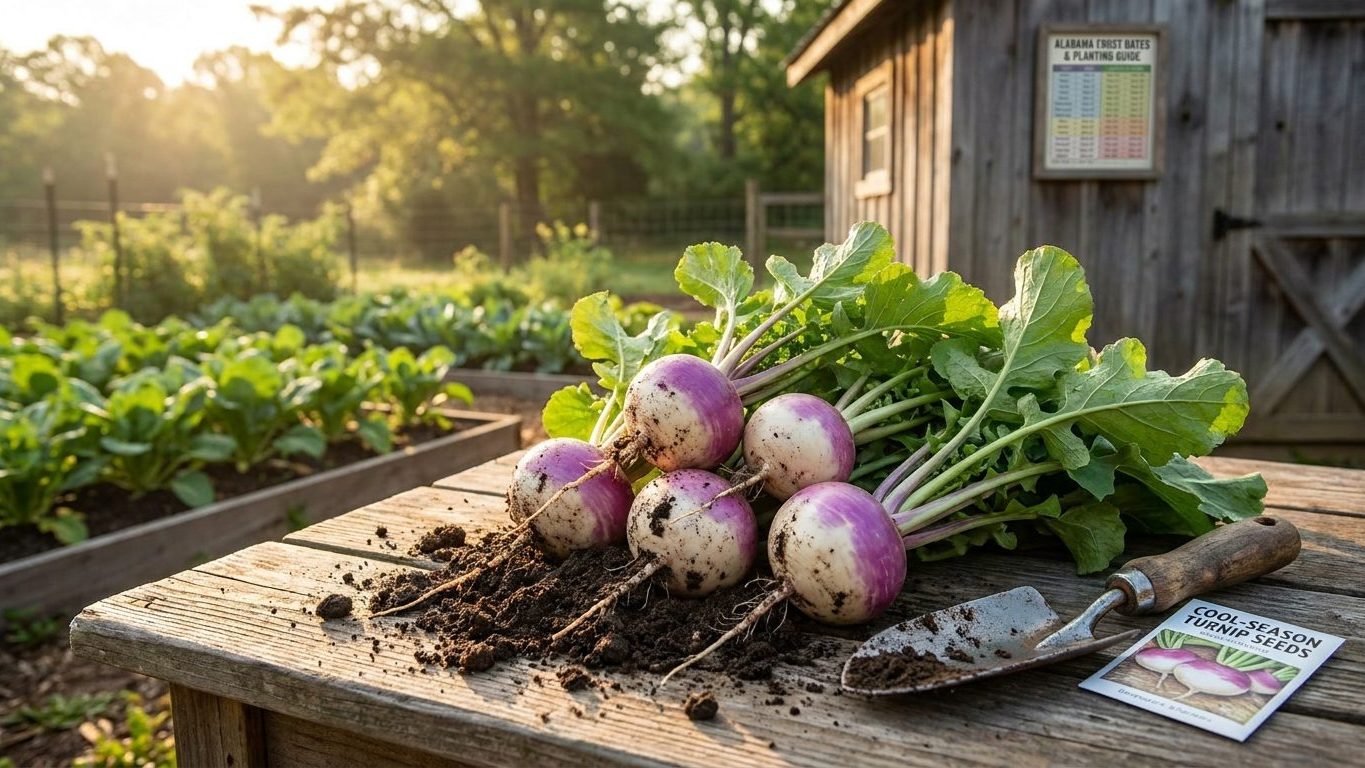

Sow turnips in West Virginia twice a year: in early spring, around the April 9 to April 23 last-frost window, and again in late summer, counted back from the October 18 to November 1 first-frost window. The fall sowing usually gives the sweeter, less woody root. Those dates come from Charleston, a river valley, so a mountain garden runs on a different clock.
The short answer for West Virginia
Sow spring turnips from the last week of March through the April 9 to April 23 window, and fall turnips from mid-August to early September. Both are my arithmetic from the frost dates, and both assume you are gardening near Charleston’s elevation.
Here is what those frost dates actually are. NOAA’s 1991-2020 Climate Normals for the Charleston station (USW00013866) give the dates when the chance of a 32°F freeze sits between 30 and 70 percent. April 9 to April 23 is the spring stretch, when a freeze after that date is a coin flip. October 18 to November 1 is the fall stretch, when the first freeze is about as likely to have arrived as not. They are probabilities of a 32°F freeze, not promises. A frost on April 28 is unusual but not shocking, and one on October 10 would surprise nobody who has gardened here long.
Why do turnips fit so well? They tolerate light frost, so the spring crop does not have to wait for the last freeze to pass. Sowing a couple of weeks ahead of the April window lets the roots size up before summer heat turns them pithy and sharp. In fall the logic reverses. A turnip needs roughly 45 to 60 days from seed to a usable root (check your seed packet, since varieties differ), and rutabaga needs closer to 90. Count backward from October 18 and you land in mid-to-late August for turnips and late July for rutabaga.
| Crop and season | Sowing window (Charleston area) | How it is figured |
|---|---|---|
| Spring turnips | Last week of March through mid-April | Before and into the April 9 to April 23 freeze-probability band; roots mature before summer heat |
| Fall turnips | Mid-August to early September | About 45 to 60 days counted back from October 18 |
| Fall rutabaga | Late June into July | About 90 days counted back from October 18 |
The span between the two frost windows is worth a look. From April 23 to October 18 is 178 days, and from April 9 to November 1 is 206. That is a long frost-free stretch by northern standards, which is why West Virginia gardeners can run two turnip crops instead of one. For the wider picture of both crops in the state, see Growing Turnips and Rutabaga in West Virginia.
What will not work here
Rutabaga sown in April. It is the classic mistake, and the numbers explain it. A 90-day crop started in mid-April would be sizing up through July and August, the warmest part of a season that has 178 to 206 days between frosts. Roots that bulk in summer heat turn out coarse and bitter. Rutabaga belongs in the fall slot, sown in the weeks before the turnips.
Planting turnips in May and June fails for the same reason. The season is long enough that you might think more time means more room to sow, but a long season is not a cool one. Spring sowings made after mid-April run into summer warmth before the roots finish, and bolting or woody texture follows. If you miss the April window, skip to August rather than forcing a late spring crop.
Leaving turnips in the ground all winter is another gamble. The mean daily minimum of the coldest month at Charleston is 26.1°F. That is an average, so many nights run colder, and a root left unprotected through a stretch of those nights can turn to mush. A thick mulch buys some margin in the valley, and none you should count on at altitude. Pull the crop in late fall and store it.
Tight spacing is the quieter failure. Most of West Virginia stays humid through summer and into early fall, and the August-sown crop grows in warm, damp air. Crowded rows hold moisture against the leaves, and thinning late is a common reason fall turnips come up leggy with spotted foliage. Thin to the spacing on your seed packet while seedlings are small, and keep the rows open enough that leaves dry after rain.
The last failure is variety choice. A fast, small-rooted turnip suits an August sowing and a squeeze before frost. A big, slow storage type does not. If you are choosing seed, The Best Turnips and Rutabaga for West Virginia sorts types by days to maturity so you can match them to the dates above.
What changes across West Virginia
There is no single answer for the whole state. The USDA Plant Hardiness Zone Map (2023 edition, built on 1991-2020 normals) places West Virginia in zones 5a through 7a. That is five half-zone steps: 5a, 5b, 6a, 6b and 7a. Zone is built on one variable only, the average annual extreme minimum temperature, so it tells you about winter cold and says little about when spring frost ends or how soon fall frost arrives. Still, a spread that wide inside one state is a sign that the Charleston dates are a reference point, not a rule.
If you garden in the north or at altitude
The caution attached to the frost data is plain: Charleston sits in a river valley, and higher elevations across the state freeze noticeably earlier in fall. So the fall sowing is where you give up the most calendar. Shift it earlier, because the days you counted back from October 18 start from a frost that may arrive sooner on a ridge. A fall turnip sown in mid-August in the valley may need to go in closer to early August on a hilltop, and rutabaga earlier still, or you skip it for a faster crop.
Spring moves the other way. Cold air settles late on mountain slopes and in northern counties, so the last freeze comes later than April 9 to April 23. Hold your spring sowing back by days or weeks, depending on how your own spot behaves. I will not put a number on that shift, because the facts behind this page only cover Charleston, and a guess would be worse than none.
Which zone are you in? This page cannot tell you. Look up your location on the USDA Plant Hardiness Zone Map and read the zone for your own address, not for the nearest big town. Then treat the Charleston dates as the middle of the range, nudging later in spring and earlier in fall as your elevation and latitude suggest.
Where to check this for your own county
Start with West Virginia University Extension, the state’s land-grant extension service, with offices serving counties across the state. Two things are worth looking for there. The first is a local planting calendar for vegetables, ideally one tied to your county’s frost dates instead of the state’s. The second is any record of varieties trialled in your county, since a turnip that did well in a cool northern valley may not behave the same in the southern coalfields.
Ask the county office directly if the website does not spell it out. Staff and Master Gardener volunteers often know things that never reach a PDF, such as the average fall frost date in a specific hollow, or which seed lots have stood up to local disease pressure. Asking “when do people around here sow fall turnips” is a perfectly good question to bring.
A county recommendation beats a state one. This page is the state one, and a thin one at that: it rests on a single reference station in a river valley. The sources behind it do not include a West Virginia University planting calendar for turnips, so I cannot tell you what that calendar says. Other states’ extension publications exist, but they describe other climates and other species, and borrowing a neighbor’s calendar is how gardeners end up sowing three weeks too late or too early.
Use this page to build a first draft of your calendar, then let the county office correct it.
Checking this against your own garden
Your own observation outranks every date above. A garden is a microclimate, and three simple things will show you how yours compares with Charleston, with no instruments beyond your hands and eyes.
- Soil by feel. In spring, squeeze a handful from about 3 inches down. If it crumbles instead of staying in a wet clump, it is workable, and turnip seed can go in. A bed that stays clumpy a week or two after your neighbor’s is telling you that you are on the late side of the range.
- First true leaves. Turnip seedlings show a pair of seed leaves first, then the rough-edged true leaves. Note how many days that takes. Fast emergence in March means warm soil, and slow emergence in August means your bed is running hot and dry or cooler than you assumed.
- Where frost lands first. On the first frosty mornings of fall, walk the yard and see which low spots turn white. That map shows you where cold air pools, and it tells you where the fall crop is at most risk.
Write down the dates for a season or two. A scrap of paper on the garage wall is enough. After two years you will have a calendar that is more accurate than any in print.
If you follow the almanac, here is when to plant turnips by the moon. It is a tradition, not a proven method.
Common questions
Can I sow turnips in July in West Virginia?
Turnips, usually not; rutabaga, yes. Counted back from the October 18 to November 1 first-frost window, July is the right month for a roughly 90-day rutabaga. A quick turnip sown that early will be ready in the heat and often ends up woody, so wait until mid-August.
Do turnips survive a frost?
Light frost is generally fine for turnips, which is why you can sow them ahead of the April 9 to April 23 window. A hard freeze is another matter. The mean daily minimum of the coldest month at Charleston is 26.1°F, so winter nights can damage unprotected roots.
Are the Charleston dates right for my town?
Maybe, maybe not. The frost dates on this page come from one Charleston station in a river valley, and higher elevations freeze noticeably earlier in fall. Use them as a reference, then adjust for your elevation and confirm with your county extension office.
Is spring or fall better for turnips here?
Fall is usually the better bet. Roots mature as the weather cools, and the frost-free stretch of 178 to 206 days leaves plenty of room to start in August. Spring works if you sow early and harvest before summer heat, and a small spring sowing makes a sensible test before you commit to a big fall one.