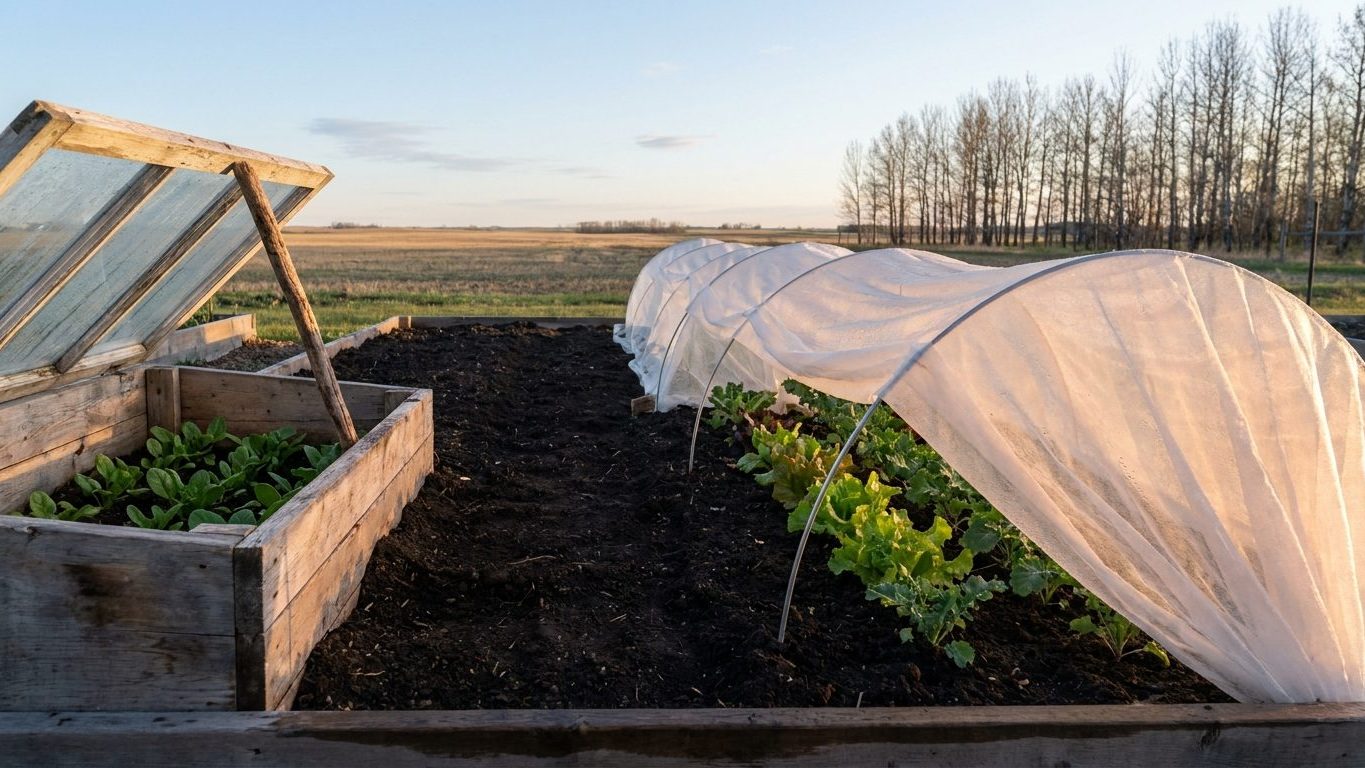

Row cover, cold frames, and low tunnels are the season extenders that earn their keep in Kansas, and they pay off most at the two ends of the growing year. Summer is the other half of the story, where shade cloth and mulch matter as much as plastic. The numbers below come from the Wichita airport weather station. Read them as a reference city, not a promise for your yard.
The short answer for Kansas
For most Kansas gardeners, the first purchase should be lightweight floating row cover, followed by a simple cold frame or low hoop tunnel. They cost little, they handle the frosts Kansas actually delivers, and they work with wind and bright sun rather than against them. Heavier gear such as a heated greenhouse rarely makes sense for a backyard vegetable plot here.
What the frost dates say
At the Wichita station, the last spring 32°F freeze falls between April 4 and April 18. That range is the middle band of the odds in NOAA’s 1991-2020 Climate Normals, the dates when the chance of a 32°F freeze still being ahead runs from 30 to 70 percent. It is a probability, not a deadline. The first fall freeze lands between October 23 and November 2, using the same 30-70 percent band.
Those figures come from an airport, and airports run warmer than many gardens. Suburban and rural plots often see the last spring frost one to two weeks later and the first fall frost one to two weeks earlier, and more so at elevation. A gardener outside a city may have a window noticeably shorter than the one printed above.
The winter figure matters too. The mean daily minimum in Wichita’s coldest month is 22.5°F. That is an average low, not a record, so individual nights go lower. It does tell you that a hardy crop under cover can ride out an ordinary Kansas January, while tomatoes and peppers cannot.
Matching the tool to the job
| Extender | Best Kansas use | Main limit |
|---|---|---|
| Floating row cover | Frost nights in spring and fall, insect barrier | Needs anchoring against wind |
| Cold frame | Hardy greens and seedlings, late fall through winter | Must be vented on sunny days |
| Low hoop tunnel | Earlier spring beds, fall crops held into winter | Overheats if closed up |
| Shade cloth | Summer heat on lettuce, and on fall seedlings getting started | Slows warm-season crops if left on |
| Mulch | Holding soil moisture and root-zone steadiness | Cools soil if laid too early in spring |
For a wider look at how these tools fit together, see Extending the Growing Season in Kansas.
What will not work here
Kansas has a long frost-free stretch, roughly six and a half months between the middle of the spring band and the middle of the fall band. That is the first reason some popular advice fails. A gardener told to pour money into a heated structure to “get a jump” is solving a problem this state mostly does not have. The calendar is generous. The weather is what bites.
Closed plastic under a spring sun
Clear plastic hoops sealed tight are a classic mistake. A Kansas March can swing from a hard freeze at dawn to a sunny afternoon, and a closed tunnel can turn into an oven by midday. Cool-season crops like spinach and lettuce stall or bolt in that heat, and tender seedlings can scorch. A tunnel here needs ends you can open, or sides you can lift, every sunny day. If you cannot be home to vent it, use fabric row cover instead, which breathes.
Light covers on a windy plain
Wind is the second killer. Kansas is open country, and loose fabric that works fine in a sheltered valley will end up in the neighbor’s yard. Row cover needs soil, boards, or landscape staples along every edge, and hoops need to be set deep. A cover that flaps also abrades leaves.
Warm-season crops far ahead of the date
Using covers to put tomatoes or peppers out in mid-March is a gamble the numbers do not support. The Wichita band for the last freeze runs to April 18, and a country garden may be later. Fabric buys you a few degrees, not a different season. A hard freeze after a cover-assisted early planting will win. Soil warmth is the other limit. Cold ground stalls warm-season roots no matter how snug the air above them is.
Planning around the fall date alone
Gardeners who treat the first fall freeze as the only deadline miss the hot-summer problem. A Kansas July and August can be hard on lettuce, spinach, and brassica seedlings meant for fall. Extension for the cool end of the year starts in summer, with shade, steady moisture, and mulch. Weekly watering is not enough for new fall seedlings in a hot, dry spell, so plan on checking them more often, and remember that covers in fall are for holding a harvest, not for rescuing a late start. For the timing of those frost nights, see When to Cover Your Garden in Kansas.
What changes across Kansas
Kansas is not one garden. The USDA Plant Hardiness Zone Map 2023, built on 1991-2020 normals, places the state in a range from 5b to 7a. That is four half-zone steps, so there is no single answer for the state. The zone system rests on one number, the average annual extreme minimum temperature, and says nothing about summer heat, wind, or frost dates. Use it for winter survival of perennials, not for planting dates.
The reference figures here belong to Wichita, at 37.65 degrees north. A reader in the northern tier of the state sits at a higher latitude, and one in the far south sits lower. Latitude matters because day length, not warmth, tells an onion when to stop making leaves and start forming a bulb. A gardener near the northern or southern edge of Kansas should check their own latitude rather than lean on Wichita’s.
The practical shift is simple. In the colder north and in the higher west, expect a later last spring frost and an earlier first fall frost than the Wichita bands, then lean harder on row cover and cold frames to pad both ends. In the warmer south, covers do more good in winter for hardy greens than in spring, and shade cloth becomes the tool you use most. Where you sit within that four-step spread changes which extender does the most work.
Do not guess your own zone from a neighbor or a plant tag. The USDA map is searchable by ZIP code, and that is where to find it for your address.
Where to check this for your own county
The best next stop is K-State Research and Extension, the state’s land-grant extension service. Its county and district offices employ agents who know local soil, wind, and frost pockets. A county recommendation beats a state one every time, and this page is the state one, built on a single reference station and written for a very large area.
Look for two things there. First, the local planting calendar for your county, which will give vegetable timing tied to your area instead of Wichita’s. Second, any varieties trialled in your county, since a cultivar that performs in a research plot nearby has already handled your wind and heat. Ask also about local frost-date guidance and about extenders agents recommend for the crops you grow.
This page does not have a county-level calendar for Kansas, and it will not borrow one from another state. Calendars published by other states’ extension services are written for their own climates and species, so they are no substitute. If your county office has a master gardener program, those volunteers are often the fastest route to practical, hyperlocal answers about which covers survive the wind on your road.
Checking this against your own garden
Your own observations outrank every date on this page. Three are worth tracking, and none needs an instrument.
- Soil warmth by feel. Push a hand into the bed in the morning. If the soil still feels cold and clammy, warm-season roots will sulk, whatever the calendar says. Beds that warm sooner than the yard around them tell you about slope, drainage, and shelter.
- The first male flowers. Squash and cucumbers usually open male blooms before female ones. When they appear, and how quickly they follow, shows how fast your garden is warming and whether covers delayed or helped.
- The first true leaves. The seed leaves come first. The first true leaves signal that a seedling has established itself. Slow arrival under a tunnel can mean it is too cool or too crowded, while fast arrival with scorched edges means too much heat.
Write down the dates for one season. A notebook beats any average, because it records your own yard, including the cold corner by the fence and the warm wall that gets afternoon sun.
Common questions
What is the cheapest season extender for Kansas?
Lightweight floating row cover is the lowest-cost starting point. It protects against light frost, blocks some insects, and breathes on sunny days. Anchor the edges well, because Kansas wind will find any loose corner.
When is the last spring frost in Kansas?
At Wichita’s airport station, the last 32°F freeze falls between April 4 and April 18, using the 30-70 percent probability band from NOAA’s 1991-2020 normals. Gardens outside the city often see it one to two weeks later, so check your own county.
Can I grow vegetables through a Kansas winter?
Hardy crops can survive under a cold frame or tunnel. The coldest month’s mean daily minimum in Wichita is 22.5°F, and that is an average, not the lowest night. Growth slows sharply in deep winter, so think of it as holding a harvest, not producing a large one.
Do I need shade cloth in Kansas?
Many gardeners do, especially for lettuce and for fall seedlings started in summer heat. Shade cloth also keeps tender transplants from scorching. Remove it once temperatures ease, or it will slow crops that want full sun.