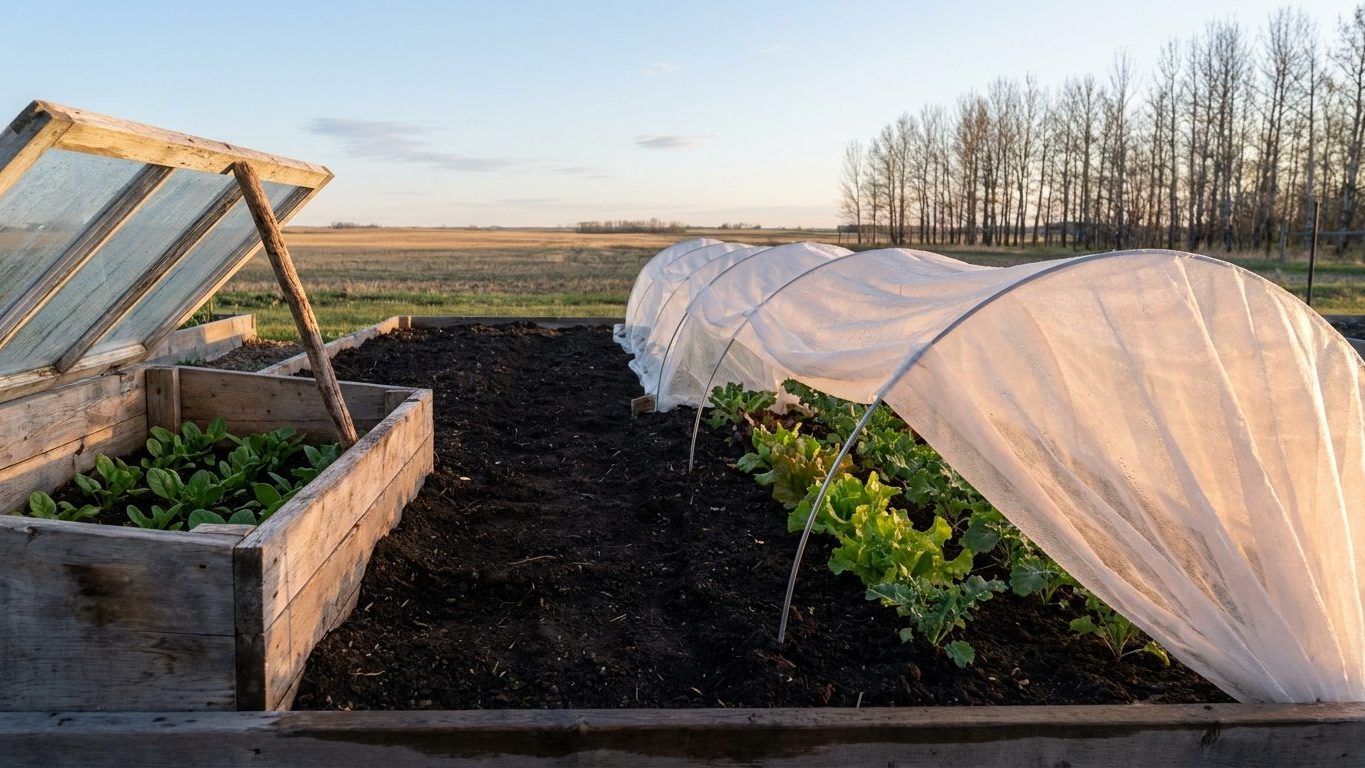

Floating row cover on hoops, cold frames and unheated hoop houses are the season extenders that earn their keep in Maine. Each one buys a few weeks at either end of the year, not a second summer. Which one fits depends on what you are protecting (an early tomato or December spinach) and on how far inland and north you garden.
The short answer for Maine
Start with the dates the covers have to work around. At Portland, NOAA’s 1991-2020 Climate Normals put the last spring 32°F freeze between April 22 and May 1, and the first fall freeze between October 9 and October 21. Those are probabilities, not promises. Each date marks the band where the chance of a freeze sits between 30 and 70 percent, so a frost after the later spring date, or before the earlier fall one, is entirely ordinary.
That gap is where season extenders work. A cover traps a little heat radiating from the soil overnight and blocks wind, which is enough to carry plants through a light frost. It will not carry them through a hard freeze.
Covers that add weeks
Lightweight row cover laid over wire or PVC hoops is the best first purchase. It lets light and water through, goes up in minutes and comes off just as fast. Clear plastic tunnels warm soil faster in spring but overheat on a sunny day, so they need venting. Black plastic mulch warms the soil under heat-lovers such as peppers and squash. For timing, the page on when to cover your garden in Maine goes through the nights that matter.
Structures that add months
Cold frames and unheated hoop houses protect hardy crops (spinach, kale, mâche, carrots) well past the fall freeze dates. Putting a second layer of cover inside the hoop house is how Maine growers keep greens alive through deep winter. The broader picture sits in extending the growing season in Maine.
| Extender | What it does | Best Maine use |
|---|---|---|
| Floating row cover on hoops | Holds a little heat, blocks wind | Light frost at both ends of the season |
| Clear plastic low tunnel | Warms air and soil quickly | Early spring greens and transplants, with venting |
| Black plastic mulch | Warms soil | Peppers, squash, melons |
| Cold frame | Sheltered, glazed pocket | Hardy greens into late fall and early spring |
| Unheated hoop house | Walk-in protection, can be double-layered | Winter harvest of the hardiest crops |
What will not work here
Planting tomatoes on April 22 because a cover is on hand. That date sits at the early edge of the freeze band, and a single layer of fabric will not hold against the kind of night that still turns up in late April. Soil is also slow to warm in Maine, so even a protected tomato may sit and sulk. Heat-lovers belong under cover only after the later spring date (May 1) has passed, and they still need a spare cover on hand.
Winter outdoors is the second failure. The mean daily minimum of Maine’s coldest month is 15.6°F at Portland, and that is an average, so plenty of nights run colder. A thin cover over a tender crop in January does not cut that. Hardy greens survive in a hoop house, but at roughly 43.65 degrees north (Portland’s latitude), midwinter days are short enough that growth nearly stops. You are storing a crop in the ground, not growing one. Plan to harvest what matured before the light faded.
Another miss is sealing everything shut. Maine’s humid, changeable weather punishes a closed tunnel: a cool, sunny morning can run a clear plastic tunnel hot enough to scorch seedlings, and trapped moisture invites fungal disease. Vent on any sunny day, and close it again before dusk.
Leaving cover on through flowering is a quieter mistake. Squash, cucumbers and melons need pollinators, and fabric keeps bees out. Take it off once flowers open.
Last, snow. A hoop that handles a wet October frost can fold under a heavy snow load. Hoops intended for winter need sturdy frames and a plan to shake snow off, and wind-exposed coastal sites need extra anchoring.
What changes across Maine
Portland is the mild end of the state, and the figures above belong to it. The USDA Plant Hardiness Zone Map (2023, built on 1991-2020 normals) places Maine across zones 3b to 6a. That is a wide spread, and it means there is no single answer for the whole state.
Remember what the zone measures, though: only the average annual extreme minimum temperature. It tells you whether a perennial survives winter. It says nothing directly about when your last spring frost falls, which is what decides when covers go on.
Inland and northern Maine run substantially later in spring and earlier in fall than Portland. A gardener in the north or at altitude should shift in three ways. First, add days to the spring planting dates above and subtract days from the fall ones. Second, count on covers for a larger share of the season, since the open window is shorter. Third, choose sturdier structures: a low tunnel that works near the coast may be outmatched by an inland cold snap or a heavier snowpack.
Latitude matters too. Portland sits at 43.65 degrees north, and the state reaches several degrees beyond that. Day length, not warmth, is what tells an onion to stop making leaves and start making a bulb, so a reader near the far northern edge should check their own latitude before leaning on this page’s timings. To find which zone your garden falls in, use the USDA map and look up your location. Do not guess from a neighbor’s tomatoes.
Where to check this for your own county
The best local source is University of Maine Cooperative Extension. What you want there is narrow: the planting calendar for your county, and the varieties that have been trialled in conditions like yours. A calendar tells you when to sow and cover. A trial tells you which cultivar of a spinach or tomato held up where you garden.
A county recommendation beats a state one, and this page is the state one. It is built on a single reference station in Portland. This page does not carry a county-by-county calendar, and it does not list trialled varieties for each part of Maine. Extension offices do.
When you search the site, look for crop-specific guidance rather than general season-extension articles. Extension publishes one calendar per crop (or per lawn species), because different plants run on different clocks. Use the one for what you are actually growing.
Checking this against your own garden
Your own observations outrank every date here. Three signs cost nothing to watch.
- Soil warmth by feel. Push your hand a few inches into a bed on a mid-morning in spring. If it feels cold and clammy, heat-lovers will stall. Compare a covered bed and an uncovered one, and you learn how much your covers are really adding.
- The first male flowers on squash. They open before the female ones. When they show, warmth has arrived, and the date tells you how your site runs compared with the calendar.
- The first true leaves on seedlings. The rounded seed leaves come first, then the leaves that look like the plant. A seedling slow to make them is telling you the spot is cooler than you thought.
Keep a note of each date for a season or two. Two or three years of those notes will describe your microclimate better than any statewide band.
Common questions
What is the cheapest season extender for Maine?
Floating row cover over hoops. It handles light frost at both ends of the season and costs far less than a hoop house.
Can I grow vegetables outdoors all winter in Maine?
Not tender ones. With a coldest-month mean daily minimum of 15.6°F at Portland, only hardy greens in a protected hoop house or cold frame stand a chance, and growth is slow in short winter days.
When is the last spring frost in Maine?
At Portland, the 32°F freeze probability band runs April 22 to May 1 (NOAA 1991-2020 normals). Inland and northern Maine run substantially later.
Does my hardiness zone tell me when to cover plants?
No. The USDA zone (3b to 6a across Maine) rests only on the average annual extreme minimum temperature. It shows winter survival, not frost timing.