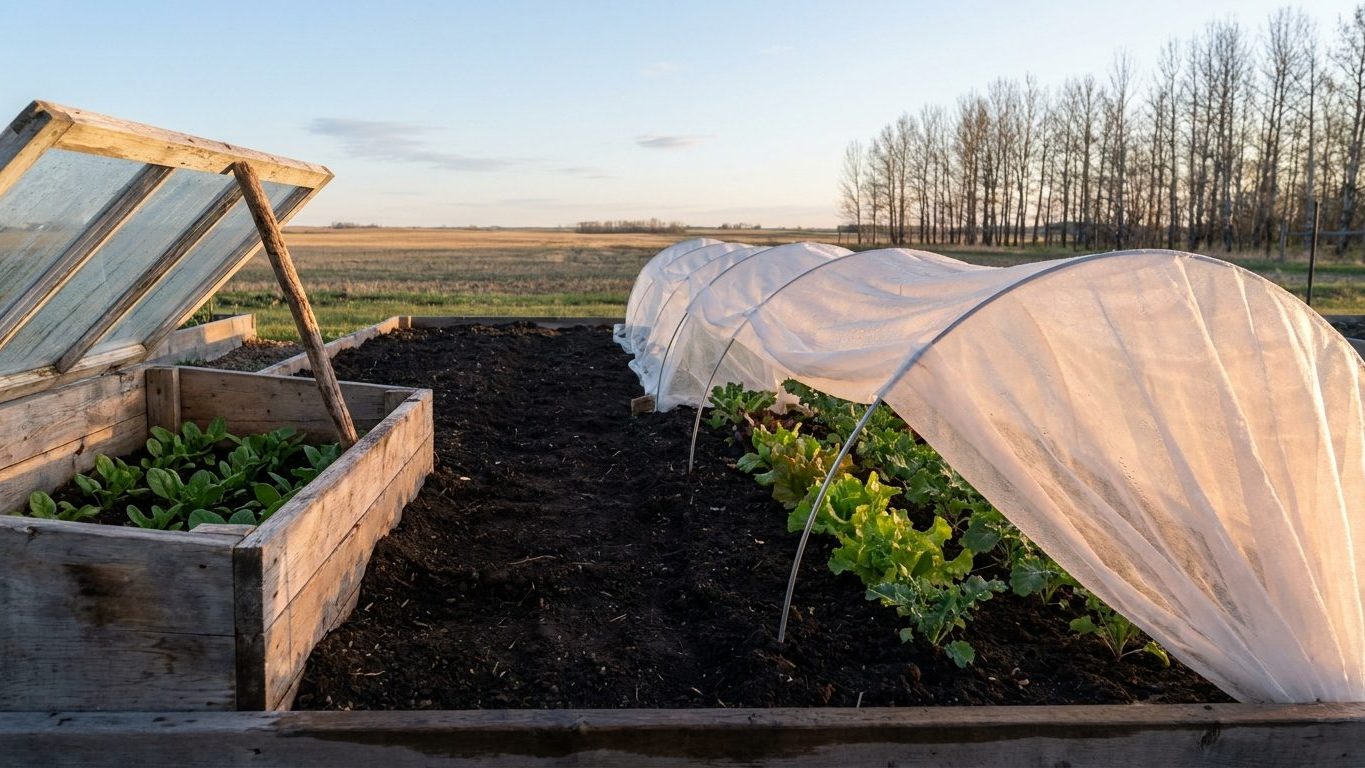

Floating row cover over wire hoops does the most for the money in Manitoba. A cold frame handles spring and fall greens, and plastic mulch warms the soil for squash, corn and other heat lovers. Each one buys days, sometimes a few weeks, at either end of the season. None of them changes the climate, and none will carry tender plants through a hard freeze or a prairie winter.
The short answer for Manitoba
For most Manitoba gardens, a low tunnel of floating row cover is the extender to buy first, followed by a cold frame and then plastic mulch. Together they stretch the frost-free stretch at both ends, which is where Manitoba gardeners lose the most time.
The numbers explain why. At the Winnipeg Richardson airport station, the average last spring frost falls on May 23 and the average first fall frost on September 22. That leaves 122 days between the two dates. Both are means, not safe dates: in about half of all years the spring frost comes later than May 23, and in about half the fall frost arrives ahead of September 22. They are the midpoint of a window, and a long one. The figures also come from 1981-2010 normals measured at one station, so districts away from Winnipeg will differ.
Extenders work on that window. A tunnel or cold frame lets you set out hardy transplants and sow cool-season crops before the average last frost has passed. In fall, the same covers keep lettuce, spinach and kale going through the first light frosts, which tend to arrive before the weather has truly turned. The full range of methods is laid out in Extending the Growing Season in Manitoba.
How the three main options compare
| Extender | Best use | Limit in Manitoba |
|---|---|---|
| Row cover on hoops | Early transplants, fall lettuce, spinach, brassicas | Light frost only; wind lifts it unless the edges are anchored |
| Cold frame | Hardening off, early and late greens | Overheats on sunny days unless vented; not a winter greenhouse |
| Plastic mulch | Warming soil for squash, corn, melons, peppers | Warms the ground, not the leaves on a frosty night |
Row cover earns its place first because it is cheap, light and does two jobs. It takes the edge off a frosty night, and it holds some warmth around plants on cool, windy days. The other two options solve narrower problems.
What will not work here
Cover that can’t handle the cold
Winter is the clearest failure. The mean daily minimum in the coldest month is -21.4 °C (-6.6 °F). A sheet of row cover or an unheated cold frame will not keep lettuce or other tender crops growing through a month of nights like that. Midwinter days are also short and the sun sits low, so even a perfectly warm frame would give plants too little light to grow. Treat winter structures as storage and shelter for very hardy crops, not as a way to harvest fresh salad in January.
Row cover also fails against a hard freeze. A light fabric is built for the first frosts of spring and fall, the ones that blacken basil and squash leaves overnight. When the forecast drops well below freezing, a single layer will not hold. Add a second layer, drape a blanket over the hoops for the night, or harvest what you can. When to Cover Your Garden in Manitoba covers the timing in more detail.
Cover that handles the weather badly
Open prairie wind is hard on covers. Fabric that is only weighted down at the corners will lift and tear. Bury the edges, or pin them every foot or so, and use hoops sturdy enough to stay put in a gust.
Clear plastic tunnels have the opposite problem. On a bright spring afternoon with a cool breeze, the air inside can climb far above the air outside, and seedlings cook. Open the ends or lift the sides on any sunny day, then close them again before evening. Snow load is the other risk: wet spring snow can flatten a hoop house that was fine in October.
Finally, the calendar itself can mislead. Planting tender transplants on May 23 because it is the average last frost date is a coin flip, with no cover at all. Melons, sweet potatoes and long-season peppers have the most to lose, because the 122 days between mean frosts is already shorter than it sounds once you subtract the cold, slow weeks at each end. Pick varieties with shorter days to maturity, and treat covers as insurance rather than a license to plant early.
What changes across Manitoba
Winnipeg sits in hardiness zone 3b on Canada’s system, based on 1991-2020 normals. That describes one city, not a province. Manitoba stretches from the Red River Valley and the US border to the northern boreal forest, and the zone changes along the way. There is no single answer for the whole province, only a spread, and northern and upland districts run weeks behind the Winnipeg dates.
This is not a USDA zone, and it does not convert to one. The Canadian system draws on seven climate variables, while the USDA system uses winter minimum temperature alone. Natural Resources Canada says there are no simple conversions, and that Canadian zone 4a overlaps nine USDA zones, from 3a to 7a. If a plant tag or an American catalogue quotes a USDA zone, do not translate it by guesswork. To find your own zone, use the municipality lookup on Natural Resources Canada’s plant hardiness site.
For a gardener in the north or at higher elevation, the practical shift is to start later and finish earlier, so covers matter more. Later spring frosts mean waiting longer to set out tender plants, even under a tunnel. Earlier fall frosts mean favoring quick varieties and keeping a cold frame or row cover ready by late summer. Hardening off in a cold frame becomes more useful the shorter the season gets.
Latitude matters too. Winnipeg is at 49.92 degrees north, and a garden well north of it has different day lengths in summer. Day length, more than warmth, tells an onion when to stop making leaves and start making a bulb. Gardeners near the north or south edge of the province should check their own latitude before relying on a variety rated for Winnipeg.
Where to check this for your own county
Start with Manitoba Agriculture, the provincial extension resource. Two items matter most for a gardener: a planting calendar written for the district where you live, and any variety trial results from nearby. A variety that shines at one research site can stall in a cooler or windier spot an hour away, and local trials show that.
When you look, ask three specific questions. What are the average frost dates for the nearest long-term weather station, and how far is it from your garden? Which varieties of tomatoes, squash, corn and brassicas performed well in your part of the province? And are there local notes on covering, such as when growers near you pull covers off in spring?
Advice written for your own district beats any provincewide guidance, and the Winnipeg-based dates here are the provincial kind. They describe one station’s climate. A garden in a river valley, on a hilltop or beside a large lake can sit weeks apart from that station.
Checking this against your own garden
Your own observations outrank every date quoted above. Three things are worth watching, and none of them needs an instrument.
- Soil warmth by feel. Push your hand into the bed in the morning. Cold, clammy soil means seeds of warm-season crops will sit and rot. If a bed under plastic or a tunnel feels noticeably warmer than an open one, you have measured what your cover is worth.
- First true leaves. Seedlings put out rounded seed leaves first, then the leaves that look like the mature plant. If they arrive quickly under cover but stall in the open bed, the open bed is running cold.
- The first male flowers on squash. Male blossoms open ahead of the female ones. If they appear early on one side of the yard and late on the other, you have found a warm spot and a cold one.
Keep notes for a season or two. A garden against a south-facing wall, or one in a low spot where cold air pools, often behaves like a different zone than a bed ten feet away, and your own notes will show it.
Common questions
Is row cover enough to protect plants from frost in Manitoba?
It handles light frosts in spring and fall, not a hard freeze. When the forecast shows temperatures well below freezing, add a second layer or a blanket for the night, or harvest first.
Is May 23 a safe date to plant tender crops outside?
No. It is the average last frost at the Winnipeg station, which means the frost comes later than that in about half of years. Treat it as the middle of a window, and keep cover on hand.
Can I grow vegetables through winter with a cold frame?
Not in the sense of steady growth. The coldest month averages a daily minimum of -21.4 °C (-6.6 °F), and winter light is weak. A frame can shelter very hardy plants, but it will not keep lettuce growing.
Does zone 3b mean the same as a USDA zone?
No. Zone 3b is a Canadian rating based on seven climate variables, and the two systems have no simple conversion. Check your municipality on the Canadian map rather than translating a number.