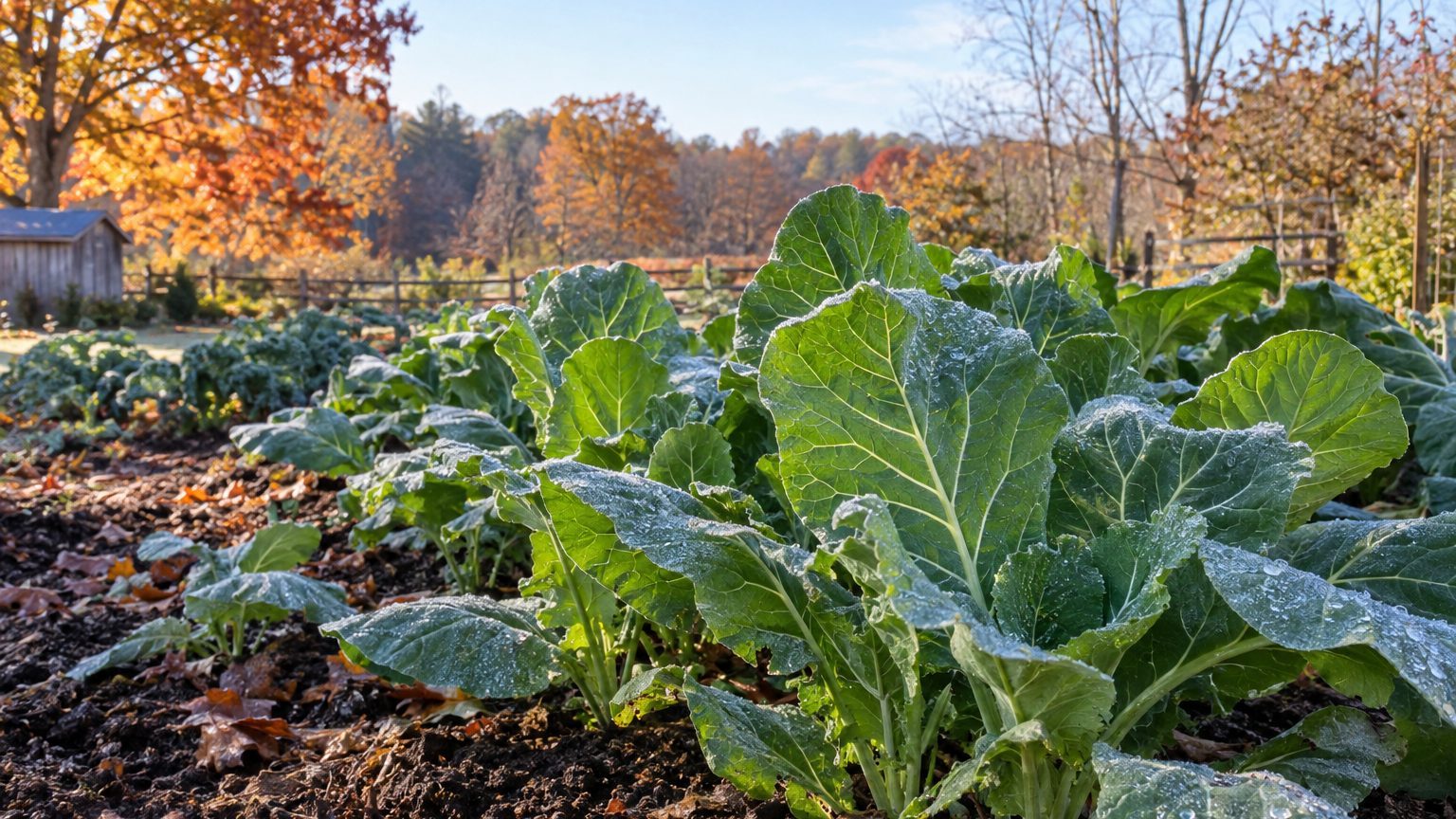

Start collards indoors in mid-March and set transplants out from mid-April to early May. For a fall crop, sow in late June to mid-July. Those dates follow Portland’s frost record, which is the mild end of Maine. Gardens inland and to the north should plan on a later spring start and an earlier fall finish.
The short answer for Maine
Plan around two frost windows. At Portland, the NOAA 1991-2020 normals put the last spring freeze at 32°F between April 22 and May 1, and the first fall freeze between October 9 and October 21. Those are probability bands, not calendar promises: each is the stretch of dates where the chance of a freeze at 32°F or colder sits between 30 and 70 percent. On any given year, the last freeze can land before or after the band.
That distinction matters for collards because they tolerate cold better than most vegetables. The gap between the two bands is roughly 23 to 26 weeks, and a collard plant can use both ends of it. For deeper background on the crop itself, see Growing Collards in Maine.
| Task | Portland timing | Cue |
|---|---|---|
| Start seed indoors | Mid-March | About six weeks before the spring frost band |
| Transplant outdoors | Mid-April to early May | Hardened-off seedlings, soil workable |
| Sow for fall | Late June to mid-July | Plants need size before the October band |
| Fall freeze band | October 9 to October 21 | Light freezes sweeten the leaves |
Spring crop
A seedling started in mid-March has six weeks under lights or on a bright sill, enough for a sturdy transplant with several true leaves. Setting it out in the April 22 to May 1 band means accepting some risk of a freeze, and collards can take a light one, especially after a week of hardening off. A hard night in the low 20s is another story, so keep a row cover or old bedsheet handy for the first two weeks.
Fall crop
Fall is where Maine does well with this crop. Seed sown in late June to mid-July grows through the long days of summer and matures as nights cool. The first freezes in the October 9 to 21 band do not end the harvest. They tend to make the leaves tastier. Check the seed packet for days to maturity, and note whether the count starts at sowing or at transplanting, because the two differ by several weeks.
What will not work here
The slowest collards will let you down. Maine’s frost-free stretch is a little under six months at the very best, and that is at coastal Portland. A variety that wants a long, hot season to size up its big, tender leaves may still be a seedling-sized plant when October’s freeze arrives. Pick types listed with shorter maturity, and see The Best Collards and Greens for Maine for which ones fit.
Sowing seed outdoors in early April is the second mistake. The air may be mild at noon, but soil in a Maine garden is still cold, and collard seed sits and rots or germinates unevenly. Transplants dodge that problem, because they have already put on weeks of growth indoors.
Overwintering fails too. Southern gardeners can leave collards standing all winter and pick from them in January. In Maine, the mean daily minimum of the coldest month is 15.6°F, and that is an average, so many nights run colder. Plants left in the open will generally not come through to spring. Mulch and a low tunnel can stretch the fall harvest into November or early December, but they will not carry a crop to March.
Late summer sowing has its own cutoff. A packet sown in early August leaves too few warm weeks to build a plant of harvestable size before the October band. Count backward from the first freeze and leave the full maturity time, plus a margin of a few weeks for cooling days, which slow growth.
Finally, the Southern recipe of planting thick and picking small leaves from a crowded bed has a Maine cost. Cabbage root maggot flies are active in spring and lay eggs at the base of young brassicas, so crowded early transplants with no cover are a common casualty. Floating row cover laid at transplanting keeps the flies off. Spacing plants a foot or more apart also lets foggy coastal mornings dry from the leaves, which cuts down on leaf disease.
What changes across Maine
Maine is not one garden. The USDA Plant Hardiness Zone Map (2023 edition, built on 1991-2020 normals) runs from zone 3b to 6a across the state, six half-zone steps. That range is wide enough that no single sowing date works from the southern coast to the northern border. The zone system measures only the average annual extreme minimum temperature, so it describes winter survival of perennials. For a crop planted every year, frost dates matter more, but the zone spread is a good proxy for how much colder and shorter the season gets as you move north and inland.
Portland’s dates are the reference, and they sit at the mild end. A gardener in the northern part of the state, or at higher elevation in the western mountains, should push the spring transplant date later, often well into May, and bring the fall sowing date earlier. Inland valleys that collect cold air at night can see freezes well after the coastal band has passed. The same shift runs in reverse in autumn, when the first freeze can arrive before the first of October.
For northern gardens, this tilts the plan toward earlier-maturing collards and toward protection at both ends of the season: row cover in spring, and a low tunnel in autumn. A raised bed or south-facing slope warms sooner and may recover a week or two. Gardeners in coastal towns can lean toward the dates given for Portland, since the ocean moderates both ends of the season.
Which zone you are in is a question for the USDA’s online map, where you can enter a ZIP code. Take that result, and your local frost experience, as the guide for how far to shift the dates above.
Where to check this for your own county
The best next stop is University of Maine Cooperative Extension, the state’s land-grant extension service. It runs county offices across Maine, staffed by people who know local soils, weather patterns and pest pressure. A recommendation from your county office will beat a state-level one every time, and the dates on this page are the state-level kind.
When you look there, search for two things in particular:
- A local planting calendar for cool-season vegetables, ideally one that lists brassicas such as cabbage and kale, since collards follow the same timing
- Variety trials from nearby test gardens, showing which collard and kale types actually matured in your county’s conditions
Extension calendars are usually organized by crop rather than by state, so look for the one that covers brassicas or leafy greens specifically. Most offices also publish fact sheets on cabbage root maggot and other brassica pests, which is useful before you commit seedlings to the ground.
Many extension offices offer a free or low-cost soil test, which shows pH and nutrient levels. Collards perform best in slightly acidic to neutral soil, and Maine’s naturally acidic ground often needs lime. If you have an office nearby, a phone call is often faster than searching the website for the details that fit your town.
Checking this against your own garden
Your own observations outrank every date above. Three things to watch will tell you more than a calendar can:
- Soil warmth by feel. Push your hand a few inches into the bed in the morning. If it feels cold enough to numb your fingers quickly, the soil is not ready for direct seed, and transplants will sit still. A bed that feels merely cool, and that crumbles rather than clumps, is ready. Beds that reach this point earlier tell you that you have a warm microclimate, perhaps from a south wall or sandy soil.
- The first flush of male flowers. Watch the early-blooming trees and shrubs near you, such as maples, and the catkins on alders and birches. When the catkins loosen and shed pollen, spring is moving. If they open in your yard a week ahead of a neighbor’s, plan for earlier planting.
- The first true leaves. On seedlings, the first pair of leaves are rounded seed leaves. The next pair, which look like a real collard leaf, are the true leaves. A seedling with two or three true leaves is ready to harden off. If your indoor seedlings reach that stage slowly, your window is too dim or too cool, and the dates should shift.
Keep a few notes from year to year: the date of the last freeze, the date you transplanted, and the date of first harvest. Within two or three seasons, you will have a calendar tuned to your own yard.
Some gardeners also time this by the Moon: when to plant collard greens by the moon, as almanac tradition rather than fact.
Common questions
Can I plant collards in Maine in March?
Indoors, yes. Seed started in mid-March gives you transplants for the April 22 to May 1 window. Outdoors, soil is typically too cold and wet in March for seed to germinate well.
How late can I sow collards for a fall harvest?
Sowing from late June to mid-July suits Portland, working back from the October 9 to October 21 freeze band. Inland and northern gardens should sow earlier, since fall freezes arrive sooner there.
Will collards survive a Maine winter?
Generally not in the open. The coldest month averages a daily minimum of 15.6°F in Portland, with colder nights in between. A low tunnel and heavy mulch can extend picking into late fall, but plants should not be counted on to return in spring.
Do frost dates mean I must wait until after the last freeze to plant?
No. The April 22 to May 1 band is a 30 to 70 percent probability of a 32°F freeze, not a hard deadline. Collards tolerate light frost, so hardened-off transplants can go out in that band with row cover ready for a colder night.