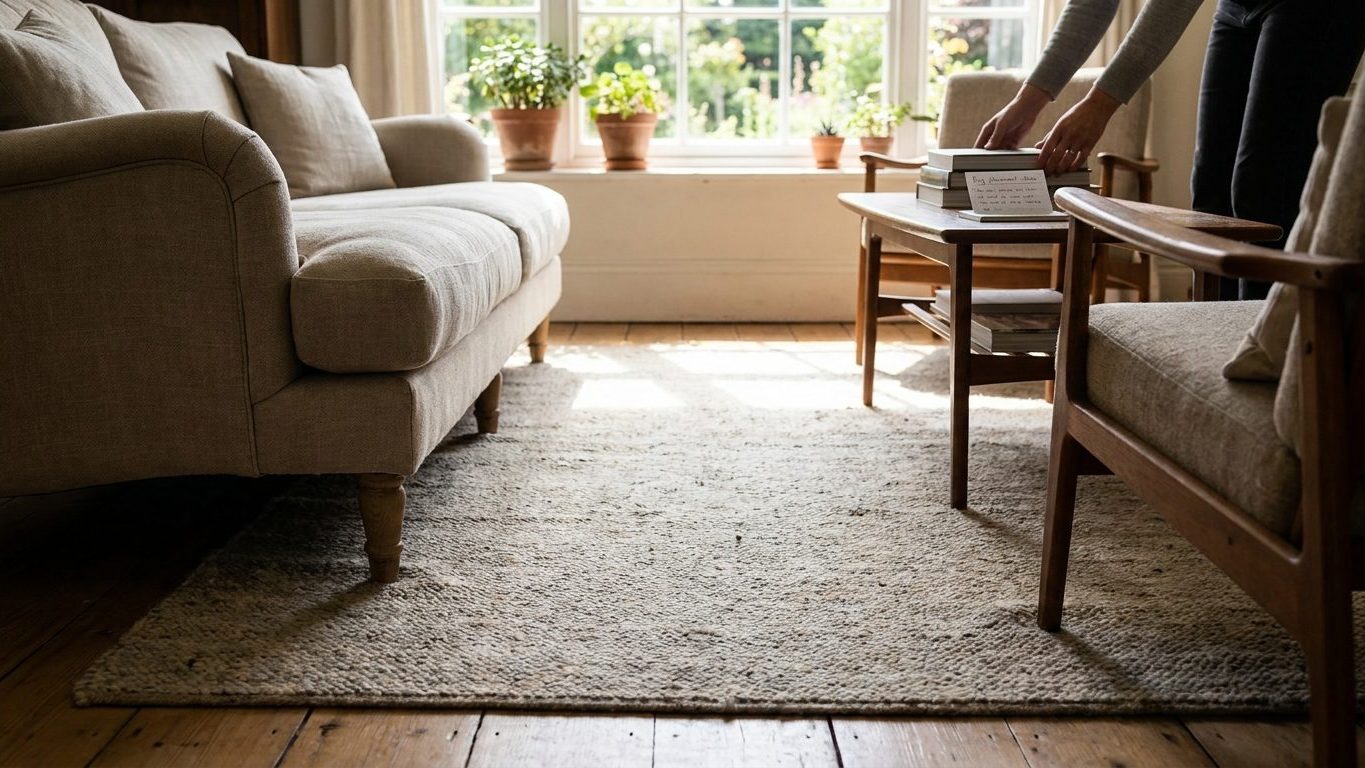

Front legs on, back legs off: that split decides whether a rug reads as anchoring a seating group or floating underneath it. A rug centered on the room’s four walls ignores the furniture entirely, which is why it looks stranded even at the right size. Push the sofa and chairs to the rug’s edge, not the room’s edge, and start from there.
Where a rug sits is one of the few decisions in furnishing a room that changes how large the room feels, before a single piece of furniture moves.
What is actually going on

A rug’s real job is zoning. It draws a boundary on the floor, and the eye reads everything inside that boundary as one group and everything outside it as separate. A living room with a sofa, two chairs, and a coffee table only reads as a single conversation area if the rug ties those pieces together. Center that same rug on the room instead of on the furniture, and you get a floor covering with no relationship to anything sitting on it. The room still looks unfinished, even though there’s a rug in it.
The furniture decides, not the walls
This is the part that trips people up: they measure the room, buy a rug that fits the floor space, and lay it down centered between the walls. But a room’s walls rarely line up with where the furniture actually sits, especially once you account for doorways, windows, or a fireplace pulling the layout off-center. The rug has to follow the furniture group’s own center, not the architectural center of the room. If the sofa and chairs sit closer to one wall than another, the rug shifts with them.
How much rug has to touch the furniture
There’s a convention here, not a rule: the usual practice is to get at least the front legs of every major piece onto the rug, so the whole group is tied together at the point where people’s feet actually land. In a larger room, it’s common to go further and get all four legs of each piece resting on the rug, which reads as more grounded but needs a bigger rug to pull off. In a small room, some decorators drop the front-legs guideline entirely and let a smaller rug sit under just the coffee table, using it as an accent rather than a zoning device. None of these is more correct than the other. What matters is picking one and applying it consistently across every piece in the group, because a rug that catches the front legs of the sofa but misses the chairs entirely looks like an accident rather than a choice.
The same optical logic that governs where you hang a mirror to move light around a room applies here: both a rug’s edge and a mirror’s frame draw a boundary the eye reads as a stopping point, covered in more detail in Using a Mirror to Move Light Around a Room. Get the boundary in the wrong place and the eye keeps looking for the thing it’s supposed to be resolving.
Doing it
Once you know the furniture sets the boundary, the actual placement follows a short list of checks for each common layout. Skipping any one of them is what produces the floating, off-center look described above.
- Identify the group first, not the room. Decide which pieces of furniture belong to the same conversation or activity: the sofa and its facing chairs, or the dining table and its chairs, not the whole room’s contents. Skip this and you’ll size the rug to the floor plan instead of to the group it needs to hold together.
- Pick front-legs-on or all-legs-on before you measure. This decision changes the minimum rug size by a significant margin, so it has to come before you shop, not after. Skip it and you’ll end up with a rug that’s the wrong size for the approach you actually wanted.
- Center the rug on the furniture group, not on the room’s walls or windows. Measure from the group’s own edges. Skip this and the rug ends up centered on an architectural feature that has nothing to do with where people sit.
- Leave a walking margin between the rug’s edge and the wall. A rug that runs edge-to-edge across a room reads as wall-to-wall carpet rather than a defined piece, and it also picks up more foot traffic at the perimeter, wearing unevenly. Skip this and the rug ages faster at the edges than in the middle.
- Check the doorway swing. This is the step people forget: a rug that extends into a door’s swing path gets caught under the door itself, or bunches up every time the door opens. Walk the door through its full arc before you commit to the rug’s final position, not after it’s already down.
- Check that a rug in a hallway or entry doesn’t force a step-up. A thick pile rug butted directly against a hard floor creates a lip that catches shoes. Skip this and you’ve built a trip point into a high-traffic path.
For a dining room, the same front-legs logic becomes an all-legs rule in practice: the rug needs to be large enough that every chair, even pulled out for someone to sit down, stays on the rug rather than catching its back legs on the bare floor edge. Skipping that check is what produces the scraping, catching feeling of a dining chair half on and half off the rug every time someone stands up.
What it looks like when it goes wrong
Some rug placement failures are cosmetic and fixable in an afternoon. Others are safety problems that need attention regardless of how the room looks.
- The rug floats in the middle of the room, touching no furniture. Cosmetic, and correctable just by sliding the furniture toward it or sizing up to the next rug size. This is the most common version of the problem described above.
- The rug catches only some of the group’s front legs. Cosmetic, correctable by nudging the pieces that missed, or by swapping the rug for a slightly larger one if the group can’t be pulled any tighter.
- The rug’s edge curls or ripples underfoot. This is a safety issue, not a decorating one: a curled edge is a trip hazard, and it usually means the rug needs a pad underneath or has been down long enough that the backing has started to fail.
- The rug slides on a hard floor when walked on. Also a safety issue. A rug without adequate grip on tile, wood, or laminate moves underfoot, especially near a doorway or at the base of stairs, and that’s not something to leave for later.
- A dining chair snags the rug’s edge when pulled out. Cosmetic in origin but produces real wear over time, since the snagging distorts the rug’s edge and eventually frays it. Correctable early with a larger rug, but not once the fraying has set in.
- The rug’s pattern or size makes the room look smaller. This is the one true taste call on this list rather than a hazard, and opinions differ on how much a busy pattern or an undersized rug actually shrinks a room visually.
A rug that’s simply too small for its furniture group looks a lot like a floating shelf mounted with no visible support: something is there, but nothing is resting on it, an effect explained on the wall side of the room in Floating Shelves: Where the Load Actually Goes.
What to settle first
Before any rug goes down, the floor itself needs a look, not just the furniture arrangement on top of it. Hard flooring and carpet behave differently underneath a rug, and the difference changes whether a pad is doing any work or is just extra material. On a hard floor, a pad is doing real work: gripping the floor on one side and the rug on the other so neither slides. On top of existing carpet, a pad still helps the rug from creeping but isn’t preventing the same kind of slip, since carpet already has friction the rug can grab onto.
Measure the group before the room
Every mistake described above traces back to measuring the wrong thing first. Measure the furniture group’s footprint, including how far chairs pull out from a table, before measuring the room’s open floor space. The room’s dimensions only matter for confirming the rug will actually fit once it’s centered on the group, not for deciding the rug’s size in the first place.
Check what’s underneath, not just what’s on top
A rug is one small piece of the larger set of decisions a room asks about attaching, hanging, and grounding everything else to its walls and floor, a subject covered more broadly in “/decor/”>Hanging, Shelving and Fixing: The Wall Decides. Where a rug interacts with a floor vent, a radiator, or a section of flooring that’s uneven or damaged, that has to get settled before the rug goes down, not after, since a rug hides a floor problem rather than fixing it. If there’s any doubt about what’s under the floor covering itself, whether that’s a heating element, an old adhesive, or a subfloor issue, check with a flooring professional or the material manufacturer’s guidance before laying anything permanent on top.
Common questions
What size rug do I need for a living room?
It depends on the furniture group’s footprint, not the room’s square footage. Measure the sofa and chairs as one unit, including some margin for front legs to land on the rug, and size from that rather than from the room’s walls.
Can a rug be too big for a room?
Yes, if it runs edge-to-edge with no walking margin against the walls. That reads as wall-to-wall carpeting rather than a defined rug, and it also means the entire perimeter takes foot traffic instead of just the center.
Do all four legs of a chair need to be on the rug?
Not necessarily. Front-legs-on is the more common approach in smaller or mid-sized rooms, while all-legs-on is more common in larger rooms where a bigger rug is practical. Both are conventions, not rules, and either works as long as it’s applied to every piece in the group consistently.
Why does my rug keep sliding on the floor?
Almost always a missing or worn-out rug pad. A hard floor gives the rug nothing to grip on its own, so the pad is what’s actually holding it in place. If it’s already slid despite a pad, check that the pad itself isn’t undersized relative to the rug.