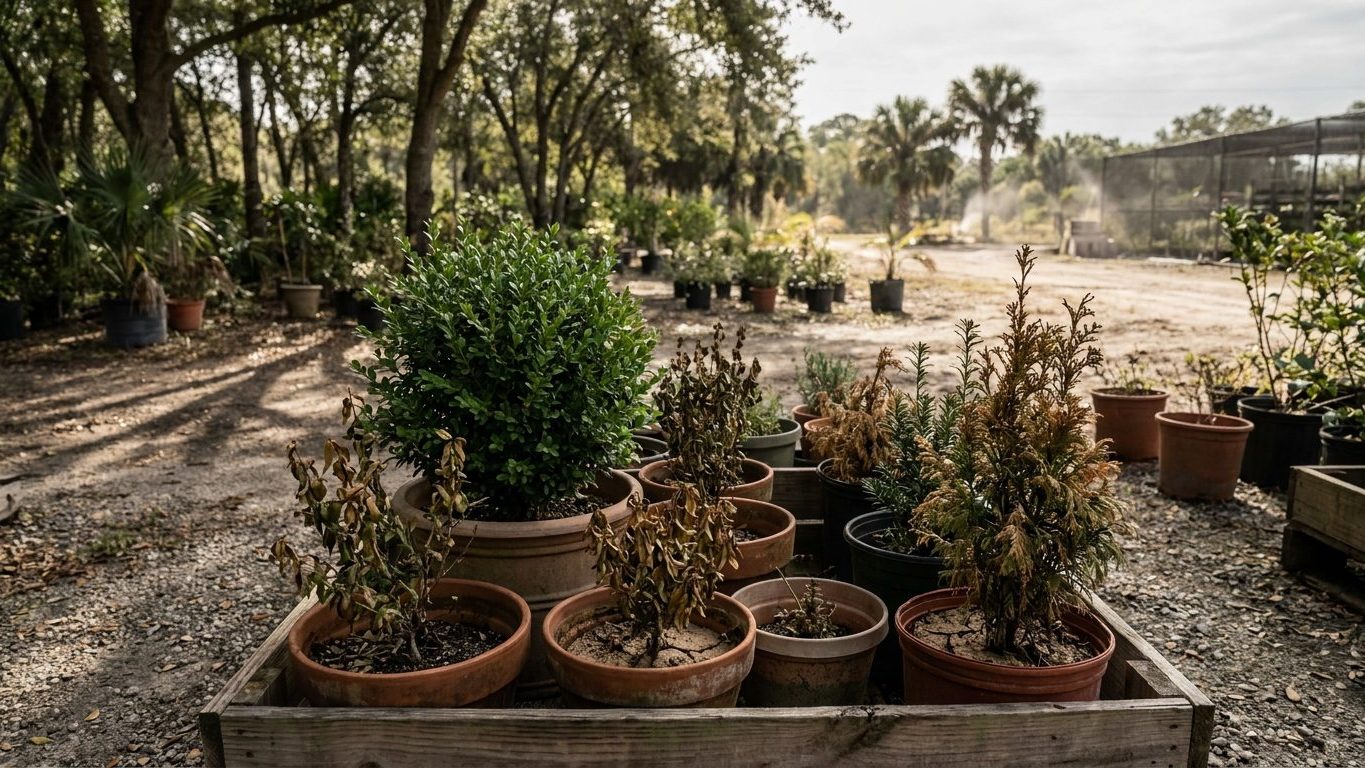

Texas runs from USDA zone 6a to 10a, and that spread decides which hedge plants work. Of 12 common hedge species, only Leyland cypress holds in every zone. Eleven survive in part of the state, and four of them (privet, yew, arborvitae and eastern hemlock) stop at zone 7b. Three can never be cut back to size once they outgrow the space. Check your zone and the pruning rule before you buy.
What actually holds in Texas
The USDA Plant Hardiness Zone Map (2023 edition, built on 1991-2020 normals) rates a place on a single number: the average annual extreme minimum temperature. It says nothing about summer heat. Hardiness ranges for the species below come from the NC State Extension Gardener Plant Toolbox. A plant listed through zone 9b has passed the cold test, but the top of a range is often a heat limit. “Holds” here means survives. A shrub at the edge of its range can live for years and still look thin and tired by August.
Which hedge plants stop short of most of Texas?
Nothing on the list fails everywhere, but most plants drop out zone by zone. Sorted by the warmest zone each one tolerates:
- Zones 6a to 7b only: privet (Ligustrum vulgare), yew (Taxus x media), arborvitae (Thuja occidentalis) and eastern hemlock (Tsuga canadensis).
- Zones 6a to 8b: boxwood, cherry laurel and arrowwood viburnum.
- Zones 6a to 9b: American hornbeam, inkberry holly, winterberry holly and eastern red cedar.
The first group belongs to the coldest corners of the state. Plant a yew or a hemlock in a zone 9 yard and you are betting against the climate. Both look fine for a season or two, and then the decline starts.
Which hedge holds across all of Texas?
Leyland cypress (x Hesperotropsis leylandii) is the only one of the 12 hardy from 6a through 10a. It grows 3 to 4 feet a year and reaches 15 to 25 feet as a screen. That reach is also its trap, covered in the next section. Survival across the whole range does not mean it will be happy in every zone, so the heat caveat applies to it as well.
Your closest reference is your own zone, not the state range. Look up your ZIP code on the USDA map, then ask your county office of Texas A&M AgriLife Extension which of these plants it sees thriving locally. For the wider picture across states, see our guide to hedges.
The hedges you can never cut back down
Three of the 12 species will not regrow from bare, leafless wood: Leyland cypress, eastern red cedar and arborvitae. Cut into the brown interior of any of them and the branch stays bare for good. The other nine sprout again from old wood, which means a neglected boxwood or privet can be rescued with a hard cut. These three cannot.
Leyland cypress is the one that catches people. At 3 to 4 feet a year, a row planted along a property line can pass a 10-foot fence in a few seasons. Once it is 20 feet tall and a neighbor complains, topping it leaves a flat, brown-edged stump of a hedge. The plant wants to be a tall screen of 15 to 25 feet. If you have room for that, trim in late spring to midsummer and keep each cut inside the green foliage. If you do not, choose something else on day one.
Eastern red cedar grows 12 to 24 inches a year and reaches 8 to 20 feet as a screen. Its pruning rule is late winter, light cuts only. Arborvitae is slower, 6 to 9 inches a year, and stays in a 4 to 15 foot range. Prune it in late winter before growth starts, or in midsummer. Because it grows slowly, mistakes show for years.
Among the plants that do regrow, speed varies. Privet grows 2 to 3 feet a year and needs trimming twice a season, in spring and midsummer. Cherry laurel adds 1 to 2 feet a year and is pruned in late spring, after flowering. Arrowwood viburnum grows 12 to 24 inches a year and gets cut right after it flowers. Even plants that forgive hard pruning do better with small, regular trims than with one big renovation. Hemlock and red cedar are marked for light cuts only, so regrowth there is a rescue option rather than a plan.
Matching the plant to the job
Start with what the hedge has to do, then check the zone. A privacy screen, a low formal border and a loose flowering boundary call for different plants, and the zone column below cuts the list down quickly.
| Plant | Zones | Height as hedge | Prune |
|---|---|---|---|
| Leyland cypress | 6a-10a | 15 to 25 ft | Late spring to midsummer |
| Eastern red cedar | 6a-9b | 8 to 20 ft | Late winter, light cuts |
| Eastern hemlock | 6a-7b | 10 to 20 ft | Late spring, light cuts |
| Arborvitae | 6a-7b | 4 to 15 ft | Late winter or midsummer |
| Cherry laurel | 6a-8b | 6 to 15 ft | Late spring, after flowering |
| Inkberry holly (evergreen) | 6a-9b | 5 to 15 ft | Late winter, dormant |
| Winterberry holly (loses leaves) | 6a-9b | 5 to 15 ft | Late winter, dormant |
| American hornbeam | 6a-9b | 6 to 15 ft | Midsummer, after first flush |
| Arrowwood viburnum | 6a-8b | 6 to 10 ft | Right after flowering |
| Privet | 6a-7b | 4 to 12 ft | Spring and midsummer |
| Yew | 6a-7b | 3 to 8 ft | Late spring, after growth hardens |
| Boxwood | 6a-8b | 2 to 6 ft | Late spring, after last frost |
For a low formal edge, boxwood and yew are the usual picks. Boxwood adds just 3 to 6 inches a year, so a 2-foot border takes patience and then needs little shearing. For a tall evergreen wall in the warmer zones, cherry laurel, red cedar and Leyland are the options that reach the zone 9 range, with the regrowth limits above. Inkberry gives evergreen cover from 5 feet up. Winterberry drops its leaves, so it will not screen a window in January.
Timing depends on where you live. Houston’s 1991-2020 normals (NOAA NCEI, station IAH) put the last spring freeze between February 4 and March 1 and the first fall freeze between December 1 and December 19. That is the mild Gulf end of Texas. The Panhandle sits months apart on both dates, and North Texas and the Hill Country differ again. So “late winter” for the hollies means the weeks before your own last frost, and “after the last frost” for boxwood means your date, not Houston’s. Your county extension office can give it to you.
The ground you are planting into
Texas has hundreds of soil series, and the one the USDA lists as the state soil is the Houston Black series, a Vertisol. It is a shrink-swell clay that cracks open when dry and turns to glue when wet. Representative surface values record a pH of about 7.9, which is alkaline, with 20 percent sand, 54 percent clay and 26 percent silt. Organic matter is about 3.0 percent, and drainage is moderately well drained. These are USDA’s mapped values for the surface layer of the series, not a reading from your bed.
Your yard may look nothing like this. River bottoms, Hill Country limestone and any lot a builder has scraped or filled behave differently. But the series shows what a lot of Texas ground tends to do: hold water, swell, crack and run alkaline. Hedges planted in it react in predictable ways. Roots sit in soggy clay after heavy rain and then face open cracks in a dry August.
Alkaline clay is hardest on the hollies. Inkberry and winterberry are known to prefer acidic ground, and yellowing leaves in high-pH soil are a common sign they are struggling. Check pH before you buy a holly hedge that you plan to run the length of a yard. Plants that ask for sharp drainage suffer in the wet phase of a clay that turns to glue.
Plant with the clay in mind. Dig the hole wide, not deep, and set the top of the root ball slightly above the surrounding grade so water drains away from the trunk. Fill with the soil you dug out. A pit of improved soil in heavy clay acts like a bathtub. Mulch the whole row to slow cracking, and water slowly and deeply during dry spells rather than in short, frequent doses.
A soil test gives you your own pH, which no state average can. Your county AgriLife Extension office can explain how to collect a sample and what to do with the result.
Common questions
What is the fastest hedge for privacy in Texas?
Leyland cypress, at 3 to 4 feet a year, is the quickest of the 12 and the only one that holds across the whole state. It also cannot regrow from old wood, so plant it only where a 15 to 25 foot screen fits. Privet grows 2 to 3 feet a year and tolerates hard pruning, but it is limited to zones 6a through 7b.
Can you cut a Leyland cypress back down to size?
No. Leyland cypress will not sprout from bare, leafless wood, so a cut into the brown interior leaves a permanent gap. Keep every trim inside the green foliage and start in late spring, while the plant is still small.
When should I prune a hedge in Texas?
It depends on the species. Hollies go in late winter while dormant, arrowwood viburnum right after flowering, cherry laurel and boxwood in late spring, and Leyland from late spring to midsummer. Houston’s average last freeze falls between February 4 and March 1, but other parts of Texas run months different. Time it by your own last frost.
Do hedge lists from nearby states apply to Texas?
Only for the zones they share. Our guides to hedge plants for Oklahoma, hedge plants for Louisiana and hedge plants for New Mexico list what holds in those states. A plant that works at the northern edge of Texas may match Oklahoma’s zones, while the Gulf coast has more in common with Louisiana. Check your own zone first.