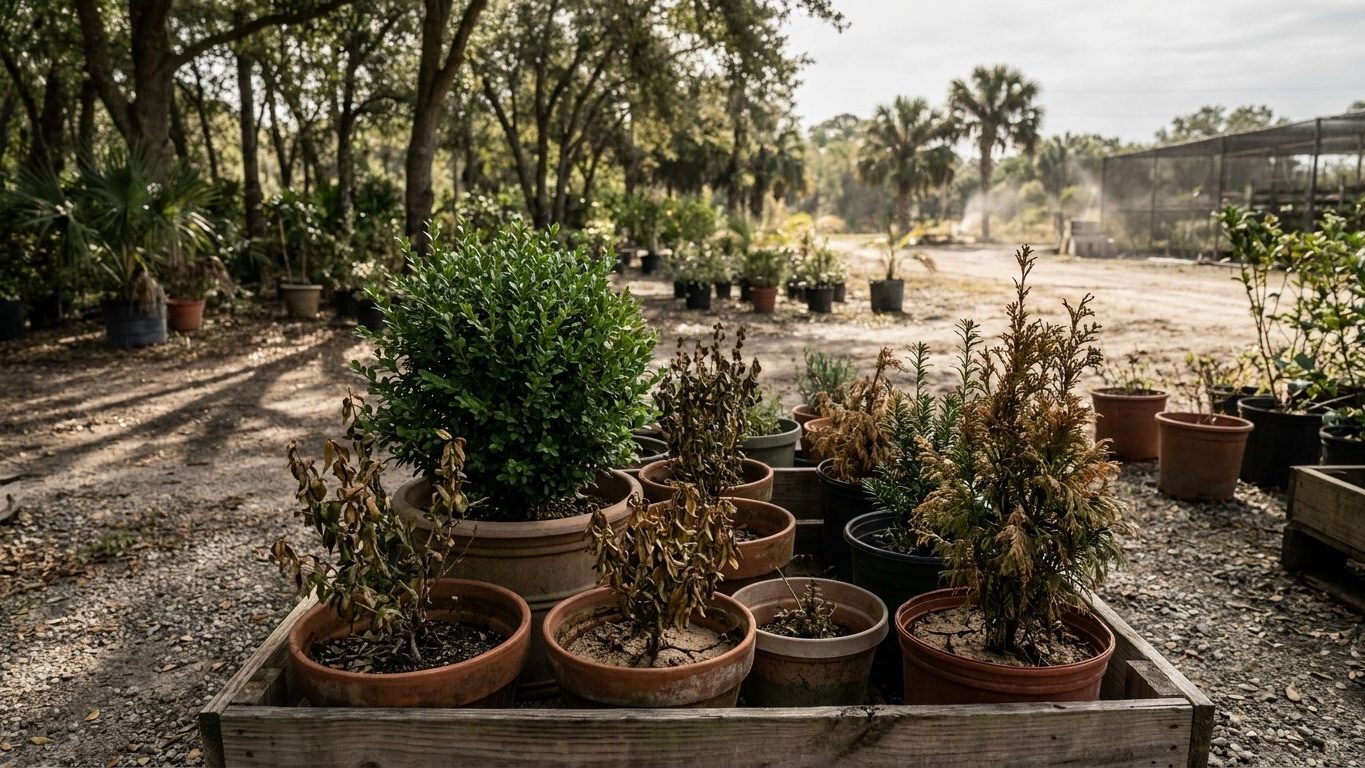

Of twelve widely planted hedge species, six survive winter anywhere in Virginia, across USDA zones 5a to 8b: boxwood, American hornbeam, inkberry holly, winterberry holly, eastern red cedar and arrowwood viburnum. The other six hold in only part of that range. Three of the twelve can never be cut back to size once they outgrow their spot, so choose them with the mature size in mind.
What actually holds in Virginia
A USDA hardiness zone rests on a single number: the average annual extreme minimum temperature. The 2023 USDA Plant Hardiness Zone Map, built on 1991 to 2020 normals, puts the state anywhere from 5a to 8b. The colder end covers the high ground of the Blue Ridge and the southwest. The mild end is the coast. A hedge that sails through one end can die at the other, and a label reading “hardy in Virginia” tells you very little.
“Holds” here means survives. It does not mean thrives. The upper end of a plant’s range is often a heat limit, so a shrub rated to 7b can live in 8a and still look tired by August. With that in mind, here is the half of the list that fails somewhere in the state.
Which hedge plants fail in the colder zones?
Two of them. Leyland cypress and cherry laurel are rated for zones 6a through 8b only. Where winter minimums drop into 5a or 5b, as they can on high mountain ground, both are at risk. Leyland is the bigger gamble: it grows 3 to 4 feet a year and reaches 15 to 25 feet as a screen, so a failure shows up after you have already invested years in it. Cherry laurel is slower at 1 to 2 feet a year, with a hedge height of 6 to 15 feet.
Which hedge plants fail in the warmest zones?
Four of them. Privet (Ligustrum vulgare), yew (Taxus x media), arborvitae (Thuja occidentalis) and eastern hemlock are rated for zones 5a through 7b. Zones 8a and 8b, the warmest ground in the state, sit beyond their range. That upper edge is a heat limit, so on the mild coast these four will struggle or fail even though winters are easy.
| Plant | Zones where it holds | Regrows from old wood? |
|---|---|---|
| Leyland cypress | 6a to 8b | No |
| Cherry laurel | 6a to 8b | Yes |
| Privet | 5a to 7b | Yes |
| Yew | 5a to 7b | Yes |
| Arborvitae | 5a to 7b | No |
| Eastern hemlock | 5a to 7b | Yes |
Neighboring states shift the picture somewhat. A hedge list for Hedge Plants for Maryland: What Holds, and What Only Looks Hardy or one for Hedge Plants for Tennessee: What Holds, and What Only Looks Hardy will not sort the same way, because their zone spreads differ. To compare a much colder climate, see Hedge Plants for Massachusetts: What Holds, and What Only Looks Hardy.
The hedges you can never cut back down
Three of the twelve species will not sprout from bare, old wood. Leyland cypress, arborvitae and eastern red cedar all share this trait. Once you cut into the brown interior, nothing grows back from the cut. You can trim the green outer growth, but you cannot reduce the plant to a smaller size later.
That changes how you plant them. Leyland puts on 3 to 4 feet a year and reaches 15 to 25 feet as a screen. Pruning is done from late spring to midsummer, and only on green growth. A Leyland planted along a 10-foot side yard gets away from you in a few seasons, and the only fix is removal. Arborvitae is much slower at 6 to 9 inches a year, with a hedge height of 4 to 15 feet. It takes pruning in late winter before growth starts, or in midsummer. It also holds only in zones 5a through 7b, so it fits the cooler half of the state and not the coast.
Eastern red cedar holds across all of Virginia. It grows 12 to 24 inches a year and reaches 8 to 20 feet as a screen. It takes light cuts only, in late winter. For a tall, wide screen with plenty of room it is the most dependable of the three, because it has no cold or heat limit inside the state.
The other nine species forgive mistakes. Boxwood, American hornbeam, both hollies, arrowwood viburnum, cherry laurel, privet, yew and hemlock all regrow from old wood. A yew or boxwood that has gone woody and bare can be cut hard and will fill back in, though yew grows only 6 to 12 inches a year and boxwood 3 to 6, so recovery takes several seasons. Privet recovers faster at 2 to 3 feet a year, and it wants pruning twice a season, in spring and again in midsummer.
A practical rule follows. If the plant cannot regrow from old wood, buy for the final height and width, not for the size you want in year three. If the plant regrows, you can correct your mistakes. When the space is tight and you want to keep the option of renovating later, pick from the second group.
Matching the plant to the job
The right hedge depends on what you need it to do. A low, tidy edge, a quick privacy screen and a loose flowering boundary each call for different plants, and the growth rates are far apart.
| Job | Plant | Hedge height | Growth a year |
|---|---|---|---|
| Low formal edge | Boxwood | 2 to 6 feet | 3 to 6 inches |
| Low formal edge | Yew (zones 5a to 7b) | 3 to 8 feet | 6 to 12 inches |
| Evergreen mid-height hedge | Inkberry holly | 5 to 15 feet | 6 to 12 inches |
| Fast tall screen | Eastern red cedar | 8 to 20 feet | 12 to 24 inches |
| Flowering informal hedge | Arrowwood viburnum | 6 to 10 feet | 12 to 24 inches |
| Leafy hedge that drops in winter | American hornbeam | 6 to 15 feet | 12 inches |
For a formal edge that stays put, boxwood is the one that holds in every zone. It is slow, and at 3 to 6 inches a year you will wait for it, but it needs trimming in late spring after the last frost. At the Virginia Beach reference station that last frost falls between March 20 and April 3. The Blue Ridge and southwest Virginia run weeks later, so the trimming date moves with your elevation.
For a hedge that fills in over a few seasons, arrowwood viburnum and American hornbeam both put on a foot or more a year. Viburnum is pruned right after it flowers, so you do not cut off next year’s blooms. Hornbeam is pruned in midsummer, after its first flush of growth.
The two hollies look alike but behave differently. Inkberry is evergreen and gives a screen all winter. Winterberry loses its leaves, so it gives you structure but no winter privacy. Both grow 6 to 12 inches a year, reach 5 to 15 feet and take pruning in late winter while dormant.
Where you want speed and the site is cold enough, eastern hemlock grows 12 to 24 inches a year and reaches 10 to 20 feet, but it holds only in zones 5a through 7b and takes light cuts only. More options for different regions sit in the main Hedges section.
The ground you are planting into
The soil USDA lists as representative of Virginia is the Pamunkey series, an Alfisol. That is a forest soil of moderate fertility that holds nutrients reasonably well. USDA’s records for its surface layer show a pH of about 6.2, which is slightly acid, and a texture of loam to silt: 50 percent sand, 11 percent clay and 39 percent silt. Organic matter is about 1.2 percent, and the soil is well drained.
Read that as what the ground tends to do. Well-drained loam suits most hedge plants because roots are rarely sitting in water. Low organic matter means a new planting dries out faster than the loam texture suggests, so a hedge planted this fall still needs deep watering while it establishes.
That soil represents the state. It is not necessarily what is in your yard. Virginia has hundreds of soil series, and river bottoms, mountain slopes and ground that a builder has scraped or filled will behave very differently. A new subdivision lot can be compacted subsoil with no resemblance to a forest loam. The surface pH figure is not your pH either.
A soil test gives you your own numbers. Virginia Cooperative Extension and your county office can tell you how to collect a sample and read the result. Do this before you buy the plants, not after.
Planting time matters as much as soil. At the Virginia Beach reference station the first fall frost arrives between November 10 and November 24, which leaves a good window for fall planting there. In the Blue Ridge and southwest Virginia frost comes earlier, so the window closes sooner. Fall planting gives roots time to establish before summer heat.
Common questions
What is the fastest-growing hedge plant for Virginia?
Leyland cypress grows 3 to 4 feet a year, the quickest of the twelve, but it holds only in zones 6a through 8b and can never be cut back to size. Eastern red cedar, eastern hemlock and arrowwood viburnum grow 12 to 24 inches a year. Of those, red cedar and viburnum hold in every zone in the state.
Can I cut an overgrown arborvitae or Leyland hedge back hard?
No. Neither plant regrows from old wood. Cutting into the brown interior leaves a bare patch that stays bare. Trim only the green outer growth, and do it so the hedge never gets far past its intended size.
Is boxwood hardy everywhere in Virginia?
Boxwood survives across the whole state, zones 5a to 8b. It grows 3 to 6 inches a year and reaches 2 to 6 feet as a hedge. Prune it in late spring after the last frost. It regrows from old wood, so an overgrown boxwood can be cut back hard.
When should I prune my hedge?
It depends on the plant. Hollies and eastern red cedar are pruned in late winter. Boxwood, cherry laurel, yew and hemlock are pruned in late spring. Arrowwood viburnum is pruned right after it flowers. Hornbeam is pruned in midsummer. Spring frost dates run weeks later in the mountains than on the coast, so let your own last frost set the timing.