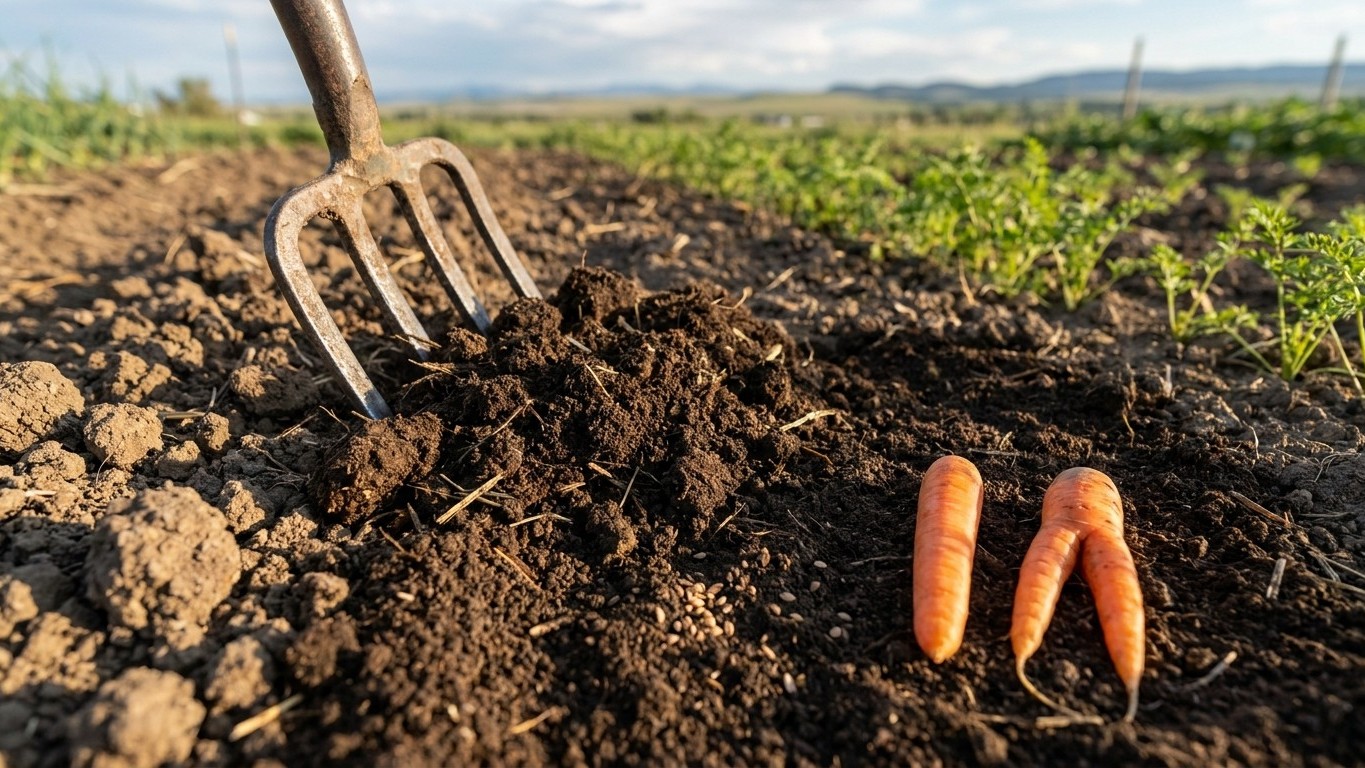

Carrots in Wisconsin lose tissue at three stages. Seedlings get cut or chewed soon after they sprout, tops get nibbled through the leafy stretch of summer, and roots get tunneled or scarred as they swell toward harvest. The stage tells you more than any insect name does. Carrots are sown in place, so the whole 70 to 100 days from seeding is spent in one bed, and each stage draws different visitors.
Which pests attack carrot in Wisconsin
Extension educators sort carrot trouble by the part of the plant under attack, and that is the most useful way to read a bed too. Wisconsin carrot damage falls into four groups: pests that sever seedlings at the soil line, chewers that work on the leaves, sap feeders that cause curling and stunting, and larvae that tunnel into the root itself. A fifth group is the larger animals. They clip tops cleanly instead of leaving the ragged edges an insect does.
Insects of orchards, forests and shade trees, and pests that feed only on grains or cabbage-family leaves, are not carrot problems. What remains are the groups that feed on carrot or its close relatives in the parsley family. Because carrots are sown directly, with no transplant to protect, a bed has no head start on any of them.
The practical rule: find the damaged part of the plant first, then the stage of growth it happened in. Those two facts narrow the cause far better than guessing at an insect from a photograph. Your county Extension office can then name the exact species active in your part of the state. Wisconsin’s range of soils and local climates means the culprit in one county is not always the culprit in the next.
When each one shows up, and what it does first
Count from the last spring frost, not from a month name. A cold spring pushes everything later and a warm one pulls it forward. The sowing window that follows the last frost is laid out in When to Sow Carrots in Wisconsin: Counting Back From the Last Frost. The pest calendar rides on that same clock.
Seedling stage: the first weeks after seeding
The first sign is a gap in the row. Seedlings that were up on one visit are simply gone on the next. Look closely and you may find stems severed at the soil line, or tiny plants that wilt and fall over with the stem still attached. Cool, wet soil keeps seedlings small and vulnerable for longer, so a cold spring stretches this stage out. Check the row every few days from the moment seedlings break the soil, because losses at this stage are fast and cannot be undone by thinning.
Leafy stage: the middle of the season
Once the tops fill out, the first sign is on the leaves. Edges turn ragged, whole leaflets disappear, or the foliage curls, yellows and feels sticky. Chewing damage points to something with mouthparts, often feeding at dusk or overnight. Curling and stickiness point to sap feeders, which usually sit on the undersides of leaves. Clipped stems with a clean slanted cut are a larger animal, not an insect.
Root-swell stage: the final weeks before harvest
This is the hardest stage to read because the damage is hidden. The usual first sign is a top that looks tired in the middle of the day even though the soil is moist, or a few outer leaves yellowing early. Often nothing shows until you pull the carrot and find tunnels or a scarred, rough shoulder. Larvae that work underground have been feeding for weeks by then.
Telling the damage apart from everything else
A lot of carrot trouble has nothing to do with insects. Dry spells, heavy ground, uneven watering and disease can each produce damage that looks like a pest at first glance. The table lists common symptoms, the usual suspects and the check that separates them.
| What you see | Possible causes | What settles it |
|---|---|---|
| Gaps in the row, seedlings gone | Severed stems, damping off, a crusted soil surface | A clean cut at the soil line versus a shriveled, watery stem; crust you can lift off with a fingertip |
| Ragged leaf edges | Chewing insects, wind or hail tearing | Insects or droppings on the plant; tearing that hits every plant in the bed the same way points to weather |
| Yellow or purple-tinted tops | Sap feeders, cold soil, nutrient shortage | Insects under the leaves; a bed-wide pattern points away from insects, and a soil test sorts out nutrients |
| Midday wilting | Dry soil, root damage | Push a finger past the first knuckle; if the soil is moist, pull one root and inspect it |
| Forked, stubby or twisted roots | Heavy or rocky soil, not insects | Smooth roots with branching but no tunnels or chew marks |
| Roots split lengthwise | Uneven watering after a dry stretch | Clean-edged cracks with no tunnels inside |
| Tunnels or rough scars on the root | Root-feeding larvae, hoe nicks, rot | Larvae or frass inside the channel; straight clean cuts are mechanical, soft slimy patches are rot |
The forked-root row fools gardeners every season. Utah State University Extension describes carrots as wanting deep, sandy, well-drained soil rich in organic matter, and notes that heavy or rocky soil makes the root fork. Wisconsin’s official state soil, the Antigo series, is a useful point of comparison. USDA NRCS Soil Data Access gives representative surface values of about 70 percent silt, 20 percent sand and 10 percent clay, with roughly 3.0 percent organic matter, a pH near 5.5 and good drainage. That is a loam to silt, firmer than the sandy ground carrots prefer. The Antigo series stands for the state, not for your garden, since Wisconsin spans hundreds of soil series. A soil test through your county Extension office settles what your own bed holds, and Will Carrots Fork in Wisconsin Soil? covers the fix.
Dig up one affected root and cut it open before you decide anything. Tunnels, larvae or droppings mean an insect. A smooth root that is merely forked or split does not. Soft, slimy tissue means disease, which needs a different answer. If you cannot tell which it is, take the root and a clear photo to the Extension office.
What actually works here, and what is a waste of time
On a short northern season, a physical barrier at the right moment beats any treatment. A lightweight row cover laid over the bed at seeding, with the edges buried or weighted down, keeps flying insects from reaching the seedlings and leaves. Carrots are grown for the root, so nothing needs pollinating and the cover can stay on until harvest. Lift it for weeding and put it straight back. A barrier put on after damage appears protects nothing, since the eggs are already in the soil or on the plants.
Calendar choices help as much as the cover does. Sowing on a schedule counted from the last spring frost puts the fragile seedling stage in cool, moist weather rather than a dry spell. Rotating carrots to a new bed each year, away from where carrots or their relatives in the parsley family grew last season, breaks the cycle of pests that overwinter in the soil. Thin on a cool evening and carry the thinnings out of the bed, because crushed foliage can attract insects. Pulling and discarding crop debris after harvest leaves less shelter for the next season.
Several habits waste time. Spraying at the first sign of damage, before the cause is known, hits the wrong target as often as the right one. Sowing extra seed to outrun losses only feeds the same pests if the cause is still there. Extra fertilizer does not repair roots that larvae have already tunneled. Which products are registered for home garden use in Wisconsin changes, so ask the county Extension office for the current answer for carrots.
Handle the harvest carefully, too. Clemson Cooperative Extension suggests harvesting carrots about 65 to 75 days after planting and storing them at 33 °F with high humidity to prevent wilting. That temperature sits just above freezing, so a 50 °F cellar is too warm and the carrots sprout and soften quickly. Cut the tops off first, because the leaves keep drawing moisture from the root. Carrots with tops on keep only 10 to 14 days. Trimmed ones last far longer. Set damaged roots aside to eat first, since tunnels and scars give rot a way in.
Where to check this for your own county
Your county Extension office is the right place to start. Every Wisconsin county has one through the state’s university Extension system, and its staff see the pests and weather of your area rather than the state average. Ask about carrots specifically, and ask what has been active locally this season. Pest presence and soil vary a great deal inside Wisconsin, and a bed that a builder scraped or filled can differ completely from the statewide picture.
Come prepared. Bring a damaged root in a sealed bag, a clear photo with a coin for scale, the sowing date, the date you first saw damage, and what grew in that bed last year. If you have not yet had the soil tested, ask about that at the same visit. The next move is a phone call or a drop-in to your county office before the next sowing, with a root in hand if you have one.
Common questions
Why are my carrot seedlings disappearing?
Look at the stem remains. A clean cut at the soil line suggests something severed it, while a shriveled, watery stem suggests disease or crusted soil. Gently digging around the missing plants can show what is there. The county Extension office can confirm the cause.
Can I eat carrots with insect tunnels?
If the tissue around the damage is firm, you can cut the damaged part away and use the rest soon. Soft, slimy or foul-smelling roots should be thrown out. Damaged carrots do not store well, so eat them first and save the clean ones for storage.
Does row cover work, and when does it come off?
It works when laid at seeding with the edges sealed. Roots do not need pollination, so the cover can stay on through the season. Lift it for weeding and replace it.
Do forked carrots mean insects are the problem?
Not usually. Forking comes from heavy or rocky ground, as Utah State University Extension notes. A forked root with a smooth surface and no tunnels points to soil. The usual fixes are loosened ground, extra compost or a raised bed.