
Pull carrots when the roots reach the width the seed packet describes for your variety. That usually lands between 70 and 100 days from seeding, because carrots are sown in place and never transplanted. After that, the keeping rules matter more than the picking date. Cut the tops off, then hold the roots at 33 °F with high humidity. Left with their leaves on, carrots last only 10 to 14 days.
How do you know when carrots are ready to pull?
The clock starts the day the seed goes into the ground. Clemson Cooperative Extension says to harvest carrots about 65 to 75 days after planting, and packets for slower varieties run closer to 100 days. Since the range is wide, the calendar only tells you when to start checking. The roots tell you when to stop.
Brush the soil away from the top of one carrot and look at the shoulder. If it has reached the diameter your packet promises, the rest of the row is probably close. Pull one test carrot, taste it, and decide.
Utah’s state soil, the Mivida series, shows what the region’s ground tends to do at harvest. USDA records its surface as sandy, with 72 percent sand, 9 percent clay and 19 percent silt. It drains well, holds about 1.5 percent organic matter and has a surface pH around 8.1, which is alkaline. That is the soil chosen to represent the state, not a reading of your bed. A state has hundreds of soil series, and river bottoms, hillsides and ground scraped by a builder can be very different.
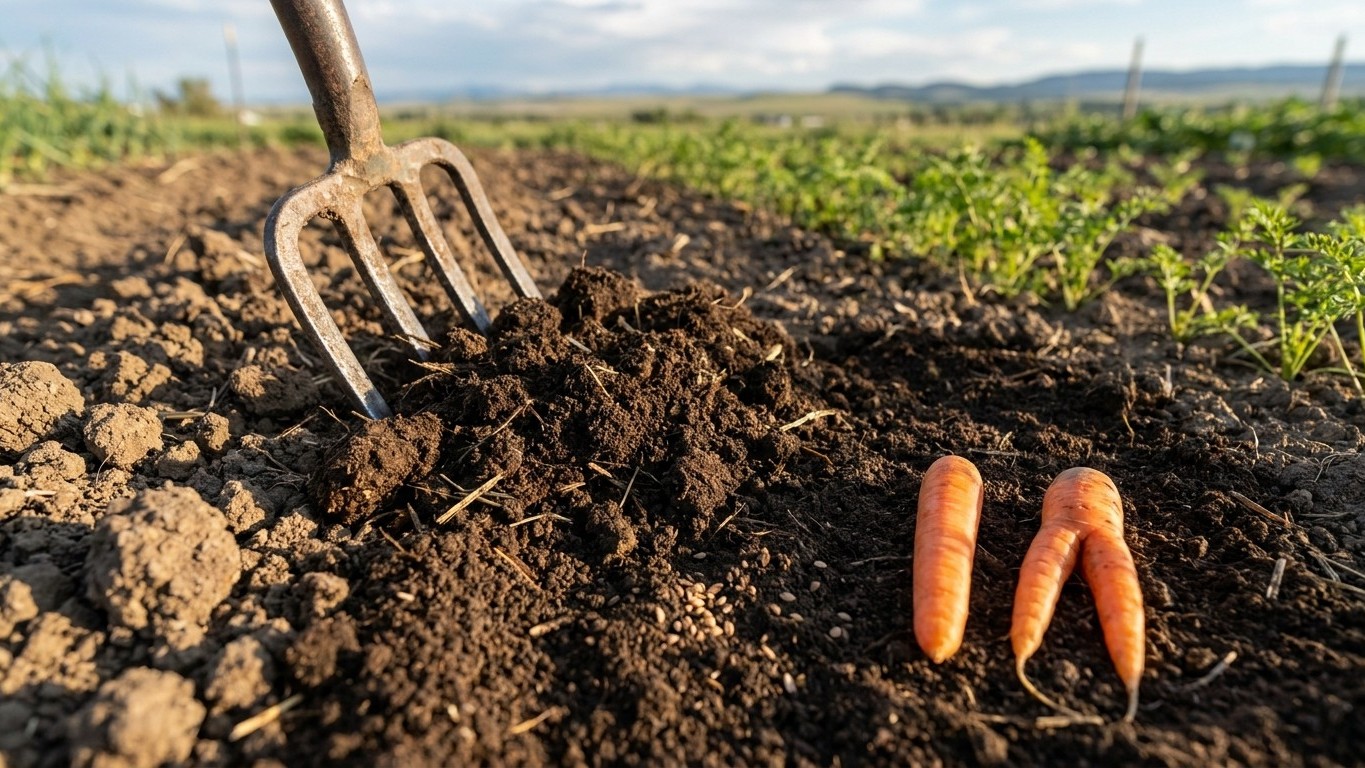
Sandy, well-drained ground is what carrots want, and it lets roots slide out easily. Utah State University Extension says carrots do best in deep, sandy, well-drained soil rich in organic matter, and that heavy or rocky soil makes the root fork. If your harvest comes up twisted or split into legs, read Will Carrots Fork in Utah Soil? before the next planting. Double digging and compost, or a raised bed, fix that problem. A different variety will not.
You can find out what you have in an afternoon. For pH and organic matter, send a sample to a soil lab through your county extension office.
Sort as you go. What Eats Carrot in Utah, and When explains what causes that damage. If you are still planning your season, Growing Carrots in Utah covers it from seeding on.
Keeping them, and for how long
Clemson Cooperative Extension’s Home & Garden Information Center gives the storage targets plainly: store carrots at 33 °F and high humidity to prevent wilting. That temperature sits barely above freezing. It is nowhere near a cellar or a pantry shelf, and the gap matters. A carrot held at 50 °F will sprout and go soft in a fraction of the time.
How long do carrots keep once they are pulled?
The same Clemson factsheet (hgic.clemson.edu) says bunched carrots, meaning plants with the tops still on, keep about 10 to 14 days. Treat that as a ceiling reached only when the temperature and humidity are right. A fridge that runs warm, a drawer that dries the air, or a root nicked during harvest will cut it short.
Carrots with the tops removed keep for months under the same cold, humid conditions. Again, that is the best case, and a few roots in any batch will go soft or sprout sooner.
Why do the tops have to come off first?
The leaves keep working after the carrot is out of the ground. They pull moisture from the root through the crown, and the root shrivels while the greens stay perky. That is why bunched carrots last days to weeks and trimmed ones last months. Cut the tops off before storing. The greens are edible, so use them fresh or compost them.
Handle the roots gently. Brush off loose dirt with your hand rather than scrubbing, because a skin scraped raw invites rot, and a soaked carrot sealed in a bag turns slimy. If the soil is caked on, rinse the carrots and let them air-dry before they go into the cold.
Where in the house that actually is
A temperature of 33 °F is easy to read on a factsheet and hard to find in a real house. Most rooms are too warm, one spot is close, and one is risky. Knowing which is which saves a harvest.
Which room comes closest to 33 °F?
The refrigerator is the nearest match, usually the crisper drawer. A frozen carrot goes limp and mushy once it thaws. A kitchen counter is worse still.
An unheated garage looks promising, but it follows the weather. In much of the intermountain West, a clear autumn day can warm a garage by afternoon and drop it hard by dawn.
What should you check with a thermometer?
Do not trust the dial inside the fridge. Put a thermometer in the crisper drawer, or in a glass of water on the same shelf, and leave a thermometer in the drawer for a full day before the harvest goes in. If it reads warmer than 33 °F, turn the control colder a notch and check again the next day. If anything in that drawer freezes, back off a little.
Keep the carrots away from the vents and the back wall, where air blows cold and dry. A lower shelf in a bag is often steadier than the drawer itself. If you have more carrots than the fridge can hold, store what you will eat in the next two weeks in the coldest spot you can verify, and give the rest the same cold, humid treatment in a spare refrigerator if you have one.
Common questions
Can carrots stay in the ground over winter?
They can for a while where the ground has not frozen solid. A thick layer of straw or leaves over the row slows freezing and makes pulling easier. Once the soil hardens, the roots are hard to get out without breaking, so pull the rest before then. Your county extension office can tell you how soon your elevation will freeze.
How long do carrots keep after harvest?
Clemson Extension says bunched carrots, with the tops on, keep about 10 to 14 days at 33 °F and high humidity. With the tops cut off, carrots keep much longer, up to months in the best conditions. Those are maximums, and an ordinary fridge or a bruised root will shorten them.
Why are my carrots forked or twisted?
Utah State University Extension says heavy or rocky soil makes the root fork. A root that hits a stone or a hard clay layer splits around it. Loosen the bed deeply and work in plenty of compost, or build a raised bed. Heavy soil benefits from double digging.
Do I count the days from transplanting?
No. Carrots are sown directly where they will grow and do not take well to being moved. The 70 to 100 days on a packet run from the day you seed. If you thin the row, the clock does not restart.